- seo
- umkm
- engineering
- mvp
AI Search SEO Strategy for Indonesian Business Websites
AI search SEO for Indonesian SMB websites: structured answers, owned-domain trust, and lightweight technical basics that support conversions.
When a search interface shows a concise answer before the classic list of blue links, many owners ask whether AI search SEO still matters. For Indonesian business websites, the better framing is not “rank chasing,” but publish information that is easy to summarize accurately—without forgetting that humans still make the purchase decision. This article summarizes a practical approach we use with small teams, including MSMEs around East Java and clients operating across Indonesia.
1. What Changes on the Results Page
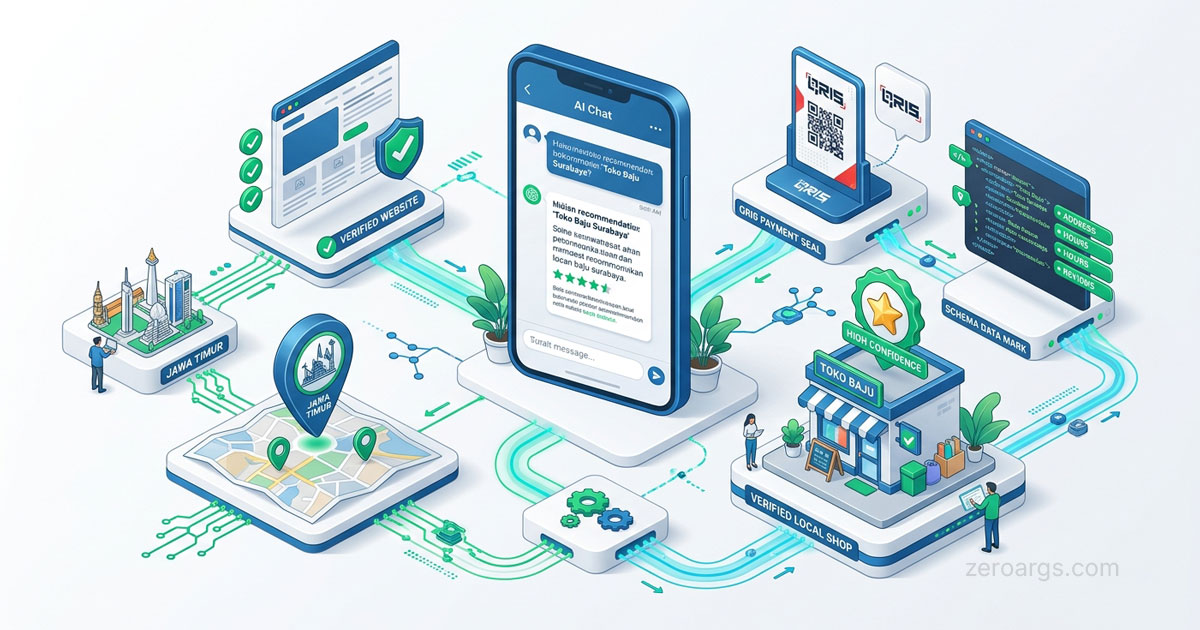
AI-led search experiences tend to foreground summaries, excerpts, and answers that feel “complete” in one screen. That can increase zero-click behavior: users get a fast answer without opening your site. That shift does not remove the need for a website. It clarifies the website’s job as a trust anchor—the place for product detail, policies, social proof, and transaction flows that do not fit a short generated paragraph.
It also changes what “success” means. Raw organic clicks may fluctuate while signals like branded search, mixed-channel conversions (Instagram, WhatsApp, marketplaces), and lead quality often track reality better than impressions alone. That is especially true when shoppers compare Tokopedia or Shopee listings with your official page before sending a WhatsApp message: the website becomes the reconciliation layer for details that summaries omit.
If your analytics only credit the last click, you may undercount the site’s role. A lightweight approach is to tag outbound links consistently, keep UTM parameters stable on campaigns, and review assisted paths monthly—even a simple spreadsheet export is enough to spot whether certain pages repeatedly appear before conversions.
2. Why Owned Assets Still Anchor the Strategy
Marketplaces and social commerce remain strong discovery channels—and that is fine as a top-of-funnel path. When answers are assembled from many sources, a stable domain with clear pages and an update history you control is more likely to be treated as a safe reference than thin duplicates scattered across the web.
If you are still deciding how a site fits next to paid channels, our post on why Indonesian SMEs still need a website beyond marketplaces describes a lightweight omnichannel pattern. In an AI search era, that pattern becomes more valuable: marketplaces for volume, your site for clarity and authority.
3. From Short Keywords to Real Customer Questions
More conversational retrieval rewards pages that answer long questions with concrete examples. Instead of only targeting “catering service,” address minimum portions, delivery areas, QRIS or bank transfer payments, and how menu revisions work—then present answers in a scannable layout.
A structure that tends to work well:
- A 2–3 sentence summary at the top that states the core answer.
- Clearly titled subsections for details your sales chats repeat daily.
- Pricing or ranges aligned with WhatsApp and marketplace listings so customers never get conflicting facts.
That makes your page a better candidate for accurate excerpts—and when someone needs proof, they still have a reason to open your site.
4. Technical Basics That Still Differentiate: Speed, Structure, and Schema
Reliable engineering remains a baseline signal. On lower-end phones—still common in Indonesia—slow sites lose readers before the content matters. A realistic priority list for a small team:
- Reasonable Core Web Vitals: compress images, avoid heavy font stacks, trim nonessential tracking scripts.
- Consistent heading hierarchy: one primary topic per page; avoid dumping unrelated topics on the same URL.
- Structured data that matches the page type—
LocalBusinessfor a physical store,Productwhen SKUs are explicit, orFAQPagewhen FAQs are genuine—not keyword stuffing.
Schema does not guarantee rich results, but it helps systems understand what you offer and where it is relevant geographically—for example service areas around Kediri or Surabaya when that reflects real operations.
5. Comparison Table: Old Optimization Habits versus AI-Search-Resilient Focus
| Easy legacy trap | More durable focus |
|---|---|
| Keyword packing in the first paragraph | Answering user questions in full sentences with examples |
| Many thin pages for tiny variants | One deep, well-structured page for related intent |
| Measuring success only by organic clicks | Measuring branded search, chat load, and mixed-channel outcomes |
| Letting price and policy drift across channels | Keeping critical facts consistent on web, WhatsApp, and marketplaces |
The table is intentionally simple: it is a decision filter when time is tight.
6. Trust, Sources, and Privacy as Part of Modern SEO
AI answers can sound confident even when wrong. Business sites that show verifiable facts—address, hours, official contact channels, warranty language—are more likely to be treated as safe references. For customer data, basic transparency aligns with Indonesia's Personal Data Protection Law (UU PDP): state what you collect and why, without legal wording designed to confuse. If you want a practical checklist, see our guide on Indonesia's data protection law for web and business apps.
7. A Sensible MVP Roadmap for Small Teams
You do not need to do everything at once. A sequence that usually pays off quickly:
- Upgrade your main service or category pages with a direct answer at the top.
- Align critical facts (base pricing, delivery area, payment methods like QRIS or virtual accounts) across every channel.
- Add one proof block: a short testimonial, a mini case study, or process photos.
- Review weekly with an operational question: did repetitive chat questions decrease?
For local services, one strong service page often beats ten rarely updated thin blog posts — for example website development in Nganjuk or our East Java hub page with FAQs and a direct contact path.
Conclusion
AI search SEO for Indonesian business websites is less about daily algorithm hacks and more about publishing information that is accurate, consistent, and usable for both people and retrieval systems. With clean owned assets, you keep a stable presence even as the results page continues to evolve. If you want help prioritizing technical fixes, information architecture, and a realistic content plan for your team, Start a conversation.