- seo
- engineering
- umkm
Core Web Vitals Optimization for Indonesian Business Sites
A practical Core Web Vitals guide for Indonesian business websites: LCP, INP, CLS, performance audits, Southeast Asia hosting, and realistic fix priorities for SMBs.
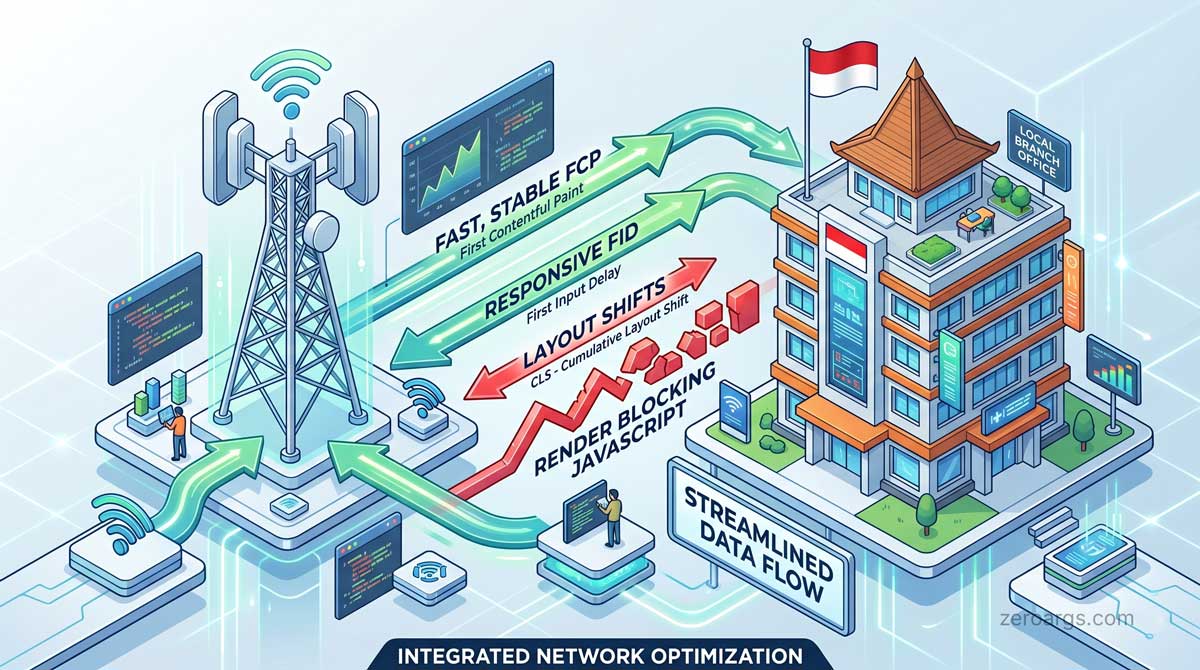
Your business website can have polished product copy and consistent pricing across WhatsApp and marketplaces — and still lose customers because the page takes five seconds before a button responds. In 2026, Core Web Vitals optimization is no longer SEO jargon reserved for marketing agencies. It is a concrete measure of whether your site earns trust on Indonesian 4G networks, and whether Google (including AI Overviews) treats your pages as a stable source worth surfacing. This article summarizes the technical approach we apply when helping SMBs and small product teams in Nganjuk, East Java, and clients across Indonesia.
1. Why Core Web Vitals still shape SEO in 2026
Core Web Vitals are a set of metrics that measure real page experience: how fast main content appears, how responsive the site feels on interaction, and how stable the layout is while loading. Google uses them as one ranking signal — not the only one, but often a tiebreaker when two pages have comparable content.
The biggest shift in 2026 is the dominance of INP (Interaction to Next Paint) as the replacement for FID. INP measures the full interaction lifecycle, not just the first click. A "Buy Now" button that freezes for half a second, a checkout form that lags on keystrokes, or product filters that respond slowly all drag your score — and your user experience.
For Indonesian businesses, context matters: most traffic is mobile, connections are not always stable, and many sites still load heavy sliders, chat widgets, and tracking pixels from three platforms at once. Competitors who optimize performance first often gain ground without increasing ad spend. If you already work on content strategy for the AI search era, Core Web Vitals are the technical layer that complements clear writing — AI crawlers also crawl faster sites more efficiently.
2. LCP, INP, and CLS: the three metrics you must understand
Understanding these three pillars keeps your audit focused instead of chasing a green lab score with no business impact.
LCP (Largest Contentful Paint) measures when the largest visible element finishes rendering — usually a hero image, promo banner, or main text block. Good target: under 2.5 seconds. Common LCP failures on Indonesian business sites: uncompressed product photos, heavy web fonts, distant servers, or render-blocking CSS.
INP (Interaction to Next Paint) measures latency from an interaction (click, tap, keystroke) to the next visual update. Good target: under 200 milliseconds. Poor INP usually comes from too much JavaScript on the main thread: chat popups, heatmap trackers, animation libraries, or frameworks that ship large bundles before the page becomes interactive.
CLS (Cumulative Layout Shift) measures how much content "jumps" during load — for example, an ad banner pushing the checkout button down right as the user taps. Good target: under 0.1. High CLS erodes trust and increases mis-taps on mobile.
These metrics interact. Fixing LCP with aggressive lazy-loading but no dimension placeholders can worsen CLS. Adding JavaScript for skeleton screens can help LCP but hurt INP if not tuned. A holistic approach beats optimizing one metric in isolation.
3. Performance audits: field data vs lab data and the tools to use
Before changing code, determine where the problem actually lives. Two data types often confuse small teams.
Field data comes from real users (Chrome User Experience Report, the "Core Web Vitals" section in Google Search Console). This is what Google uses for ranking evaluation. Lab data comes from simulations in PageSpeed Insights or Lighthouse — useful for diagnosis, but a lab score of 95 does not guarantee green field data if most of your users are on budget phones over 3G.
The audit flow we recommend:
- Open Google Search Console → Experience → Core Web Vitals. Note URLs marked "Poor" or "Needs improvement".
- Run PageSpeed Insights on those URLs — review Opportunities and Diagnostics.
- Test on real devices: mid-range Android, 4G connection, data saver enabled.
- Prioritize templates used across many pages (product layout, blog posts, landing pages) — fixing one template often improves hundreds of URLs.
Do not audit the homepage alone. Category pages, product detail pages, and contact forms often fail differently because they load more images or third-party scripts.
4. Realistic LCP fixes for Indonesian business websites
LCP is usually the easiest metric to improve with visible impact, as long as you target the dominant cause.
Image optimization comes first. Convert product photos to WebP or AVIF, serve responsive sizes (srcset), and avoid uploading 3 MB files straight from a phone camera. For hero banners, use fixed dimensions and 70–80% compression — visual quality on a 6-inch screen remains strong.
Speed up server response (TTFB). If Time to First Byte exceeds 600 ms, the issue is often hosting or heavy database queries. For the Indonesian market, choose a Southeast Asia region — GCP asia-southeast2 (Jakarta), AWS ap-southeast-3 (Jakarta), or a CDN edge with a Singapore PoP. Hosting in the US or Europe adds hundreds of milliseconds of latency invisible in a developer's local fiber connection.
Reduce render-blocking resources. Inline critical above-the-fold CSS, defer nonessential JavaScript, and avoid loading five font files with every weight. Many WordPress themes or page builders ship global CSS for components not used on a given page — audit with the Coverage tab in Chrome DevTools.
Preload key resources when LCP is a hero image:
<link rel="preload" as="image" href="/images/hero-product.webp" fetchpriority="high">
Use fetchpriority="high" on the LCP image and loading="lazy" on below-the-fold images — not the other way around.
5. Lowering INP without breaking interactive features
INP is the hardest challenge in 2026 because business sites keep adding widgets: live chat, promo popups, heatmaps, A/B testing, and Instagram embeds. All of them compete for the browser's main thread.
Strategies that work without removing important features:
- Defer third-party scripts until after the first interaction or via
requestIdleCallback. Chat widgets rarely need to load in the first second. - Split large JavaScript bundles with code splitting — product pages should not load the admin dashboard bundle.
- Avoid long tasks over 50 ms. Profile with the Chrome Performance panel; common culprits are large JSON parsing or unmemoized React re-renders.
- Debounce input on product search and category filters so every keystroke does not trigger a full request.
For sites built with modern frameworks (Next.js, Nuxt, Laravel + Inertia), ensure hydration does not block interaction. Server-side rendering helps LCP, but heavy hydration can destroy INP — consider partial hydration for isolated interactive components. Custom builds also give full control over JavaScript bundles; see our custom vs template website comparison for trade-offs.
6. Preventing CLS on product pages and checkout forms
CLS is often ignored because it does not feel "slow," yet it directly affects conversion — especially on mobile checkout.
Non-negotiable practices:
- Set width and height on every
<img>and<video>. In modern CSS, useaspect-ratioon product image containers. - Reserve space for ads, promo banners, or cookie consent before content paints — do not inject elements above already-rendered content.
- Avoid font swaps that drastically change text size. Use
font-display: swapwith fallback fonts that have similar metrics. - Stabilize action buttons — "Add to Cart" should not shift when a discount badge or stock label appears later.
On checkout pages integrated with a payment gateway, ensure payment iframes or e-wallet widgets sit in containers with a minimum height. Layout shifts right as the user taps "Pay" are a classic CLS scenario that increases abandoned transactions.
7. Hosting, CDN, and the Southeast Asia region
Infrastructure choices affect all three metrics at once. For businesses targeting users in Indonesia, network latency is a factor teams developing on office fiber often underestimate.
| Component | Practical recommendation | Primary impact |
|---|---|---|
| Origin server | Jakarta or Singapore region | TTFB, LCP |
| CDN | Cache static assets (images, CSS, JS, fonts) | LCP, INP (less origin load) |
| Database | Avoid N+1 queries on catalog pages; index filter columns | TTFB, INP (busy server = slow response) |
| HTTPS | HTTP/2 or HTTP/3, valid certificate | All metrics (efficient connections) |
| Monitoring | Real User Monitoring (RUM) beyond Lighthouse | Accurate field data |
A CDN is not a magic fix for dynamic HTML, but for online stores with hundreds of product photos, edge caching can cut more than a second of LCP for users outside Java. Vercel and Netlify deploy to the Singapore edge by default; if you self-host on a VPS, consider Cloudflare with proxy enabled.
Also protect crawl budget: slow error pages or messy redirects cause crawlers to leave before reading content — see our AI search SEO strategy for the full technical foundation.
8. Fix priority vs business impact comparison table
Small teams cannot fix everything at once. Use this table as a decision filter:
| Common issue | Fix | Metrics affected | Effort | Business impact |
|---|---|---|---|---|
| 2–5 MB product photos | WebP compression + srcset | LCP | Low | High — product pages get the most visits |
| Overseas hosting | Migrate to Jakarta/SG region | LCP, INP | Medium | High site-wide |
| Chat widget on initial load | Defer 3–5 seconds after load | INP | Low | Medium — chat remains, first paint improves |
| Images without dimensions | Add width/height + aspect-ratio | CLS | Low | High on mobile checkout |
| Unused WordPress plugins | Disable + audit bundle | LCP, INP | Low–medium | Medium–high depending on plugin count |
| Slow catalog queries | Database indexes + pagination | INP (via TTFB) | Medium | High during promo traffic |
Start with rows that combine low effort and high impact. Once field data in Search Console moves to "Good" for most URLs, advance to heavier optimizations like service workers or edge rendering.
Conclusion
Core Web Vitals optimization for Indonesian business websites in 2026 means understanding LCP, INP, and CLS in the context of mobile users on variable connections — not chasing laboratory scores alone. Audit from field data, fix images and hosting first, defer noncritical scripts, and stabilize layout on pages closest to conversion. These improvements complement the content and security foundations you already build, and make your site a more credible source for search engines and AI summaries alike.
If you want to assess your current site performance and build a realistic fix roadmap for a small team, start a conversation with us — Zero Args Technology helps SMBs and startups in Nganjuk and the surrounding region build websites that are fast, secure, and ready to scale. For new builds with performance foundations from day one, see website development in East Java or website development in Nganjuk.