- seo
- umkm
- engineering
- mvp
How to Get Indonesian SMEs Recommended by AI: Website Guide
Practical guide to get Indonesian SMEs recommended by AI: entity signals, NAP consistency, comparison data on your website, and a monthly observability workflow for ChatGPT and Gemini.
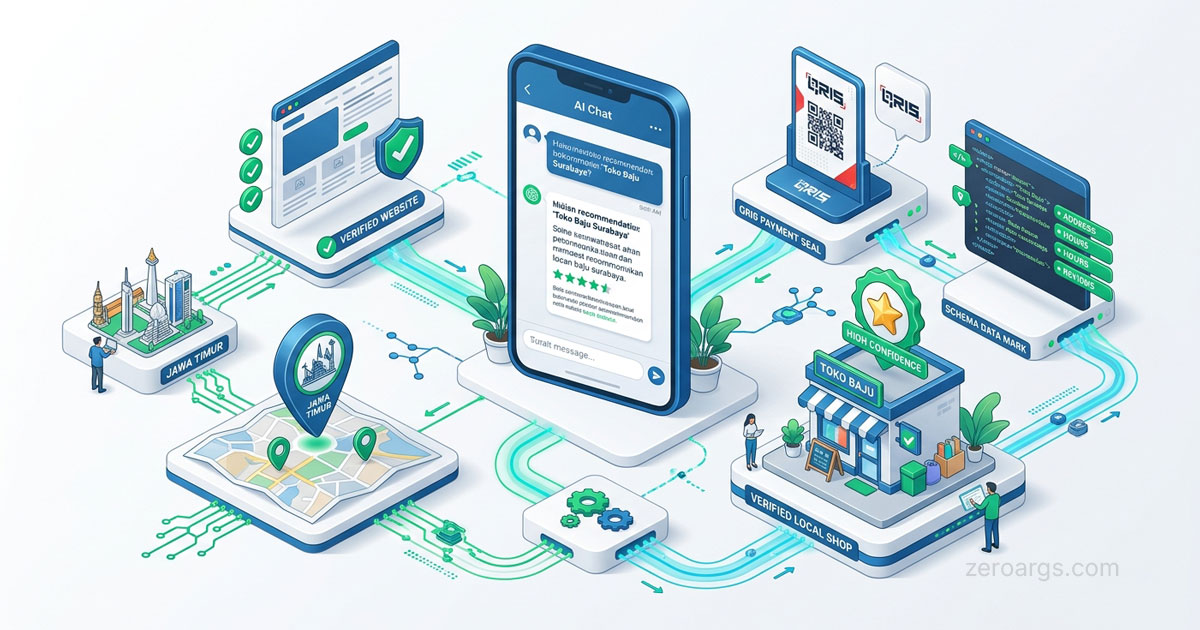
More buyers in Indonesia now start with ChatGPT, Gemini, or Perplexity: "recommend a website developer for SMEs in East Java", "best QRIS-enabled bakery near Kediri", or "custom packaging vendor in Nganjuk". If your business never appears, it is not always a product quality problem—often AI lacks enough signal to compare and recommend you confidently. This guide explains how to get Indonesian SMEs recommended by AI through website structure and business data consistency you control directly.
1. Why AI Recommends Other Businesses, Not Yours
The discoverability problem Trade Minister Budi Santoso emphasized at the Gapai Pasar Global dengan AI program (September 2026) is not only about product quality—it is about being found by potential buyers. AI search adds a new layer: engines do not just match keywords; they assemble recommendation lists with short rationales.
AI tends to skip businesses that:
- Use different names, categories, and locations across website, Google Business Profile, and marketplaces
- Rely on Instagram feeds alone without a stable entity profile page
- Lack comparison data (price ranges, service areas, differentiators) worth citing
- Depend on heavy JavaScript so core content is invisible to crawlers
Your own website is the most stable foundation to fix this. Unlike descriptions on Tokopedia or Shopee that follow marketplace templates, your domain can serve as a canonical source—similar to what we cover in how to build an AI-readable website, but focused on recommendation readiness, not markup alone.
2. Three Core Signals: Entity, Source, and Decision
Recommendation readiness for Indonesian SMEs simplifies into three signal layers:
| Signal | What AI needs | Website implementation |
|---|---|---|
| Entity | Name, category, products, location, business model | Profile page + LocalBusiness schema |
| Source | Verifiable official sources | Own domain, GBP, directories, FAQ |
| Decision | Reasons to pick this business over competitors | Comparison tables, price ranges, testimonials |
Entity signal answers: "Who is this business and what do they sell?" Source signal answers: "Where may AI cite information?" Decision signal answers: "Why should AI include this business in a recommendation list?"
Without all three, AI might still mention a well-known brand—but will not recommend you when users ask for a category or location.
3. Entity Profile Pages Every Website Needs
Every SME that wants to enter AI consideration sets needs at least four core pages:
- Business profile — legal name, specific category (not generic "online shop"), founding year, service area, and a one-paragraph description identical across channels
- Services or catalog page — product/service list with comparable specs (size, material, MOQ, lead time)
- Decision FAQ — pre-purchase questions: pricing, payment methods (QRIS, bank transfer, COD), shipping estimates (JNE, J&T, SiCepat), return policy
- Contact and verification — physical address or service area, WhatsApp Business number, hours, and links to official profiles
URLs should stay stable and human-readable, e.g. /about, /services, /faq, /contact. Avoid putting critical information only in banner images or popups—AI crawlers read static HTML more reliably.
For JSON-LD schema (Organization, LocalBusiness, FAQPage), see the technical guide in how to build an AI-readable website. This article focuses on the content and consistency that schema represents.
4. NAP Consistency Across Website, GBP, Marketplaces, and WhatsApp
NAP (Name, Address, Phone) is the backbone of local entity recognition. Small inconsistencies—"Jl. Raya" vs "Jalan Raya", mismatched area codes, GBP category "Bakery" vs website "Cake Shop"—make AI hesitate to merge signals into one entity.
NAP audit checklist (run quarterly):
- Legal name identical in website footer, GBP, invoice header, and Instagram bio
- Business category specific and matching GBP primary category and profile page
- Address or service area written in the same format (district, regency, province)
- Phone/WhatsApp one primary number; avoid rotating personal numbers
- Operating hours aligned across website, GBP, and WhatsApp auto-replies
Example internal entity record (team document, not a public page):
legal_name: "Katering Nusantara Nganjuk"
display_name: "Katering Nusantara"
category: "Event Catering Service"
service_area: ["Nganjuk", "Kediri", "Jombang"]
address: "Jl. Imam Bonjol No. 199, Nganjuk, East Java"
phone: "+6281234567890"
whatsapp: "+6281234567890"
website: "https://kateringnusantara.id"
gbp_url: "https://maps.google.com/?cid=..."
After the audit, update all channels in one sprint—do not refresh the website alone while GBP still shows stale data for weeks.
5. Comparison Data: Pricing Tables, Differentiators, and Decision FAQ
AI recommendations spike when users ask for comparisons: "pick three SME website vendors in East Java" or "halal catering in Nganjuk under IDR 50,000 per portion". Without comparison data on your official website, AI cites marketplaces or third-party directories—often incomplete or outdated.
Add to your website:
- Service and price range table — transparent, with "final quote after survey" notes where needed
- Differentiation table — what you do differently (e.g. QRIS integration on owned site, POS stock sync, BPJPH halal certification)
- "Who we serve" page — target customers (F&B MSMEs, wedding organizers, export-ready SMEs) so AI does not miscategorize you
- Trust proof — portfolio, testimonials with client names (with permission), local media mentions
Simple comparison table example for a services page:
| Criteria | Starter | Growth | Custom |
|---|---|---|---|
| Website pages | 5 pages | 10 pages + blog | Unlimited |
| QRIS integration | No | Yes (Midtrans/Xendit) | Yes + webhooks |
| Entity SEO + schema | Basic | Full + FAQ | + monthly AI observability |
| Estimated go-live | 2 weeks | 4 weeks | 6–8 weeks |
Tables like this are not just marketing—they are decision signals AI can cite when explaining why one vendor fits a specific profile.
6. AI Crawler Access and Answer-First Content
Before entity and comparison data help, ensure AI crawlers can read your site. Check that robots.txt does not block:
GPTBot(OpenAI / ChatGPT)Google-Extended(Gemini)PerplexityBotClaudeBot
Many modern website templates block AI bots by default. Allow access if you want your business in public retrieval sources—unless internal policy forbids it (e.g. sensitive data under Indonesia's Personal Data Protection Law (UU PDP)).
Answer-first content means every service page opens with a direct answer: "We provide halal catering for 50–500 portions in Nganjuk and Kediri, starting at IDR 35,000 per portion." Details follow. This aligns with AI search SEO strategy and Google Search Console generative AI reports for tracking visibility.
7. Monthly Observability: Test Queries on ChatGPT, Gemini, and Perplexity
Recommendation readiness is not a one-time project. Build a monthly observability worksheet with four query types:
| Query type | Example | What to score |
|---|---|---|
| Branded | "[Your business name] review" | Does AI recognize the entity correctly |
| Non-branded category | "recommend [category] service in [city]" | Does your business appear on the list |
| Local intent | "[product] near [area]" | Location and service area consistency |
| Comparison | "compare [A] vs [B] for SMEs" | Is website comparison data cited |
Simple maturity scoring:
- Not read — AI does not recognize the name or miscategorizes
- Partially read — name recognized, location or services unclear
- Locally read — AI links the business to the correct area and category
- Recommendation-ready — AI includes the business with accurate rationale
Log which sources AI cites (your website, GBP, marketplace, directory). If citations dominate from inaccurate third-party sources, prioritize fixes on those channels.
8. Comparison Table: Classic SEO vs AI Recommendation-Ready
| Aspect | Classic SEO only | AI recommendation-ready |
|---|---|---|
| Primary focus | Google keyword rankings | Entity + recommendation rationale in AI |
| Content | Long blog articles | Entity profile + decision FAQ + comparison table |
| Business data | Optional in footer | Multi-channel NAP consistency required |
| Schema | Article, BlogPosting | LocalBusiness, FAQPage, Product/Service |
| Monitoring | GSC clicks and impressions | GSC + ChatGPT/Gemini/Perplexity query tests |
| Time-to-impact | 3–6 months | Entity fixes 4–8 weeks; recommendations 2–4 months |
Both approaches complement each other. Classic SEO drives organic traffic; recommendation readiness ensures your business appears in answers when buyers no longer open ten blue links.
Conclusion
Getting Indonesian SMEs recommended by AI starts with your website as the canonical source: clear entity pages, NAP consistency across GBP and WhatsApp, citable comparison data, and monthly query observability on ChatGPT, Gemini, and Perplexity. This extends the technical foundation of schema and llms.txt—it does not replace it. For MSMEs in Nganjuk and surrounding areas moving from "online somewhere" to "recommended by AI with clear reasons", we help design website structure and entity data from day one. Start a conversation for an existing site review or a new build plan.
Frequently asked questions
Can an SME without a website appear in AI recommendations?
Partially, but AI more often cites stable official sources. Your own website gives full control over name, category, location, pricing, and FAQ—the signals AI needs when comparing businesses.
How long until an SME shows up in AI recommendations?
Technical fixes like consistent NAP and an entity profile page can show progress within 4–8 weeks after AI crawlers re-index. Monthly branded and local query tests help track progress.
What is the difference between an AI-readable website and one ready for AI recommendations?
An AI-readable website focuses on schema markup and llms.txt so machines understand pages. Recommendation-ready adds multi-channel consistency, comparison data, reputation proof, and decision signals that give AI a reason to choose your business.
Which platforms must match data on the website?
At minimum Google Business Profile, WhatsApp Business, official marketplace stores (Tokopedia/Shopee if used), and Instagram bio. Legal name, category, address, hours, and contact number should be identical.


