- seo
- engineering
- umkm
- mvp
How to Build an AI-Readable Website for Indonesian Businesses
A practical guide to building an AI-readable website for Indonesian SMBs: JSON-LD schema markup, llms.txt, entity consistency, and a lightweight implementation checklist.

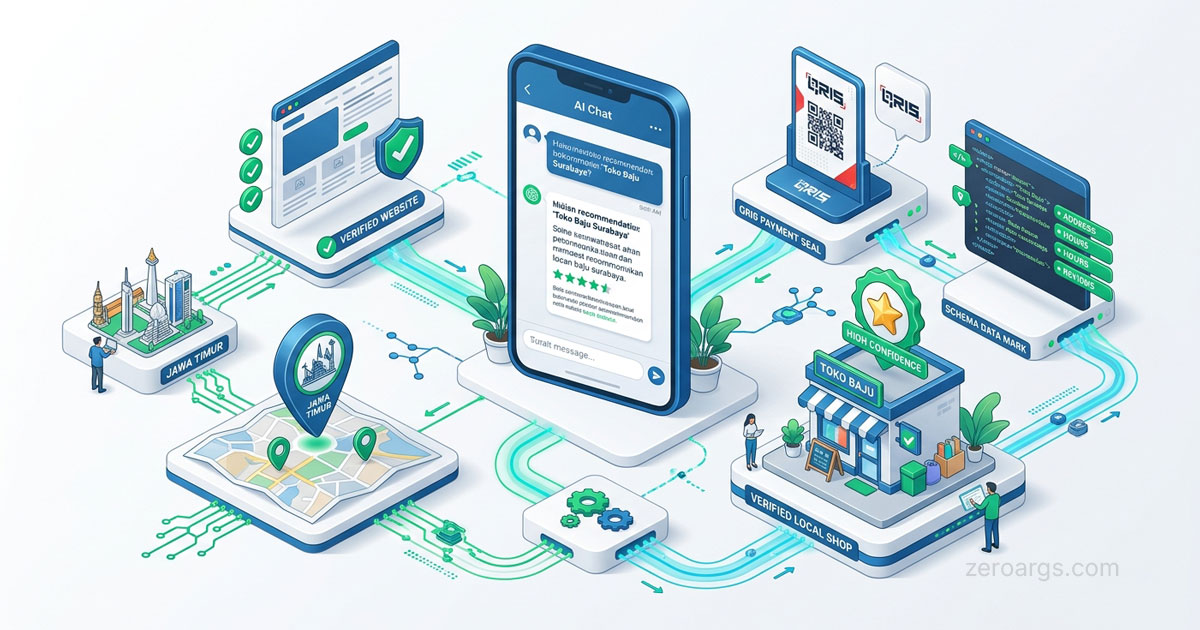
More buyers in Indonesia now start research in ChatGPT, Gemini, or AI-generated summaries—not by opening ten blue links. If your site lacks clear technical signals, models guess from random fragments: a marketplace price that disagrees with Instagram, an outdated address, or FAQs nobody maintains. This article explains how to build an AI-readable website with a lightweight foundation we deploy for small teams: schema markup in JSON-LD and a root-level llms.txt file.
1. Why Your Website Needs to Be "Readable" by AI in 2026
Search behavior is shifting. Users often want an answer, not a list: catering prices in East Java, whether a shop accepts QRIS, or which agency builds custom sites for Indonesian MSMEs. AI systems assemble replies from sources they treat as clear, consistent, and verifiable.
Your owned domain is the most stable asset for those signals. Unlike product descriptions on Tokopedia or Shopee that follow marketplace templates, your site can declare structure consistently: who the company is, what it sells, where it operates, and how to reach sales. Without that foundation, AI tends to cite third-party channels instead of your brand.
This does not replace classic SEO. It extends the approach in our AI search SEO strategy for Indonesian business websites—answer-shaped content plus a technical layer so machines do not misread page intent.
2. Schema Markup vs llms.txt: Different Jobs
Both relate to AI visibility, but they solve different problems.
Schema markup (usually JSON-LD) is structured metadata embedded in each page. It tells engines what the page represents: an organization, service, product, or FAQ set. A catering service page might use type Service with areaServed set to cities you actually deliver to.
llms.txt is a Markdown text file at your domain root (https://yourdomain.com/llms.txt) summarizing the whole site: who you are, which URLs matter most, and one-line descriptions per link. Think of it as a curated map for language models—not a sitemap replacement, but a concise site narrative.
They complement each other: schema answers "what is on this page"; llms.txt answers "what is this site and where should I go first".
3. JSON-LD Schema Types That Matter for Indonesian SMBs
You do not need to mark up every element. For small businesses, four schema types deliver most of the value:
| Priority | Schema type | When to use it |
|---|---|---|
| 1 | Organization or LocalBusiness | Homepage: legal name, logo, URL, contact, sameAs social profiles |
| 2 | Service | Each service page: description, service area, price range if published |
| 3 | FAQPage | Dedicated FAQ pages or FAQ blocks on service pages |
| 4 | Product | Only when SKU, price, and stock are real—avoid fake markup |
Minimal LocalBusiness example for a regional service company:
{
  "@context": "https://schema.org",
  "@type": "LocalBusiness",
  "name": "Nusantara Catering Example",
  "url": "https://examplecatering.id",
  "telephone": "+62-812-3456-7890",
  "address": {
    "@type": "PostalAddress",
    "addressLocality": "Nganjuk",
    "addressRegion": "East Java",
    "addressCountry": "ID"
  },
  "areaServed": ["Nganjuk", "Kediri", "Madiun"],
  "paymentAccepted": "QRIS, Bank Transfer, Cash"
}
Place JSON-LD in <head> or before </body>. Validate with Google's Rich Results Test. A common failure mode: the business name differs across schema, Google Business Profile, and Instagram—models treat them as separate entities.
On modern stacks like Next.js, generate schema from a single company config so updates do not drift across pages.
4. How to Create and Maintain llms.txt
The llms.txt spec is intentionally simple. Publish a root file along these lines:
# Nusantara Catering Example

> Nusantara Catering Example provides daily catering and event packages
> for companies and families in Nganjuk, Kediri, and nearby areas.
> Payment via QRIS and bank transfer.

## Core pages

- [Home](https://examplecatering.id/en): service overview and contact
- [Packages & Pricing](https://examplecatering.id/en/packages): package list and price ranges
- [Delivery Area](https://examplecatering.id/en/area): coverage map and delivery fees

## Business information

- [About](https://examplecatering.id/en/about): company profile and halal certification
- [FAQ](https://examplecatering.id/en/faq): ordering, revisions, and lead times
Practical rules:
- Stay under 5 KB; link only canonical URLs, not duplicates or campaign parameters.
- Update when site structure changes—new service pages, pricing URL moves, etc.
- Do not publish crawl policies that conflict with
robots.txtunless you understand the implications.
Google states AI Overviews do not rely on llms.txt, but practitioners report benefits in ChatGPT, Claude, and Perplexity for more accurate brand representation. Implementation cost is low; the risk of skipping it is AI summarizing your business from sources you do not control.
5. Priority Table: Which Pages to Optimize First
Small teams rarely markup an entire site in one sprint. This order usually returns value fastest:
| Order | Page | Schema | llms.txt |
|---|---|---|---|
| 1 | Home / about | Organization + LocalBusiness | Yes, under "Core pages" |
| 2 | Top service page | Service + FAQPage if applicable | Yes, with one-line blurb |
| 3 | Pricing / packages | Service with offers or clear HTML table | Yes |
| 4 | Blog / guides | Article with author and dateModified | Optional, separate section |
| 5 | Privacy policy | WebPage is enough; trust signal for UU PDP compliance | Skip |
If you are still weighing custom vs template sites, our custom vs template website for Indonesian SMBs post helps judge whether your stack can support schema and llms.txt without heavy plugins.
6. Entity Consistency Across Sales Channels
Schema and llms.txt fail when business facts disagree off-site. Models do not read HTML alone—they also encounter marketplace profiles, Google Business listings, and WhatsApp Business catalogs shared in forums.
Minimum consistency checklist:
- Business name matches across web, invoices, and social bios (including legal entity suffixes where relevant).
- Base pricing aligns between your packages page, WhatsApp catalog, and Tokopedia/Shopee listings—or you explicitly document differences ("web price excludes shipping").
- Payment methods (QRIS, BCA/BRI virtual accounts, e-wallets) appear in FAQ schema, not only in chat replies.
- Hours and service area match Google Maps and your contact page.
Inconsistency is a frequent reason AI answers confuse buyers—not because your JSON-LD is invalid, but because external signals conflict.
7. MVP Implementation Checklist for Small Teams
You do not need a six-month project. A realistic lightweight sprint:
- Days 1–2: Audit the homepage—are H1, meta description, and contact paths obvious without jargon?
- Day 3: Add global
Organization/LocalBusinessJSON-LD in your layout. - Day 4: Mark top service pages with
Service+ at least three FAQs inFAQPage. - Day 5: Publish
llms.txtwith 5–10 critical URLs. - Week 2: Align critical facts in WhatsApp quick replies and marketplace listings.
- Monthly: Ask ChatGPT/Gemini: "Who provides [your service] in [your city]?"—note whether you are mentioned and whether details are accurate.
For baseline performance, keep pages fast on entry-level phones—poor Core Web Vitals reduce the chance content is fully consumed. Our Core Web Vitals optimization guide complements this technical layer.
8. Comparison Table: Classic SEO Only vs AI-Ready Foundation
| Aspect | Classic SEO only | + Schema + llms.txt |
|---|---|---|
| Primary goal | Rank in Google's link list | Accurate AI answers + rankings |
| Technical effort | Content + backlinks | Content + structured metadata + AI site map |
| Misinformation risk | User never clicks through | AI summarizes third-party sources |
| Best fit | Informational blogs | Local services, MSMEs, B2B |
| Incremental cost | — | Low on modern custom builds |
Schema and llms.txt are not instant ranking hacks. They are insurance that when someone asks AI about your category, there is an official path to a source you control.
Conclusion
An AI-readable website starts with content that answers real questions, then adds schema markup per page and llms.txt as a site-level guide for language models. For Indonesian businesses—especially MSMEs competing on marketplaces and WhatsApp—that combination helps your brand stay visible in an answer-first search era. See LocalBusiness plus local service-page patterns on website development in Nganjuk and website development in Surabaya. If you want to review an existing site or plan a new build with AI-ready foundations from day one, we can help—Start a conversation.