- umkm
- e-commerce
- engineering
- startup
Indonesia Open Network (ION): A Practical Business Guide
Indonesia Open Network (ION) explained for operators: interoperability across payments and logistics, UU PDP basics, and a realistic integration roadmap.
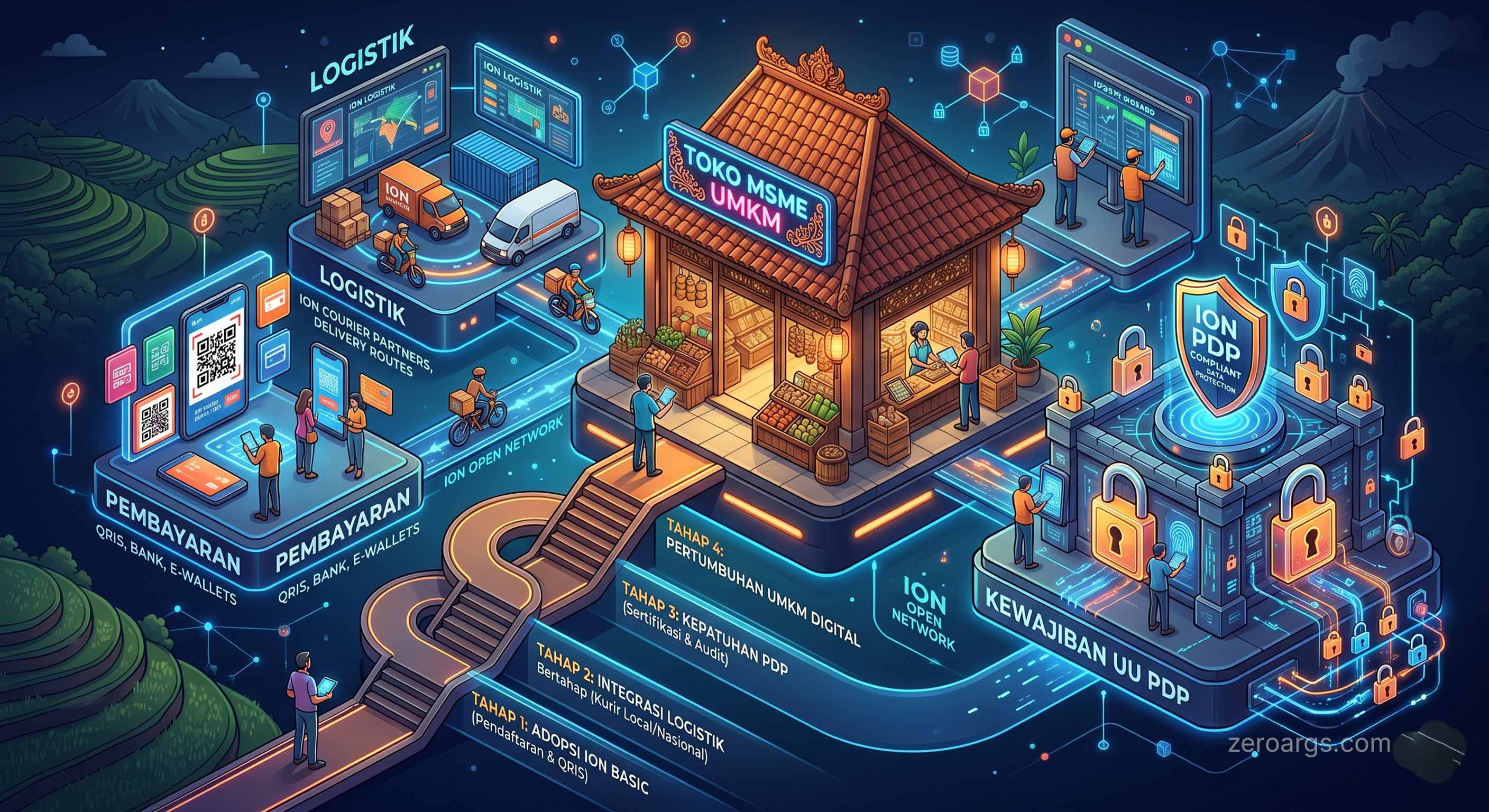
When teams discuss the Indonesia Open Network (ION) in 2026, the pitch often sounds like a more open digital economy — one where catalog data, payments, and fulfillment services are less tightly coupled to a single super-app. That is compelling, but it is easy to misread: this is usually not a replacement for Tokopedia, Shopee, or TikTok Shop. It is closer to a push for interoperability — shared rails so sellers can be discovered and served across participating apps without redoing the same manual work in five separate backends.
This article explains Indonesia Open Network from a product and engineering perspective — what changes in day-to-day operations, how it differs from “listing products in one marketplace”, and a pragmatic path if you want to prepare your ordering stack or integrations without buying an oversized platform on day one.
1. What Indonesia Open Network (ION) Is — A Beginner-Friendly Primer
If you searched for “Indonesia Open Network” or “what is ION”, start here: ION is not a new online store. It is a direction for buyer apps, seller systems, payment providers, and couriers to talk to each other under more open data rules.
Think of three layers that are often siloed today:
- Where buyers discover products — marketplaces, super-apps, or brand sites.
- How they pay — QRIS, virtual accounts, e-wallets, or cards.
- How goods arrive — JNE, J&T, SiCepat, GoSend, and local partners.
In a closed model, each layer is often locked to one app: stock is duplicated, orders are copied by hand, and payment status does not match between WhatsApp and the courier dashboard. Indonesia Open Network (ION) points toward a world where those layers connect through shared standards and data channels — so sellers do not repeat the same fragile work for every channel.
The analogy: not building one giant new mall, but laying common rails so cars (catalog, payment, shipping) from many operators can run without rebuilding everything each time. Existing marketplaces stay relevant for discovery; ION is more about reducing lock-in and making integration easier.
That matters if you already read our guide on digital transformation for MSMEs in Indonesia: mature digitization is not only adding sales channels; it is aligning orders, payments, and shipment proof so teams do not work double.
2. A Concrete Example: UMKM Seller + Buyer Flow in an ION-Style World
To keep this concrete, follow a short vignette set in Nganjuk — the pattern applies in other cities too.
Seller: Rina runs a local snacks business. Today she tracks stock in a spreadsheet, takes orders over WhatsApp, and also lists on one marketplace. Each order is often copied three times: into notes, into a courier app, then checked again when a bank transfer lands.
Buyer: Andi finds Rina’s product in App A, but wants to pay with the method he already uses in App B, and prefers a courier he trusts locally.
Without clear interoperability: Andi must check out inside a single app; Rina must keep prices and stock from colliding; month-end reconciliation eats half a day.
With an ION-style direction (ideal scenario):
- Rina’s catalog has one source of truth (SKU, base price, stock).
- Andi discovers the product through a participating app, but the product identity points at the same catalog.
- Payment uses QRIS or a virtual account with a standard order ID that marks the order “paid” in Rina’s system.
- Shipping labels are created from the same status — staff do not copy addresses from chat into courier apps by hand.
- Rina sees one work queue: order in → paid → shipped → done — regardless of which app first surfaced the product.
What changes day to day is not “move to a new platform”, but less copy-paste and fewer oversells. Buyers get a smoother cross-app experience. Sellers gain bargaining power because customers and operational data are not fully locked inside one marketplace dashboard.
3. Interoperability: Why MSMEs Should Care About the Boring Parts
For small businesses, interoperability sounds like IT vocabulary. The symptoms are concrete: spreadsheet stock does not match marketplace stock, promotional pricing is inconsistent between Instagram and the POS app, or warehouse staff do not see the same payment status as customer service in WhatsApp Business.
An open-network direction implies that “one catalog” or “one order” can flow to multiple integration points — as long as sellers and their technical partners agree on clear data contracts. Practically, your decision shifts from which platform has the most traffic to which workflow wastes the least staff time.
| Operational symptom | Without clear interoperability | A realistic improvement path |
|---|---|---|
| Duplicate order entry | Staff copy chats into spreadsheets, then into courier apps | One order source of truth + synced status |
| Inconsistent pricing and promos | Customers see different facts per channel | Central pricing policy + auditable promo rules |
| Slow payment reconciliation | Incoming transfers are hard to match to orders | Standard order IDs + payment provider integration |
The table does not promise instant automation; it helps you see where time leaks — a sane starting point before discussing heavy architecture.
4. Technical Implications: Catalogs, APIs, and a Single Source of Truth
From an engineering standpoint, open networks push the conversation toward APIs, product formats, and transaction identity. If you plan to run your own site or app, you will hear more about digital catalogs, discovery services, and payment gateways — similar to common integration patterns in Indonesia through providers like Midtrans or Xendit, but broader when multiple buyer apps can surface consistent offers.
Practices we usually recommend early:
- Define one source of truth for SKUs and stock — not necessarily an expensive ERP; a controlled database can be enough.
- Separate product identity from distribution channels — descriptions and photos can be shared, but per-channel promos must be traceable.
- Record transaction IDs and payment status on the same object so monthly audits do not become detective work.
That aligns with how founders choose foundations in our article on how to choose a tech stack for startups: open integration only helps if your internal data model is not chaotic.
5. Personal Data, Indonesia's Personal Data Protection Law (UU PDP), and Partner Chains
The more systems connect, the longer the personal-data processing chain. Names, addresses, phone numbers, and purchase histories often move between your app, payment providers, couriers, and possibly marketing tools. In Indonesia, UU PDP pushes organizations to collect data proportionally, secure storage, and have clear grounds when data is shared with third parties.
Practical steps for MSMEs and small product teams:
- Inventory partners: who receives customer data from your systems, and for what purpose.
- Processing agreements: at minimum, internal documentation covering log retention and staff access.
- Minimize copies: avoid emailing sensitive spreadsheets broadly without version control.
This is not meant to scare you away from integration — it protects customer trust when “open” means more digital handoffs.
6. A Realistic Roadmap: Small Integrations First, Measure Impact
You do not need to wait for a national ecosystem to be “perfect” to apply the same principles in your operations today. A sequence that often works:
- Unify orders from your top two channels — for example WhatsApp and one marketplace — into one work queue.
- Standardize payment proof — amount, payer name, order reference — before wiring full payment APIs.
- Add a simple weekly report — chat-to-shipped conversion — so you know which integration actually reduces human error.
Once stable, deeper integration — inventory dashboards or endpoints for external partners — becomes economically sensible.
7. Build In-House vs. Working With a Development Partner
ION signals an era where custom software often complements marketplaces rather than competing head-on: brand sites, local distributor systems, or specialized ordering apps that can still interoperate with demand-generating services. The decision is rarely “build everything from scratch”; it is choosing system boundaries — what is core to your business versus what you delegate to off-the-shelf providers.
If your internal team is thin, a development partner who understands Indonesia’s context — local payments, chat-first customers, and data compliance — reduces the risk of brittle integrations that are painful to audit when volume grows.
Conclusion
Indonesia Open Network is fundamentally about reducing digital friction between sellers, buyers, and supporting services — something you already pursue gradually if you have ever fixed payment reconciliation or aligned stock across channels. National momentum toward interoperability clarifies that the best investment is often not a flashy new feature, but consistent data and workflows.
If you want to evaluate integrations for operations in Nganjuk, Kediri, Madiun, or other regional markets — from a website prototype to API architecture — start a conversation with us and tell us which channels and systems overload your team today.
Frequently asked questions
What is Indonesia Open Network (ION)?
Indonesia Open Network (ION) is a policy and infrastructure direction so catalogs, payments, and logistics can connect across buyer apps and seller systems — not a new marketplace that replaces Shopee or Tokopedia. The goal is less lock-in to a single platform and clearer interoperability.
Does ION replace Tokopedia, Shopee, or TikTok Shop?
Usually no. ION is closer to shared rails (standards and data channels) on top of or alongside existing marketplaces. Sellers can still use marketplaces for discovery while keeping their own system as the source of truth for stock and orders.
What should MSMEs prepare before ION-style integration?
Start with operational foundations: one source of truth for SKUs and stock, consistent order IDs, standardized payment proof, and an inventory of partners that process customer data under Indonesia's Personal Data Protection Law (UU PDP). New API integrations only help if internal data is already clean.
How could ION change online shopping in Indonesia?
In an ideal scenario, a buyer discovers a product in one app, pays via the same QRIS or virtual-account rails, and tracks delivery across couriers — while the seller manages one catalog and one order queue. Cross-channel friction drops without forcing the seller to migrate platforms.