- engineering
- mvp
- mobile app
- umkm
Progressive web apps in Indonesia: when they beat native apps
Progressive web apps in Indonesia: compare PWAs and native apps on distribution, cost, QRIS, notifications, and privacy—without vendor hype or vague checklists.
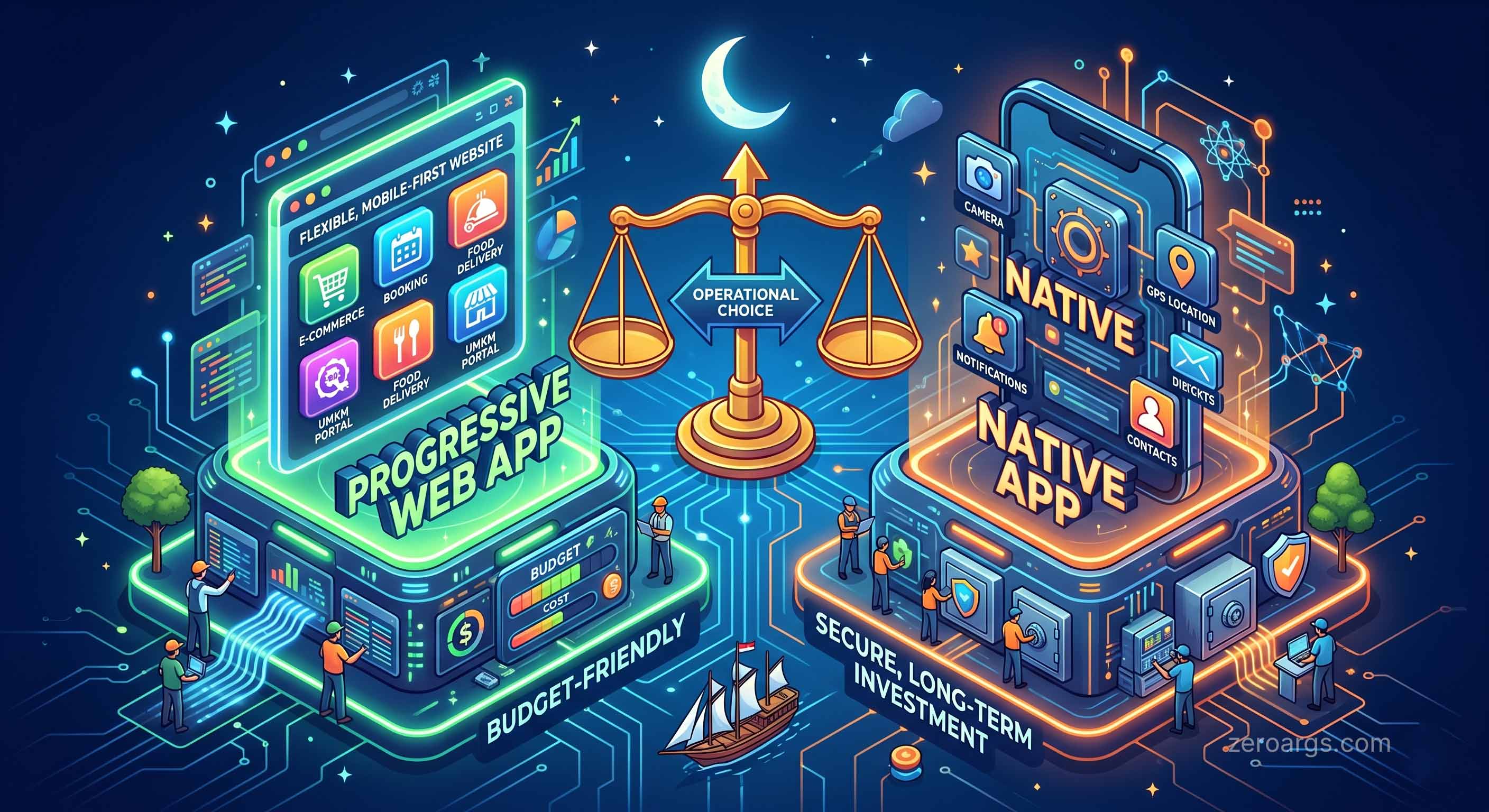
Progressive web apps in Indonesia are often sold as “cheaper than an Android app.” That can be true, but without clear constraints teams ship inconsistent Safari behavior, notifications that never arrive, or payment flows that confuse customers. This article explains when a progressive web app is genuinely the right first product — and when a native app is still the more honest investment — using the same operational lens we apply when helping MSMEs and startups choose a shape for their product.
1. What “PWA” means in real operations
A PWA is a website that uses modern browser capabilities: installable to the home screen, caches critical assets locally, and (when configured correctly) remains usable on poor networks. For businesses, the headline benefits are one codebase across Android and iOS, instant updates without app-store review queues, and links that are easy to share through WhatsApp Business or an Instagram bio.
What does not come for free is every banking-grade capability: deep hardware access, complex background behavior, and some wallet flows are still smoother on native paths. Treating a PWA as a lightweight customer interface rather than a wholesale replacement for every back-office system keeps expectations aligned with engineering reality.
2. Three signals your audience is a good PWA fit
First, most customers start from a URL — a catalog link in chat, an ad click, or a QR on packaging — rather than searching your brand in an app store. Second, your core journey is browsing a catalog, filling a short form, or checking order status, not editing heavy documents offline for hours. Third, your team (or vendor) is comfortable with weekly web releases and cross-browser testing.
When those signals line up, progressive web apps in Indonesia are often a sensible MVP: you validate demand before locking budget for iOS and Android binaries.
3. When native is still the more honest choice
Native makes sense when you need reliable push notifications with platform-specific behavior, deep camera or sensor access, security modules tied to the device keystore, or third-party SDKs that only ship official bindings for Kotlin/Swift. Also consider native if your audience judges legitimacy from store presence — downloads, ratings, and search inside the Play Store or App Store.
Deferring native is not deferring quality: many products begin as PWAs and add a native shell once retention metrics justify the cost.
4. A quick comparison for this week’s decision
| Dimension | PWA | Native app |
|---|---|---|
| Distribution | Links, QR codes, social campaigns | Play Store / App Store + review |
| Updates | Ship through your server | Tied to store release pipelines |
| MVP cost | Often lower with one web team | Higher if both platforms ship on day one |
| Device feature access | Improving, but browser gaps remain | Fuller via official platform APIs |
| Customer trust | Strong if UX is polished and HTTPS is obvious | Strong when your category “expects” a store listing |
Use the table as a fast filter before budget conversations, not as immutable law.
5. QRIS, e-wallets, and privacy (Indonesia’s PDP law) in one flow
Indonesian customers expect QRIS, virtual-account bank transfers, or e-wallet payments (GoPay, OVO, DANA, ShopeePay). PWAs can hand users off to banking or wallet apps through deep links where supported, but you should design confirmation screens so people do not abandon the tab during app switches.
Any form that stores phone numbers, addresses, or sensitive histories triggers practical duties under Indonesia’s Personal Data Protection Law (UU PDP): readable privacy notices, least-privilege internal access, and simple audit logs. A PWA does not relax those requirements — data still lands on the same backend as a website, so security must match native standards.
6. “WhatsApp-first” distribution and onboarding without an app store
A regional advantage is communication habits: customers already receive links in WhatsApp Business. PWAs lean into that pattern — the link opens a full experience without a large download. Pair it with clean Open Graph metadata so link previews in chat look as credible as a store listing.
If you encourage “Add to Home Screen,” show short, browser-specific instructions only after the user taps that action. Aggressive install prompts erode trust.
7. Cost myths, maintenance reality, and a phased roadmap to an operational PWA
Myth one: “PWAs are free because it’s just web.” Hosting, CDN spend, error monitoring, and browser QA still cost money. Myth two: “We don’t need mobile QA.” iOS behavior for caches, storage, and service workers differs from Android — real device testing matters. Myth three: “We’ll fix performance later.” Poor Core Web Vitals make a PWA feel like a slow legacy site and hurt SEO and conversion alike. Allocate a small budget for performance profiling and 3G-style network scenarios from the first sprint; it is usually cheaper than refactoring architecture in week twenty.
In practice, start from a fast, accessible marketing site. Add a service worker for static assets and catalog pages first. Then enable limited offline behavior — for example, revisiting a catalog page that was opened before. Once engagement metrics stabilize, consider advanced features like cart sync or queued forms when offline. This staged path matches broader operational digitalization priorities; for channel and payment context, see our posts on digital transformation for MSMEs in Indonesia and practical AI integration for business apps.
Conclusion
Progressive web apps in Indonesia win when your audience already lives in links and chat, core features do not depend on store-exclusive SDKs, and your team treats the web as production-grade — including privacy and performance. Native remains relevant when push notifications, hardware access, or store presence drives conversion. If you take one idea from this piece: decide based on distribution channels and feature risk, not based on the technology label in a vendor proposal.
If you want to talk through your case — from a catalog PWA to a combined web and app strategy — Start a conversation. We help teams ship MVPs that match real operations in Nganjuk, East Java, and across Indonesia.