- umkm
- e-commerce
- engineering
- seo
Digital Export Catalog for Indonesian SMEs: AI-Ready Guide
Build an AI-ready digital export catalog for Indonesian SMEs: structured product data, multilingual pages, international buyer lead capture, and TEI 2026 readiness.
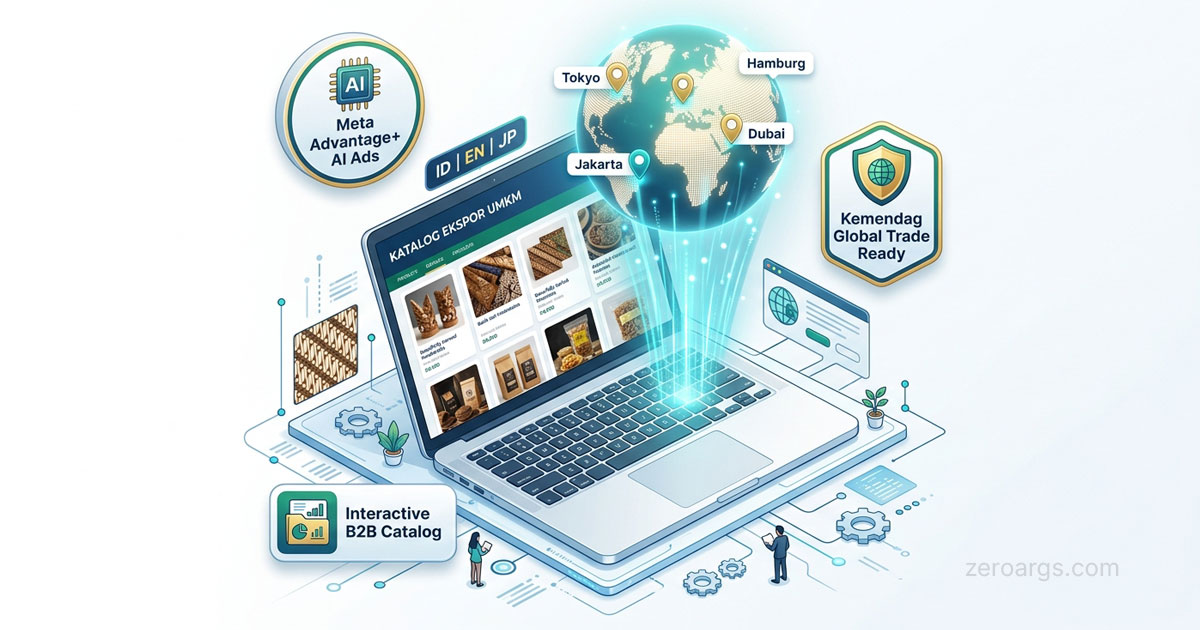
A digital export catalog for Indonesian SMEs is no longer just a PDF emailed to prospects. In September 2026, Indonesia's Ministry of Trade launched Gapai Pasar Global dengan AI (Reach Global Markets with AI) with Meta Indonesia and UKMIndonesia.id — training 200 SMEs across Bandung, Batam, and Jakarta to build digital catalogs, conduct global market research, and run Meta Advantage+ campaigns. Trade Minister Budi Santoso emphasized that the main challenge for SMEs is not product quality, but discoverability by international buyers. For businesses in East Java (including Nganjuk) and nationwide that target exports, this is the moment to build a structured, multilingual, AI-promotable catalog website — not wait for a trade show once a year.
1. Why the Export Bottleneck Is Discoverability, Not Quality
Ministry of Trade data shows SMEs contributed 15.7 percent of Indonesia's export value in 2025 — a figure the government continues pushing upward through programs like UMKM BISA Ekspor and mentoring from trade attachés and ITPC (Indonesia Trade Promotion Center). In practice, many local products lose deals not because they taste bad or use poor materials, but because foreign buyers cannot find the information they need: MOQ, packaging specs, certifications, shipping estimates, and responsive contact details.
Meta Indonesia noted the same pattern in SME mentoring in Batam and Bandung: strong products, low discoverability. AI can help with market research, content creation, translation, and ad strategy — but AI output still needs a professional landing place. Without an indexable catalog website you can share with B2B buyers, AI-generated content only circulates on social platforms without a permanent digital asset.
2. What the Gapai Pasar Global dengan AI Program Requires
The Ministry's mentoring program includes activities that directly affect your website technical decisions:
- Global market research workshops — define target countries, buyer segments, and priority languages for catalog pages.
- Digital catalog creation — not just slides, but structured product data you can update.
- Meta Advantage+ practice — ads pointing to catalog landing pages or lead forms.
- Seven days of intensive mentoring to optimize ads and identify potential buyers.
- Export readiness phase via logistics webinars, trade agreements, and business matching.
- SME Export Catalog symbolically presented at the TEI 2026 Business Forum (October 14–18, 2026).
From an engineering perspective, your website needs: product pages updatable without a developer for every new SKU, stable URLs to share with buyers, and an RFQ (Request for Quotation) form that captures leads from ad campaigns.
3. Minimum Data Fields for an Export-Ready Digital Catalog
Before choosing a platform, define your export data model. B2B buyers do not purchase from pretty photos alone — they compare specifications. Minimum fields we recommend:
| Field | Example | Reason |
|---|---|---|
name_id / name_en | "Keripik Singkong Original" / "Original Cassava Chips" | Bilingual search |
description_id / description_en | Ingredients, process, USP | AI and buyers need context |
moq | 500 kg | Filter large vs small buyers |
price_range | USD 2.50–3.00/kg FOB | Early transparency |
packaging | 250g standing pouch, 40 pcs/carton | Logistics and customs |
net_weight_kg | 0.25 | Freight calculation |
shelf_life_days | 180 | Retail/food service buyers |
certifications | BPOM, halal (BPJPH) | Gate for many countries |
hs_code | 2005.99 | Export documentation |
origin | Nganjuk, East Java, Indonesia | Geo-trust |
lead_time_days | 14 | Buyer inventory planning |
Store these fields in a database or headless CMS — not only in Instagram captions. This structure also simplifies integration with Product schema (JSON-LD) that helps Google and AI search understand your products.
4. Website Architecture: Multilingual Pages, Schema, and Lead Capture
An effective digital export catalog needs three technical layers:
Multilingual pages. At minimum Indonesian and English. Use separate URLs (/id/produk/... and /en/products/...) with hreflang tags so Google serves the right version to buyers in target countries. Avoid machine translation without review — AI drafts; you validate export terminology.
Structured data. Add Product schema on every product page: name, description, images, brand, offers (price or range), and countryOfOrigin. For B2B catalogs without online checkout, use offers.availability and direct to an RFQ form. This aligns with AI-readable website practices — generative search features cite pages with structured data more easily.
RFQ lead capture. Minimum form fields: company name, country, email, product of interest, estimated volume, and notes. Store submissions in a database or CRM; send WhatsApp/email notifications to your sales team. Connect UTM parameters from Meta Advantage+ campaigns so you know which leads came from export ads.
A concise Product schema example:
{
  "@context": "https://schema.org",
  "@type": "Product",
  "name": "Original Cassava Chips",
  "description": "Crispy cassava chips from Nganjuk, East Java.",
  "image": "https://example.com/images/cassava-chips.jpg",
  "brand": { "@type": "Brand", "name": "Your Brand" },
  "countryOfOrigin": { "@type": "Country", "name": "Indonesia" },
  "offers": {
    "@type": "Offer",
    "priceCurrency": "USD",
    "price": "2.75",
    "availability": "https://schema.org/InStock"
  }
}
Host in a region close to Asian buyers — e.g. GCP asia-southeast2 (Jakarta) or AWS ap-southeast-3 — so catalog pages load quickly from Singapore, Malaysia, and the Middle East.
5. AI Content Workflow for Export Without Sacrificing Accuracy
The Ministry program introduces Personalized AI and Meta Business Agent for content creation and automated replies. Use AI as an accelerator, not a replacement for product facts:
- Market research — use Google Trends and Gemini to map category demand in target countries (e.g. "cassava snacks" in the UAE vs "keripik singkong ekspor" in Indonesia).
- Bilingual description drafts — AI produces initial
description_en; you verify MOQ, certifications, and nutrition claims. - Packaging spec translation — keep metric units (kg, cm) consistent; international buyers reject ambiguity.
- Initial buyer replies — Meta Business Agent or a WhatsApp chatbot answers common questions (MOQ, lead time); serious RFQs route to humans.
Do not delegate to AI: certification numbers, HS codes, contract prices, and delivery commitments. One wrong sentence on an export page can trigger disputes or customs rejection at the destination port.
6. Meta Advantage+ Integration and Owned-Channel Analytics
Meta Advantage+ campaigns from Gapai Pasar Global drive paid traffic to your digital assets. Without consistent landing pages, ad spend is wasted:
- Every export product ad should point to a specific product page, not a generic homepage.
- Install Meta Pixel and a custom
Leadconversion event on your RFQ form. - Compare ad performance with organic traffic from Google Search Console — if your catalog pages appear in generative AI reports, that is long-term discoverability signal independent of ad budget.
The owned channel approach remains relevant: marketplaces like Tokopedia and Shopee dominate domestic sales, but international B2B buyers often find suppliers via Google, LinkedIn, or TEI directories. A catalog website is an asset you fully control — not bound by marketplace algorithms or platform commission fees.
7. TEI 2026 Readiness Checklist: 30-Day Timeline
Trade Expo Indonesia 2026 runs October 14–18, 2026 at Indonesia Convention Exhibition (ICE) BSD. If you participate in or aspire to join the SME Export Catalog, use this H-30 timeline:
| Week | Engineering tasks | Business tasks |
|---|---|---|
| H-30 to H-24 | Audit data fields for all SKUs; fix product photos | Finalize target export countries |
| H-23 to H-17 | Deploy bilingual pages + Product schema | Review translations with ITPC mentor |
| H-16 to H-10 | Integrate RFQ form + notifications; test mobile speed | Prepare company one-pager (PDF) |
| H-9 to H-3 | Install Pixel; test Advantage+ campaigns to landing pages | Practice 3-minute pitch for business matching |
| H-2 to H-0 | Monitor uptime; backup emergency contacts | Bring QR codes at booth linking to live catalog |
Also ensure UU PDP (Indonesia's Personal Data Protection Law) compliance on forms collecting foreign buyer data — publish a privacy policy and state data usage purposes. If you process European buyer data, consider lawful bases for cross-border transfers.
8. Comparison: PDF vs Marketplace vs Custom Catalog Website
| Aspect | PDF / print catalog | Marketplace (Tokopedia, Shopee) | Custom catalog website |
|---|---|---|---|
| Google discoverability | Low | Medium (marketplace domain) | High (your domain) |
| Structured product data | No | Limited platform templates | Full (schema, custom fields) |
| International B2B leads | Manual email | Domestically B2C-focused | RFQ form + analytics |
| Commission cost | Low | 2–8%+ per transaction | Hosting + maintenance |
| AI / export ad integration | Hard to track | Limited | Pixel, UTM, webhooks |
| Buyer data ownership | Yours | Platform | Yours |
| Best for TEI / B2B matching | Supplement | Domestic | Primary |
In short: PDFs remain useful as trade show leave-behinds, marketplaces for domestic volume, but a custom catalog website is the scalable foundation for export discoverability powered by AI and SEO.
Conclusion
An AI-ready digital export catalog for Indonesian SMEs starts with structured product data, multilingual pages with schema markup, and lead capture connected to Meta Advantage+ campaigns — not just a TEI poster or static PDF. The Gapai Pasar Global dengan AI program and TEI 2026 deadline add urgency, but catalog website benefits persist long after the event ends.
If you want to build or upgrade a digital export catalog — from product data models to RFQ integration and schema markup — start a conversation with us. We help SMEs in Nganjuk and across Indonesia prepare websites that global buyers can find, not just files stored in a Drive folder.
Frequently asked questions
What is a digital export catalog for Indonesian SMEs?
A digital export catalog is a structured product dataset on your owned website — not a static PDF — covering specifications, MOQ, packaging, certifications, and contact details in Indonesian and English so international buyers can find and evaluate your products.
How does the Gapai Pasar Global dengan AI program relate to your website?
The Ministry of Trade program with Meta Indonesia trains 200 SMEs to build digital catalogs and Meta Advantage+ campaigns. Your catalog website is a permanent asset that complements social ads and the symbolic TEI 2026 export catalog.
What product data is required in an export catalog?
At minimum: product name (ID+EN), description, quality photos, price or price range, MOQ, packaging dimensions, net weight, HS code if available, certifications (BPOM, halal, SNI), and an RFQ lead form.
Can AI replace an export catalog website?
Not entirely. AI helps with market research, translation, and initial replies, but international B2B buyers still need indexable Google pages you can share and audit for export compliance.
When is TEI 2026 and how does it connect to digital catalogs?
Trade Expo Indonesia 2026 runs October 14–18, 2026 at ICE BSD. The SME Export Catalog from the Ministry's mentoring program will be presented at the TEI Business Forum — your website should be live before then to maximize business matching.