- umkm
- e-commerce
- engineering
- seo
Halal Certificate for Indonesian SMEs: Website Guide 2026
A practical guide to publishing your SME halal certificate on websites and online stores before Indonesia's mandatory halal deadline of 18 October 2026.
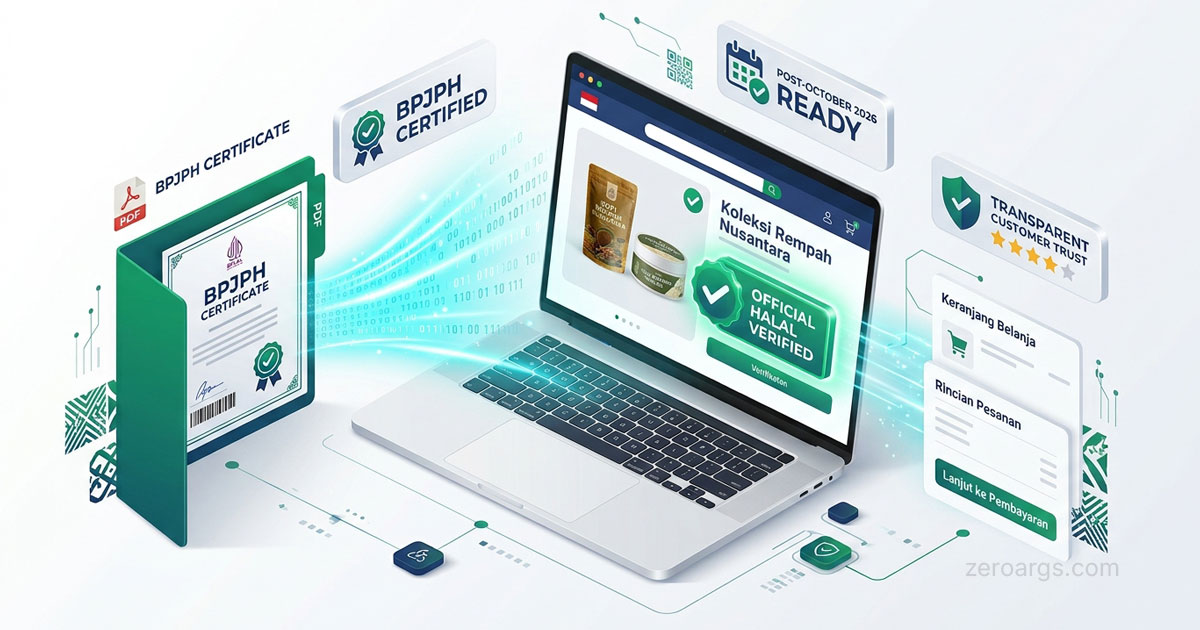
Your halal certificate exists, but a buyer opening your product page sees none of it. This scenario is surprisingly common for Indonesian SMEs holding a halal certificate: the certificate lives in a PDF, the marketplace attribute is half-filled, and the company website never changed. Since 18 October 2026, showing halal proof is no longer a cosmetic touch on a product page — it is part of a regulatory obligation and a real purchase-decision factor.
1. The 18 October 2026 Mandatory Halal Deadline: What Changes for SMEs
Indonesia has closed the phased compliance window for halal certification of food, beverages, slaughtered products, and slaughtering services produced by micro and small enterprises on 17 October 2026, under Law No. 33 of 2014 on Halal Product Assurance and Article 160 of Government Regulation No. 42 of 2024. Full enforcement begins the next day.
BPJPH head Haikal Hasan confirmed in early October 2026 that there is no postponement, while calming fears: there will be no sweeping enforcement raids, and the government is preparing special provisions for micro and small businesses, imported products, and raw materials or auxiliary goods so implementation stays proportionate.
If you are not yet certified, the fastest route is BPJPH's Sehati program (Sertifikasi Halal Gratis), backed by a quota of 1.35 million free certificates across 2026. Registration is online through SIHALAL on the self-declare route, assisted by more than 111,000 Halal Process Companions (P3H). If you are already certified, your work shifts to the next question: how that proof appears across every sales channel you operate.
2. Publishing Halal Proof on Your Website Is an Obligation, Not an Option
Many business owners assume the halal story ends at the packaging. BPJPH Circular No. 7 of 2025 clarifies otherwise: businesses with halal certification must publish their products through the electronic channels they use for marketing, including websites, marketplaces, and social media. At minimum, the publication must show the Indonesian Halal Label within promotional material, advertisements, catalogs, or customer testimonial videos.
The same circular requires the Indonesian Halal Label on the physical packaging and instructs businesses to report their publication links to BPJPH via [email protected]. Businesses that fail to display the label on certified products can face administrative sanctions. In other words, a product page stripped of halal proof is not just a lost opportunity — it is a weak compliance point.
The obligations per channel can be summarized like this:
| Channel | Core obligation | What it looks like on the page |
|---|---|---|
| Your own website | Publish the label and certificate number | "BPJPH Halal Certified" badge, certificate number as text, verification button |
| Marketplaces | The "Halal Certificate No." attribute fully filled | Product attribute field, certificate photo in the gallery, number in the description |
| Social media | Minimum label publication plus a mention of official BPJPH accounts | Product content featuring the Indonesian Halal Label, official BPJPH account mentioned |
| Packaging | Indonesian Halal Label on the package | Physical label matching the label materials set by BPJPH |
This table doubles as a work plan: each channel has a different form of obligation, but they all draw from the same underlying data, which we structure next.
3. One Halal Master Data Record for Every Sales Channel
The most expensive mistake is managing halal information channel by channel by hand: a marketplace admin fills in the attribute, a content writer types the description, and a designer pastes the logo onto images. The moment a certificate is renewed, those three copies can contradict each other.
The pattern we recommend follows the same product master data principle as our GS1 barcode guide for Indonesian SMEs: one source-of-truth record per SKU, reused everywhere. In YAML form:
sku: "KOP-ARABICA-250G"
nama_produk: "Kopi Arabika Gayo Bubuk 250g"
halal:
  status: "bersertifikat"
  nomor_sertifikat: "ID3611000123456"
  penerbit: "BPJPH"
  berlaku_sampai: "2029-08-14"
  url_verifikasi: "https://info.halal.go.id/cari/?q=ID3611000123456"
  foto_sertifikat: "/aset/produk/kop-arabica/sertifikat-halal.jpg"
From this single record, your website product page pulls the number and verification button, the marketplace CSV export fills the "Halal Certificate No." column, the PDF catalog embeds the badge, and social content borrows the verification link. Because a halal certificate is valid for four years and renewable, add a renewal reminder six months before the berlaku_sampai date so no channel ever displays a dead number.
4. The Trust Layer on Your Product Page: Badge, Number, and Verify Button
Your website is the channel you control most, so clean it up first. Arrange halal proof in three layers on the product page:
- Near the price, above the buy button: one line of text, for example "BPJPH Halal Certificate No. ID3611000123456". A hesitant buyer gets an answer exactly at the decision point.
- In the middle block of the page: the Indonesian Halal Label badge with descriptive alt text, such as "Indonesian Halal Label for X-brand ground Gayo arabica coffee", plus a "Verify Certificate" button opening info.halal.go.id/cari.
- At the bottom or on a legal page: the full list of company certificates, validity periods, and production address for partners, resellers, and corporate buyers.
The key principle is one: the certificate number must exist as text, not only as an image. A number hidden inside a packaging photo is invisible to search engines, screen readers, and buyers who want to copy it. Since the validity period changes on renewal, make sure updating the number means editing the master data record, not redesigning a banner image.
5. Halal Certificate Numbers on Marketplaces: The Rule That Gets Products Removed
Since the halal mandate took effect, major marketplaces like Shopee, Tokopedia, and TikTok Shop have tightened moderation for food and beverage items, baking ingredients, cosmetics, and supplements. A product can be removed not because it is fake, but because the "Halal Certificate No." attribute is empty or the description claims "100% halal" without a verifiable number.
Moderation systems read text data, not images. Pasting a halal logo onto a product photo is not enough. The minimal SOP for every certified SKU:
- Fill the certification or registration number attribute with the full halal ID number, for example ID3611000123456.
- Upload the certificate photo as the second or third slide in the product gallery.
- Rewrite the certificate number inside the description paragraph.
Conversely, for SKUs that are not yet certified, avoid the word "halal" in titles and descriptions entirely. An unproven claim risks a takedown and drags your store's reputation with it. If your catalog is large, attribute filling can be built from the master data above and exported in bulk, similar to the sync flow in our Sapa UMKM integration guide.
6. Social Media Publication and Reporting to BPJPH
BPJPH's circular includes an incentive most businesses ignore: halal publication content that mentions BPJPH's official accounts may be reshared by @halal.indonesia across Instagram, TikTok, X, Facebook, Threads, and YouTube. That is free distribution from the very agency that issued your certificate.
Run it as a routine, not a one-off campaign:
- One product post per week that clearly features the Indonesian Halal Label, not just a caption saying "halal".
- Customer testimonial videos that show the label, since testimonial videos are explicitly named in the circular.
- Mention BPJPH's official accounts on content worth resharing.
- Collect every publication link from your website, marketplaces, and social channels, then report them to [email protected] as required.
This link archive doubles as compliance evidence if regulators ever ask for clarification, and as raw material for internal audits during certificate renewal.
7. Structured Markup So Halal Products Are Read by Search Engines and AI
Text-based certificate numbers already help, but you can be more explicit with structured data. Schema.org's Product type has no halal-specific property, so use additionalProperty and the product description:
{
  "@context": "https://schema.org",
  "@type": "Product",
  "name": "Kopi Arabika Gayo Bubuk 250g",
  "description": "Pure ground coffee carrying BPJPH Halal Certificate No. ID3611000123456. Verify at info.halal.go.id/cari.",
  "additionalProperty": [
    {
      "@type": "PropertyValue",
      "name": "Halal Certificate",
      "value": "ID3611000123456 (BPJPH, valid until 14 August 2029)"
    }
  ]
}
This pattern complements the strategies in our AI-readable website guide and our guide to getting SMEs recommended by AI. When a buyer asks an AI assistant "is this coffee brand halal?", a page with a certified claim plus a verifiable number is far more quotable than a page that only pastes a logo image. For food and beverage categories, halal proof is as strong an entity signal as clean pricing and product photography like the workflow in our Gemini product photography guide.
8. A 30-Day Checklist Before and After the Deadline
Whether you are still preparing for certification or already hold one, the following 30-day sequence keeps both sides of compliance covered:
- Days 1–3: SKU audit. Map which products are halal-mandatory, which are certified, and which are in process. Record each SKU's certificate number and validity date.
- Days 4–7: certification. Not certified yet? Register for Sehati through SIHALAL and request P3H assistance. Your raw materials should be certified too, so the halal chain stays intact.
- Days 8–12: master data. Build the per-SKU YAML record from the example above, complete with verification links and certificate photos.
- Days 13–17: website. Implement the three proof layers on product pages: the number as text near the price, a badge with descriptive alt text, and a verification button to info.halal.go.id/cari.
- Days 18–22: marketplaces. Bulk-fill certification attributes from master data, upload certificate photos, and update descriptions.
- Days 23–26: social media and reporting. Set up a content calendar featuring the halal label, mention BPJPH's official accounts, and compile publication links.
- Days 27–30: monitoring. Test the verification button from a buyer's perspective, set a four-year renewal reminder, and track the SME-specific provisions BPJPH is still finalizing via bpjph.halal.go.id.
Passing 18 October is not a finish line, it is a mode change: from chasing the certificate to keeping the proof visible, accurate, and verifiable on every channel.
Conclusion
Indonesia's mandatory halal deadline of 18 October 2026 turns the certificate from a nice-to-have into a prerequisite for selling food and beverage products, and BPJPH Circular No. 7 of 2025 extends that obligation to your website, marketplaces, and social media. The technical work is actually simple: one halal master data record per SKU, three proof layers on the product page, fully filled marketplace attributes, and a publication routine reported to BPJPH.
If your team is busy with production and distribution, we at Zero Args Technology can help you build the product master data, apply the structured markup, and integrate halal proof into your website and marketplace export flows in a single sprint. Start a conversation to assess your website's readiness before the next enforcement wave.
Frequently asked questions
Does Indonesia's mandatory halal rule for micro and small businesses really start on 18 October 2026?
Yes. Under Law No. 33/2014 and Government Regulation No. 42/2024, food, beverages, slaughtered products, and slaughtering services from micro and small enterprises must be halal certified after 17 October 2026. BPJPH has confirmed there is no postponement.
How can Indonesian SMEs get a free halal certificate?
Through BPJPH's Sehati program (Sertifikasi Halal Gratis) via the self-declare route. Registration is done online through SIHALAL with guidance from a certified Halal Process Companion (P3H), free of charge from application to issuance.
Is displaying the halal label on a business website mandatory?
Yes. BPJPH Circular No. 7 of 2025 requires publishing certified halal products through the electronic channels used for marketing, including websites, marketplaces, and social media, and it must at minimum display the Indonesian Halal Label.
How do customers verify my product's halal certificate?
Through BPJPH's official lookup page at info.halal.go.id/cari by entering the certificate number or product name. Add this link directly to your product pages.
How long is a halal certificate valid?
Four years from issuance, renewable. Keep the certificate number and validity date on your product pages up to date so customers are never misled.