- umkm
- e-commerce
- engineering
- seo
Harbolnas 2026 Website Readiness: Technical Guide for SMEs
Harbolnas 2026 website technical readiness for Indonesian SMEs: infrastructure stress tests, payment gateway limits, stock sync, and runbooks for 5–50x traffic spikes.

Harbolnas 2026 website technical readiness is not just about discount banners and bigger ad budgets. Every year, thousands of Indonesian online stores lose transactions during peak hours because of checkout errors, stock mismatches, or product pages that take eight seconds to load on 4G. The Road to Harbolnas 2026 kick-off at Indonesia's Ministry of Trade (August 27) targets IDR 40 trillion in transactions during December 10–16 — now covering services, travel, and ride-hailing alongside physical goods. This article focuses on technical readiness you can verify yourself: server capacity, payment limits, stock architecture, and operational runbooks when traffic jumps 5 to 50 times normal.
If you already run an owned-channel strategy with marketplaces for discovery and your website for margin, Harbolnas is the year's biggest stress test. Marketing checklists are everywhere; here we cover what to test on the engineering side.
1. What Changed in Harbolnas 2026 — and Why Owned Websites Matter More
Harbolnas 2026 differs from previous editions in ways that affect technical architecture:
- Official period: December 10–16 (seven days), not a single-night flash sale.
- Expanded scope to accommodation, transport, and digital services — aligned with Permendag 19/2026.
- Government ecosystem integration (Sapa UMKM, marketplace incentives) ties business data and revenue reporting more closely together.
For SMEs selling physical products, the pattern stays the same: traffic spikes sharply, conversion rises when checkout works, and margins erode when every transaction runs through marketplaces at full commission. An owned website acts as a pressure valve — a checkout channel at roughly 2–3% via a payment gateway, not 10–18% platform fees.
What gets overlooked: preparing your marketplace store does not automatically make your website ready. Each channel needs a separate data pipeline kept in sync.
2. Technical Timeline H-90 to H-7: Realistic Preparation Phases
Starting technical prep now (September) gives roughly 97 days before December 10. Here are the phases we use when helping SME clients in East Java:
| Phase | Timeframe | Technical focus |
|---|---|---|
| Audit & baseline | H-90 to H-60 | Measure normal traffic, page load times, checkout error rate, hosting capacity |
| Critical fixes | H-60 to H-30 | Fix poor Core Web Vitals, harden checkout, set up monitoring |
| Stress test | H-30 to H-14 | Load simulation, payment gateway limit tests, stock sync validation |
| Freeze & polish | H-14 to H-7 | Freeze major deploys, finalize runbook, team briefing |
| Event days | December 10–16 | Real-time monitoring, fast escalation, no risky code changes |
Do not wait until H-14 for your first audit. Infrastructure changes — hosting migration, checkout refactors, stock webhook integrations — need propagation and debugging time. Small teams that delay until November usually only have time for banners, not foundations.
3. Infrastructure Stress Testing: Capacity Planning for 5–50x Spikes
Harbolnas traffic is not evenly distributed. A promo page, TikTok live link, or WhatsApp broadcast can drive localized spikes of 20–50x within minutes, while daily averages may only be 5–10x.
Capacity planning steps that work without a large DevOps team:
- Record weekly baselines — unique visits, peak requests per minute (RPM), and server response time (TTFB) from three normal weeks.
- Multiply by 10 as a minimum capacity target. If shared hosting shows CPU throttling at 3x test traffic, upgrade before December.
- Run simple load tests with k6, Artillery, or Apache Bench against critical endpoints: homepage, top product pages, and checkout API.
- Enable a CDN for static assets (product images, CSS, JS). Use PoPs close to Indonesian users — Singapore or Jakarta.
- Prepare a static maintenance page you can switch to if the origin server fails, so customers see a message instead of a blank error.
Basic k6 load test example:
import http from 'k6/http';
import { check, sleep } from 'k6';

export const options = {
  stages: [
    { duration: '2m', target: 50 },
    { duration: '5m', target: 200 },
    { duration: '2m', target: 0 },
  ],
};

export default function () {
  const res = http.get('https://yourstore.com/products/bestseller');
  check(res, { 'status 200': (r) => r.status === 200 });
  sleep(1);
}
Run from a separate machine, not your production server. Target error rates below 1% and p95 latency under 2 seconds.
4. Checkout and Payment Gateways: Limits, Failover, and Reconciliation
This is the most expensive failure point during Harbolnas. Payment gateways and QRIS providers enforce rate limits, daily transaction caps, and maintenance windows that nobody reads until checkout fails at peak hour.
Payment checklist before Harbolnas:
- Confirm daily limits with Midtrans, Xendit, Doku, or your provider. Request a temporary increase for December 10–16 if needed.
- Enable at least two payment methods — e.g., QRIS plus BCA virtual account — so one channel failure does not block all transactions.
- Run end-to-end transaction tests at H-7, H-3, and H-1: place a real order, pay, confirm the
payment.successwebhook reaches your server, and order status updates automatically. - Prepare a manual fallback — WhatsApp templates for manual transfer confirmation if the gateway goes down, with clear verification steps so your team is not overwhelmed.
- Plan daily reconciliation — export gateway settlements and match against your order dashboard. Small discrepancies during peak season often come from missed webhooks.
A reliable webhook handler must be idempotent — processing the same callback twice must not create duplicate orders:
async function handlePaymentWebhook(payload: PaymentEvent) {
  const existing = await db.orders.findByPaymentId(payload.transaction_id);
  if (existing?.status === 'paid') return { ok: true }; // already processed

  await db.orders.update(payload.order_id, {
    status: 'paid',
    paid_at: payload.paid_at,
    payment_id: payload.transaction_id,
  });
}
Log every webhook that fails. During Harbolnas, 0.5% failure on 1,000 transactions means five customers needing manual handling.
5. Marketplace–Website Stock Sync During Peak Demand
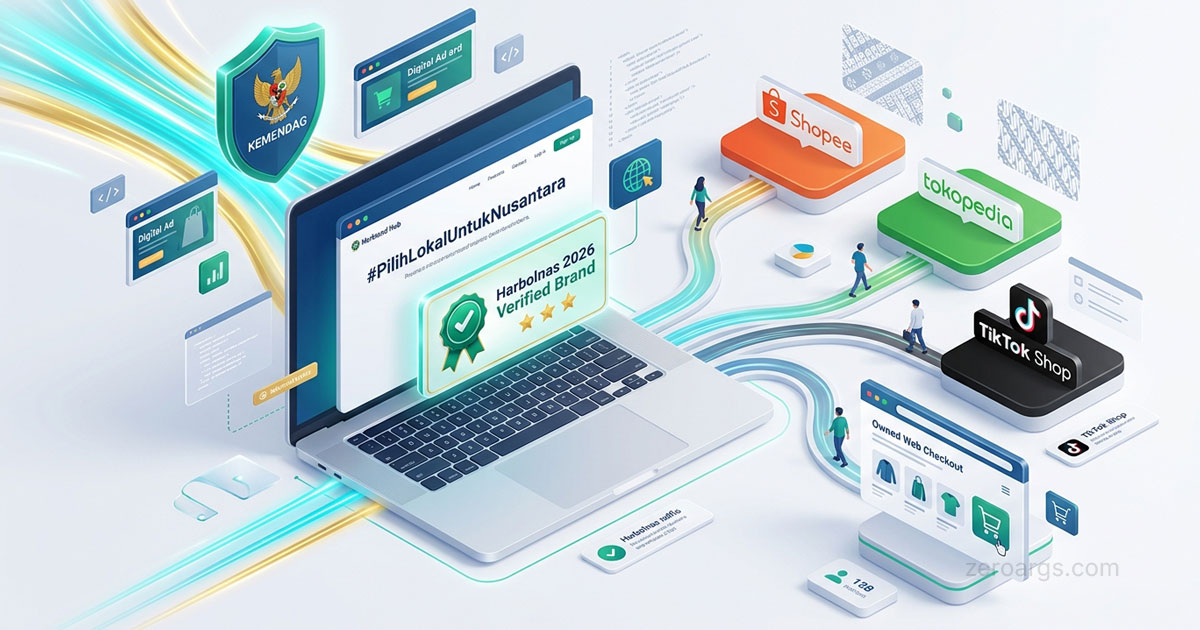
Overselling during peak season damages marketplace ratings and website customer trust. If you sell on Shopee, Tokopedia, and your own site, a single source of stock truth is non-negotiable.
Three patterns we see in the field:
| Pattern | Best for | Harbolnas risk |
|---|---|---|
| Manual spreadsheet | Under 20 SKUs, one operator | Very high — updates lag when orders arrive simultaneously |
| Omnichannel SaaS (Mekari, Jubelio, BigSeller) | 50–500 SKUs, no dev team | Medium — depends on platform sync latency |
| Website as hub + webhooks | Custom stack, technical team | Low — if webhooks are tested and stock buffers exist |
Practical approach: set a stock buffer of 2–5 units per SKU on your highest-traffic channel, or display 10% less stock on your website than physical inventory to absorb sync delays. For deeper webhook architecture, see our omnichannel stock sync guide.
At H-3, run a parallel order simulation: place orders on marketplace and website simultaneously for the same SKU. If both succeed when stock only covers one, fix your stock locking logic before event day.
6. Core Web Vitals and Product Schema for Seasonal Traffic
Harbolnas shoppers browse on phones, often on unstable connections. Slow pages do not just lose conversions — Google also reduces organic visibility when seasonal keyword competition peaks.
Performance fix priorities (highest impact first):
- Compress product images to WebP, use
srcsetfor responsive sizes. - Keep LCP under 2.5 seconds on top-selling product pages — usually the hero or main product photo.
- Defer third-party widgets — chat, heatmaps, ad pixels — until after first interaction.
- Add Product + Offer schema on promo product pages for rich results when people search "Harbolnas [category] discount."
Minimal schema for a promo product:
{
  "@context": "https://schema.org",
  "@type": "Product",
  "name": "Nganjuk Arabica Coffee 250g",
  "offers": {
    "@type": "Offer",
    "price": "72000",
    "priceCurrency": "IDR",
    "availability": "https://schema.org/InStock",
    "priceValidUntil": "2026-12-16"
  }
}
Full metric optimization guidance is in our Core Web Vitals article for Indonesian business websites. For Harbolnas, audit your top 10–20 product URLs by traffic, not the entire catalog.
7. Real-Time Monitoring and Team Runbooks on Event Day
When December 10 arrives, you need visibility without opening five dashboards at once. Minimum monitoring setup:
- Uptime checks every 1–5 minutes on homepage, checkout page, and webhook endpoints (UptimeRobot, Better Stack, or Grafana Cloud free tier).
- WhatsApp alerts to the team if checkout error rate exceeds 2% in 5 minutes, or p95 response time goes above 5 seconds.
- A simple dashboard — even a Google Sheet auto-updated from webhooks — showing: orders per hour, transaction value, payment methods, and failed statuses.
One-page runbook for the team (print or pin in your group chat):
- Checkout error → check payment gateway status → enable manual VA fallback → notify CS team.
- Website down → switch to maintenance page → direct customers to WhatsApp with manual order template.
- Stock depleted but still displayed → deactivate SKU on all channels → update hub stock → re-enable.
- Webhook backlog → check server logs → reprocess failed events → manual reconciliation.
Assign one on-call person per shift during December 10–16. For a two-person SME, split morning (09:00–21:00) and night (21:00–09:00) shifts with escalation to the founder.
8. Marketing Checklist vs Engineering Readiness
Many Harbolnas guides stop at promo banners and physical stock. This comparison closes the gaps:
| Area | Marketing checklist (typical) | Engineering readiness (this article) |
|---|---|---|
| Promos | Banners, discount codes, social content | Landing page load tests, cache invalidation plan |
| Stock | Physical warehouse count | Real-time marketplace ↔ website sync, stock buffers |
| Payments | Enable QRIS and VA | Confirm gateway limits, idempotent webhooks, manual fallback |
| Team | CS briefing, reply templates | Incident runbook, on-call schedule, automated alerts |
| Performance | — | Core Web Vitals audit, CDN, compressed images |
| Post-event | Sales evaluation | Settlement reconciliation, error log analysis, retrospective |
Use the right column as a filter: if any row is unchecked by the third week of November, that is next week's priority — not an H-1 task.
Conclusion
Harbolnas 2026 website technical readiness that lasts starts with capacity planning, checkout hardening, and stock synchronization — not the last banner uploaded at midnight on December 9. A national IDR 40 trillion target means fierce competition; stores with stable checkout during peak hours win more than those with the most aggressive promos alone.
Start this week: audit your traffic baseline, test payment gateway limits, and run one cross-channel oversell simulation. Those three steps already separate you from most SMEs who only discover technical problems when customers complain in live comment sections.
If you need help building a website with peak-season checkout, integrated stock architecture, or monitoring runbooks — start a conversation with us. We help SMEs and growing businesses in Indonesia design digital infrastructure that does not collapse when traffic jumps 50x.
Frequently asked questions
When is Harbolnas 2026?
Harbolnas 2026 runs December 10–16, 2026, with a national transaction target of roughly IDR 40 trillion. Technical website preparation should start at least 90 days in advance.
How much traffic spike should an SME website plan for?
Plan for 5–10x normal traffic as a baseline, and 20–50x for promo landing pages or viral social posts. Exact numbers depend on your marketing channels and customer base size.
Is marketplace-only preparation enough for Harbolnas?
Marketplaces handle platform infrastructure, but margins and data control are limited. A owned website plus marketplace gives backup capacity and a lower-cost checkout path during peak season.
What fails most often during Harbolnas?
The three most common failures are checkout timeouts from payment gateway limits, overselling due to unsynced stock across channels, and slow product pages that spike mobile bounce rates.