- umkm
- e-commerce
- mvp
- engineering
Owned Channel Strategy for Indonesian SMEs in 2026
Owned channel strategy for Indonesian SMEs: use marketplaces for discovery and your website for margin. A practical dual-channel playbook with cost math and MVP tech.

Headlines about sellers leaving marketplaces and shifting to owned channels dominated Indonesian business news in 2026 — but the "total exit" narrative is misleading. What is actually happening is a move toward dual-channel strategy: marketplaces and social commerce stay in play for discovery, while websites, WhatsApp Business, and self-hosted checkout carry transactions with healthier margins. This article covers an owned channel strategy for Indonesian SMEs that a small team can run, with honest cost math and a realistic technical rollout order.
If you are still weighing whether a website beats marketplace-only selling, start with why Indonesian SMEs still need a website beyond marketplaces. Here we focus on how to build an owned channel without abandoning customers you already have on platforms.
1. Why 2026 Is the Turning Point for Owned Channels
Indonesia's e-commerce ecosystem has entered a phase that prioritizes platform profitability — not unlimited shipping subsidies or burn-rate promotions. For sellers, that means:
- Commission, admin fees, and seller-funded promos increasingly feel like a rising "digital tax" with no fixed schedule.
- Algorithm ads on Shopee, Tokopedia, and TikTok Shop often decide visibility, not product quality alone.
- Revenue up but profit down is a consistent complaint in MSME coaching programs.
Demand signals for owned channels are strong: social commerce, WhatsApp Business, and private websites offer more predictable cost flexibility. But media narratives often equate this with a "marketplace exodus." Industry data shows large sellers are not leaving platforms en masse — they are orchestrating channels: marketplaces for volume and first-transaction trust, owned channels for loyalty and margin.
For SMEs in Nganjuk, Kediri, Surabaya, or other East Java cities, the same pattern applies: you do not need enterprise infrastructure, but you do need deliberate SKU and customer-flow decisions.
2. Marketplaces for Discovery, Owned Channels for Margin
The mental model we use with MSME clients:
| Channel role | Marketplace / social commerce | Owned channel (website + WhatsApp) |
|---|---|---|
| Primary goal | Find new customers | Protect margin and long-term relationships |
| Strength | Traffic, transaction trust, price comparison | Price control, bundling, customer data |
| Typical cost | Commission + promos + ads (often 10–30%) | Payment gateway ~2–3% + hosting |
| Customer data | Limited, platform-bound | First-party with UU PDP consent |
| Risk | Platform policy shifts | You operate the infrastructure |
Marketplaces are not the enemy — they are the front door. Owned channels are the business home where repeat orders, corporate packages, and high-margin products live without one-click discount races.
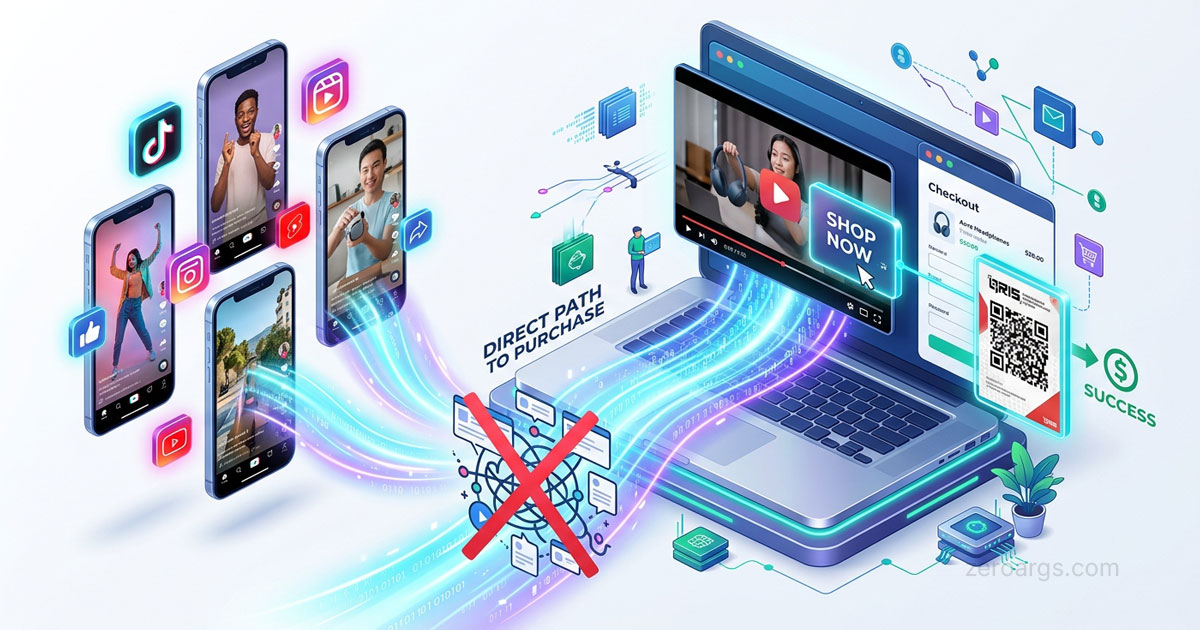
Operational example: a local skincare seller runs entry SKUs on TikTok Shop for virality, but three-month bundles and subscription refills live only on the website with QRIS — margin rises because no platform commission applies. We cover a similar pattern in TikTok Shop commission strategy for Indonesia 2026.
3. Calculate Margin per Channel Before Moving SKUs
Owned-channel strategy fails when it follows headlines instead of spreadsheets. Minimum steps before moving one SKU:
- List every marketplace deduction — category commission, processing fees, seller-funded shipping subsidies, affiliate cuts, and estimated ad cost per order.
- Calculate unit HPP — materials, packing, proportional labor. Many MSMEs skip ad spend in HPP; that is why dashboard margin looks healthy but cash is thin.
- Compare with owned channel — same selling price, payment gateway cut (Midtrans, Xendit, Doku) typically 2–3%, no marketplace commission.
- Flag the lowest-margin 20% of SKUs — first candidates to move to owned channels or discontinue.
Simple formula:
Channel margin (%) = (Selling price − HPP − Total channel cuts) ÷ Selling price × 100
Illustrative example — product IDR 150,000, HPP IDR 70,000:
| Channel | Estimated total cuts | Gross margin |
|---|---|---|
| Marketplace (commission + promo + ads) | IDR 45,000 (30%) | 23% |
| Website + QRIS | IDR 4,500 (3%) | 51% |
Marketplace numbers vary per seller; what matters is your version, not generic benchmarks. For a deeper framework, see our unit economics guide for Indonesian startups — the same logic applies to MSMEs.
4. Lightweight Dual-Channel Architecture for Small Teams
Owned channels do not require an ERP. MVP architecture that often suffices:
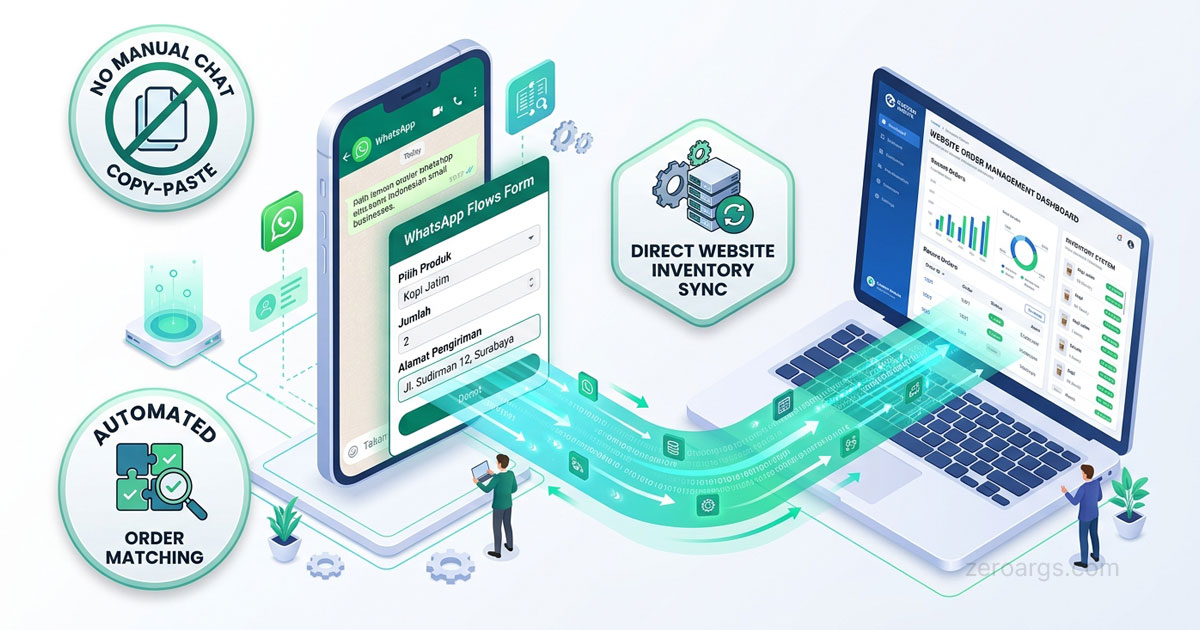
Layer 1 — Inventory source of truth. One spreadsheet, simple database, or omnichannel middleware. If you already sell on multiple channels, read omnichannel order and inventory sync for Indonesian SMBs before adding a website.
Layer 2 — Website as the official page. Home, curated catalog (not a copy of every marketplace SKU), how to order, FAQ, contact. Host in asia-southeast2 (Jakarta) or Singapore edge for fast mobile checkout.
Layer 3 — Conversion on WhatsApp Business. Many Indonesian transactions still close in chat — the website provides stable detail links; WhatsApp closes the deal. Price and stock consistency across both is operational requirement, not optional.
Layer 4 — Owned checkout. QRIS for instant payment, BCA/BRI virtual accounts for B2B orders. Payment gateway integration does not need to be complex on day one; see payment gateway integration for Indonesian business websites.
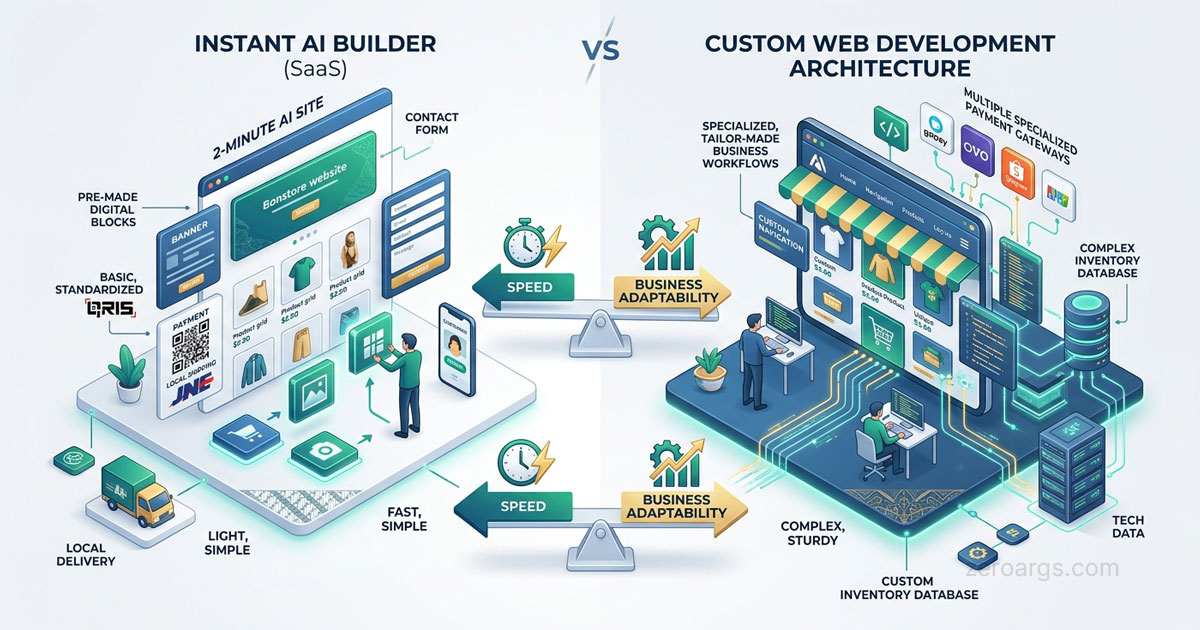
Tech stack we often use for owned-channel MVPs: Next.js on Vercel or Cloud Run, Supabase or Firebase database, payment webhooks for automatic stock updates. Teams without full-time developers can start with WordPress catalog + payment plugin — what matters is that order flow does not depend on manual copy-paste without an archive.
5. Customer Flow: From Marketplace to Repeat Order
Dual-channel works when you guide customers politely, not force them. Measurable patterns:
First purchase — marketplace. New buyers often need transaction guarantees and platform installment options. Let the marketplace handle trust-building.
After successful delivery — invite to owned channel. A note card with QR to a "order direct" page, a first-order coupon on the website (not a marketplace discount), or a WhatsApp follow-up seven days after delivery.
Repeat order — owned channel. Customers who already trust you do not need marketplace discovery fees. Offer bundling, light subscriptions, or loyalty pricing that stays profitable after payment gateway cuts.
Light B2B — website + invoice. Corporate catering, small resellers, or institutional orders often need portfolio pages, tax IDs, and formal invoices — hard to do through marketplace listings alone.
Regulatory note: marketplace incentives like Sapa UMKM fee discounts still help volume, but they do not replace margin on owned channels. See our Indonesia UMKM marketplace regulation 2026 seller guide for 2026 policy context.
6. Payments and Checkout on Owned Channels
Owned checkout must be as easy as marketplace checkout — otherwise customers return to platforms.
| Method | When to use | Technical note |
|---|---|---|
| QRIS | Daily orders, small–medium amounts | Instant confirmation via webhook; MSME-friendly |
| Virtual account | B2B, large amounts | Needs reconciliation; webhook idempotency required |
| E-wallets (GoPay, DANA, OVO) | Younger buyers, social commerce | Usually via payment gateway aggregator |
| Manual transfer | Only at very low volume | Scales poorly; avoid above ~20 orders/day |
Implementation principle: website price must be final before payment redirect — 11% VAT (PPN) and PKP status affect display. Do not change amounts at the last second after the customer scans QRIS.
7. Customer Data, UU PDP, and Trust
Owned channels deliver first-party data — email, phone, address, preferences — that marketplaces do not share. Responsibility rises with it:
- Collect only what operations need (shipping address, not excess fields).
- Clear privacy page: what is collected, why, how to delete.
- Explicit consent for newsletter or WhatsApp broadcasts — not hidden opt-out.
Our Indonesia data protection practical guide for web apps gives a checklist sufficient for small MSMEs. Clean data also eases financing access — banks treat owned-channel transaction history as a stronger credit signal than marketplace turnover without detail.
8. Model Comparison: Full Marketplace vs Dual-Channel vs Full Owned
| Model | Best for | Upside | Risk |
|---|---|---|---|
| Full marketplace | Commodity resellers, new SKU experiments | Fast, minimal setup | Crushed margin, limited data |
| Dual-channel | MSMEs with repeat customers, local brands | Balance discovery + margin | Needs discipline across 2–3 channels |
| Full owned | Mature D2C brands, large B2B | Highest margin, full control | Own traffic cost, trust from zero |
For most Indonesian MSMEs in 2026, dual-channel is the sweet spot — not because of media headlines, but because of margin math and distribution risk.
Cost estimates for building an owned channel are in website development cost for Indonesian businesses 2026. Hosting and development often cost less than three consecutive months of marketplace ads.
Conclusion
An owned channel strategy for Indonesian SMEs in 2026 is not about abandoning marketplaces — it is about building a digital business home that protects margin, customer data, and loyalty. Start with per-SKU margin math, move repeat-order products to website + QRIS, maintain one inventory source of truth, and invite marketplace customers to owned channels after trust is established.
If you want a realistic dual-channel architecture for daily operations — from website MVP through payment integration and stock sync — Zero Args Technology helps MSMEs and small businesses across Indonesia, including Nganjuk and East Java. Start a conversation and tell us which sales channels you use today; we will map the next technical steps without over-engineering.
Frequently asked questions
Do Indonesian SMEs need to leave marketplaces to build an owned channel?
No. The most realistic dual-channel model uses marketplaces and TikTok Shop to find new customers, then shifts repeat orders to your website or WhatsApp where margins are healthier.
How do transaction costs compare between owned channels and marketplaces?
Owned channels typically charge about 2–3% through a payment gateway for QRIS or virtual accounts, while marketplaces often combine commission, processing, logistics, and ads into 15–30% per transaction.
Which SKUs should move to an owned channel first?
Start with thin-margin marketplace products, customers who already reorder, or bundles that are hard to sell through platform listing templates.
What is the technical minimum for an SME owned channel?
A product or service page, QRIS or virtual-account checkout, one inventory source of truth, and a basic privacy page under Indonesia's data protection rules is enough for an MVP.