- startup
- mvp
- engineering
Unit Economics for Indonesian Startups: A 2026 Guide
A practical guide to unit economics for Indonesian startups in the profitability era: how to calculate CAC, LTV, payback period, and how product decisions affect margins.
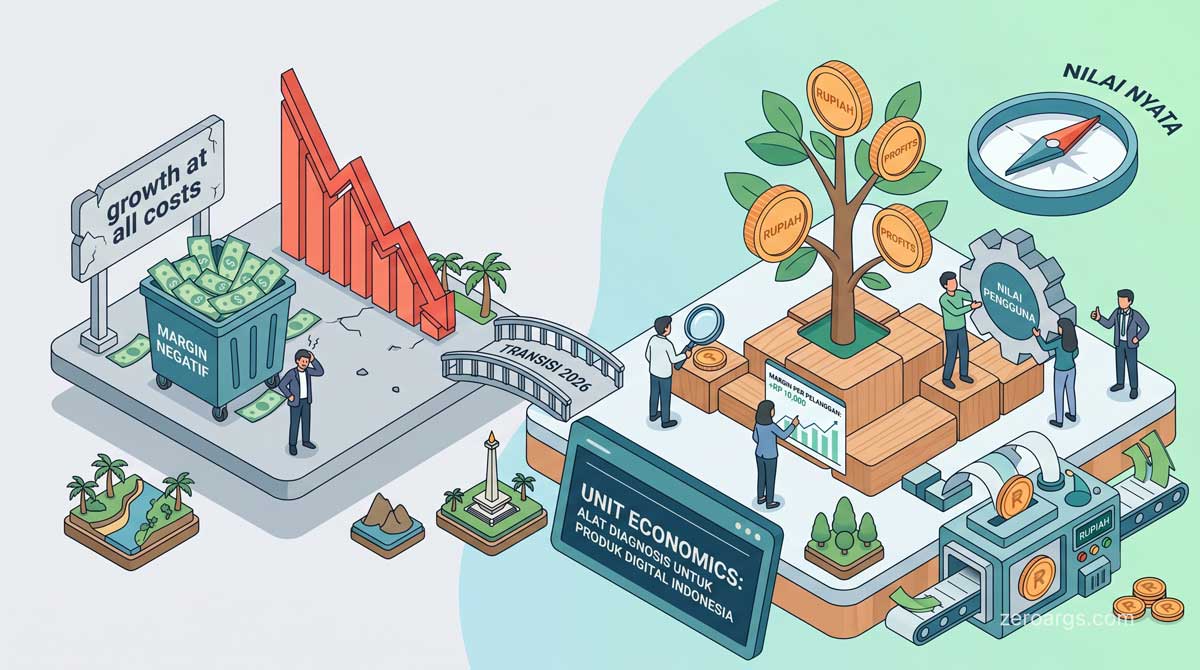
Indonesia's startup ecosystem in 2026 looks nothing like the growth-at-all-costs era. Investors are no longer impressed by massive GMV figures or inflated download counts when margin per transaction is still negative. What they want now is proof that every customer, every order, or every subscription actually creates value — that is the core of unit economics.
If you are building a digital product, preparing a pitch deck, or deciding whether a new feature is worth shipping, understanding unit economics is not a finance-team task for later. It is a diagnostic tool you should use from the day your product interacts with paying users.
1. Why GMV Is No Longer the Gold Standard
Gross Merchandise Value (GMV) was once the favorite metric on Indonesian startup pitch decks. The number looks impressive on a slide, but GMV is not revenue — and it is far from profit.
This shift is visible across public markets and venture capital. Consumer tech companies approaching IPO are now valued on cash generation ability, not theoretical market size on paper. Founders who present 300% growth without explaining gross margin per transaction face far sharper questions than they did three years ago.
Whether you are building from Nganjuk, Surabaya, or another city in East Java, the dynamic is the same: banks, angel investors, and strategic partners want to know if your business model stands on its own without permanent subsidies. Unit economics gives everyone a shared language to answer that question — whether you sell coffee, software, or logistics services.
2. Core Unit Economics Metrics You Need to Know
Before opening a spreadsheet, agree on what counts as a "unit" in your business. For a marketplace, a unit might be one order. For SaaS, one subscribing customer. For on-demand services, one trip or one job.
These four metrics form the foundation for most digital businesses:
- CAC (Customer Acquisition Cost) — total cost to acquire one new customer.
- LTV (Lifetime Value) — total margin one customer generates over the entire relationship.
- LTV:CAC ratio — whether acquisition cost is paid back with enough margin.
- Payback period — how long it takes for a customer's margin to recover their CAC.
Gross margin per unit determines your breathing room. Without healthy gross margin, growth only accelerates cash burn.
3. How to Calculate CAC, LTV, and Payback Period
Unit economics does not require expensive software. You need consistent data and definitions that do not change every month.
CAC is calculated by dividing total acquisition spend in a period by the number of new customers in that same period:
CAC = (Marketing spend + sales costs + related tools) / New customers
Make sure CAC includes growth team salaries, ad spend on Meta and TikTok, affiliate commissions, content production costs, and a share of tools like CRM or analytics — not just the ad budget line item.
LTV for subscription models can be estimated with:
LTV = ARPU × Gross margin % × (1 / monthly churn rate)
Example: ARPU of IDR 200,000 per month, 70% gross margin, 5% monthly churn. LTV ≈ IDR 2.8 million per customer.
Payback period measures how fast acquisition spend comes back:
Payback period (months) = CAC / (ARPU × Gross margin %)
If CAC is IDR 600,000 and monthly contribution per customer is IDR 140,000, payback period is roughly 4.3 months — relatively healthy for a small B2B SaaS product.
Benchmarks investors commonly use: an LTV:CAC ratio of at least 3:1 and a payback period under 12 months, ideally 6–9 months for digital products.
4. How Product and Tech Stack Decisions Affect Margins
Unit economics is not a spreadsheet separate from engineering. Every product and technology decision changes the numbers inside it.
Consider a few real examples:
- Payment gateway integration through Midtrans or Xendit adds per-transaction fees. If you absorb those fees without adjusting pricing, gross margin per order drops.
- Real-time chat features require WebSocket infrastructure, push notifications, and possibly third-party services — raising variable cost per active user.
- Over-engineered architecture at the MVP stage adds developer and hosting cost before demand is proven. Burn rate rises, and effective CAC worsens because first paying customers arrive late.
Decisions that support healthy unit economics include: building an MVP with a stack that enables fast iteration (see our guide on how to choose a tech stack for startups), deferring features that do not affect conversion, and instrumenting the product from day one so churn and ARPU are measured — not guessed.
When we build custom products for startup clients in Indonesia, we often ask teams to define unit economics metrics before the first sprint. This prevents "cool" features with no path to revenue.
5. Unit Economics Scenarios for Indonesian Business Models
Each business model has a different cost structure. The ranges below are indicative, not fixed rules — adjust them with your own data.
UMKM marketplace — thin margin per transaction (5–15% commission) but high frequency. Focus on logistics cost (JNE, J&T, GoSend) and QRIS payment fees. Unit economics are healthy when contribution per order after variable costs is positive before marketing.
B2B SaaS for SMBs — lower ARPU than global enterprise SaaS, but CAC can be reduced through referrals and local communities. A 60–80% gross margin target is realistic when hosting in Asian regions (GCP asia-southeast2 in Jakarta or Singapore edge).
D2C e-commerce — product margins (20–40%) are often squeezed by ad spend on TikTok Shop and Shopee. This is where having a website beyond marketplaces helps: owned channels and CRM reduce blended CAC over time.
Fintech or recurring services — treat compliance cost (OJK where relevant) and data security (Indonesia's Personal Data Protection Law, UU PDP) as fixed costs that must be amortized across active users.
6. Warning Signs of an Unhealthy Business Model
You do not need to wait for an investor meeting to spot trouble. Watch for these signals:
- LTV:CAC ratio below 1:1 — you lose money on every new customer.
- Payback period over 18 months while runway is under 24 months.
- Gross margin declining each quarter due to discounts or subsidies without retention gains.
- CAC rising across all channels while the team still optimizes for GMV.
- Churn spiking after promotions end — user growth was only a temporary loan.
If four or more of these appear together, stop expanding into new channels. Fix retention, pricing, or variable cost structure first.
7. From Spreadsheet to Dashboard: Instrumentation You Need
Accurate unit economics requires product data, not deck assumptions.
At minimum, your system should answer:
- How many new customers per month, per acquisition channel?
- What is revenue and margin per customer or per transaction?
- When do customers stop using the product (churn)?
- What is infrastructure cost per 1,000 active transactions?
You can start with Google Sheets filled manually from Midtrans exports, ad dashboards, and a PostgreSQL database. But once transactions exceed hundreds per day, automation matters: event tracking (via Segment or PostHog), a simple ETL pipeline, and a weekly founder dashboard.
A small engineering investment in instrumentation — often a few days of work — is far cheaper than building the wrong feature because you do not know which unit is unprofitable.
8. Unit Economics Benchmarks by Business Type
Use this table as a starting point for internal discussion, not as rigid targets:
| Business type | Target gross margin | Minimum LTV:CAC | Ideal payback period |
|---|---|---|---|
| B2B SaaS | 60–80% | 3:1 – 5:1 | 6–12 months |
| B2C SaaS / freemium | 50–70% | 3:1 | < 12 months |
| Marketplace | 50–70% (commission) | 2:1 – 3:1 | < 12 months |
| D2C e-commerce | 20–40% | 2:1 – 3:1 | < 9 months |
| On-demand / logistics | 15–30% | 2:1 | < 6 months |
| Professional services / agency | 50–70% | 3:1+ | < 3 months |
If your numbers sit well below these benchmarks, do not immediately conclude the business has failed. Identify whether the problem is pricing, variable costs, retention, or CAC — then prioritize the fix with the fastest impact on margin per unit.
Conclusion
Unit economics for Indonesian startups in 2026 is no longer optional material for "after we raise funding." It is the language investors, CTO candidates, and business partners use to judge whether your product deserves to scale.
Start by defining your business unit, calculate CAC and LTV from real data, then connect every product and technology decision to its margin impact. Healthy growth is growth where each additional unit strengthens — not erodes — the company's financial foundation.
If you are building a digital product and want to ensure architecture and feature roadmap align with unit economics targets, the Zero Args Technology team can help from MVP stage through metrics instrumentation. Start a conversation for an initial consultation.


