- umkm
- e-commerce
- engineering
Indonesia UMKM Marketplace Regulation 2026: Seller Guide
Indonesia's UMKM marketplace regulation 2026 protects sellers with fee transparency, 90-day notice, and 50% local product incentives. A practical guide for SMBs.
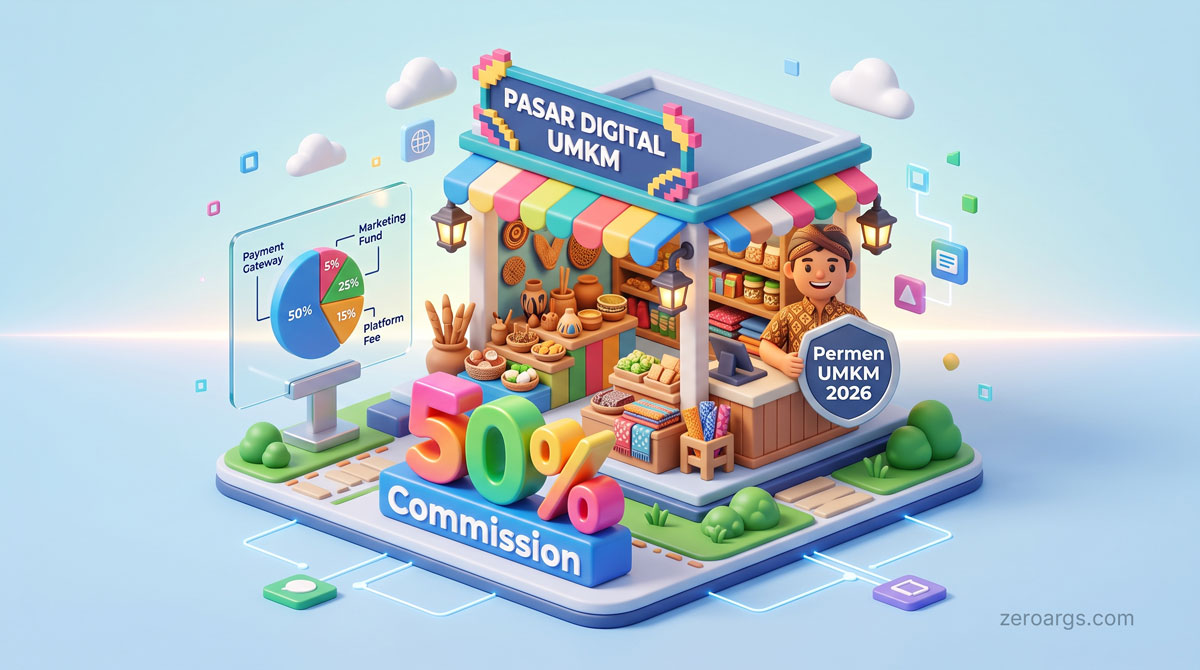
On June 17, 2026, Indonesia's Ministry of Cooperatives and SMEs (Kemenkop UKM) enacted Ministerial Regulation (Permen) UMKM No. 3 of 2026 on the protection and competitiveness of micro and small enterprises (MSEs) in electronic commerce (PMSE). If you sell on Shopee, Tokopedia, TikTok Shop, or similar platforms, this is not just legal news — it changes the rules on fee transparency, advance notice of increases, and service fee discounts of up to 50% for domestically produced goods. This article translates Indonesia's UMKM marketplace regulation 2026 into operational steps: what changed, what to verify in your partnership agreement, and how to use the six-month transition period without neglecting your own sales channel.
Read this seller-protection layer alongside broader platform rules. For obligations around AI and NIB in e-commerce, see our guide to Permendag 19 of 2026.
1. What Permen UMKM No. 3/2026 Covers and Who It Affects
Permen UMKM 3/2026 governs the partnership between electronic commerce platform operators (PPMSE) — the official term for marketplace platforms — and micro and small enterprises (UMK) that sell online.
Directly affected parties:
- Registered sellers on domestic marketplaces (Shopee, Tokopedia, Lazada, Blibli, TikTok Shop, and similar platforms).
- MSEs with an active NIB (business identification number) that meet the micro/small enterprise criteria defined in the regulation.
- E-commerce platforms that must update digital business partnership (KBD) agreements, fee notification systems, and incentive mechanisms.
Not automatically covered: sellers who have not been verified as MSEs, or businesses that rely solely on social media without a written agreement with a PPMSE. The regulation focuses on the contractual relationship between MSEs and marketplaces, not standalone Instagram shops or WhatsApp catalogs.
A transition period of up to six months is provided for technical implementation — including data integration for incentives between platforms and government systems. Some benefits may not appear in seller dashboards immediately, but transparency and notification obligations should take effect sooner.
2. Fee Transparency: What Platforms Must Disclose
The core of Indonesia's UMKM marketplace regulation 2026 is a written partnership agreement in Indonesian that explicitly lists every fee component. Platforms can no longer rely on unilateral policy pages scattered across help centers without mutual agreement.
Regulated fee types include:
| Fee type | When charged | Real-world example |
|---|---|---|
| Registration fee | One-time at onboarding | Seller store activation fee |
| Service fee | Per transaction | Commission, admin fee, order processing fee |
| Promotion/ad fee | Optional, seller-initiated | Product ads, mall campaigns, boost features |
Each fee must state the amount, calculation method, and payment terms. Marketplaces are prohibited from deducting additional charges that were never agreed upon in the original contract.
Practical implication for MSEs: re-read your seller agreement. If fee components are not clearly separated — for example, commission bundled with platform logistics without a breakdown — you have grounds to request official clarification. This aligns with concerns raised during the TikTok Shop commission increase in 2026, where many sellers only realized their total cost burden after margins eroded.
3. 90-Day Notice and the Ban on Unilateral Fee Changes
Before Permen UMKM 3/2026, platforms could change fee structures with relatively short notice — often just a few weeks. The new regulation fundamentally shifts this dynamic.
Key provisions:
- Fee changes require agreement between the PPMSE and the MSE — not a unilateral platform decision.
- Mandatory 90-calendar-day notice before any new policy takes effect — giving time to negotiate, reprice, or diversify channels.
- Platforms are prohibited from setting or changing fees without a mutually agreed contractual basis.
Operational example: if Shopee or Tokopedia plans to raise commission from 5% to 7%, you must receive notice at least three months in advance. Within that window, you can recalculate per-SKU margins, adjust prices, move repeat-order products to your website, or file an objection.
The formula we still recommend for monthly audits:
Effective fee (%) = Total platform deductions ÷ Net GMV × 100
With a 90-day window, you have real time to run this audit — instead of reacting in panic after a policy is already live.
4. 50% Service Fee Discount for Domestic Products
Beyond protection, Permen UMKM 3/2026 introduces a promotional stimulus: a minimum 50% reduction in service fees for MSEs selling domestically produced goods through PMSE platforms.
Important points to understand:
- This is not an automatic discount for every store — implementation requires coordination between Kemenkop UKM, platforms, and MSE data verification.
- Execution is expected to integrate with the Sapa UMKM ecosystem — the government's unified service app covered in our Sapa UMKM integration guide.
- Eligible domestic products are intended to gain margin room to compete with cheaper imported goods.
Preparation steps so you are ready when incentives go live:
- Ensure your business is verified as an MSE in Sapa UMKM.
- Clean up your product catalog — tag which items are locally produced vs. imported.
- Document sourcing or production origin if platforms request verification.
Do not wait for incentives as your only margin strategy. A 50% discount reduces burden, but you still depend on platform policy and program eligibility — not full control over unit economics.
5. Impact by Sector
The effects of Permen UMKM 3/2026 are not identical across categories. Three sectors that dominate Indonesian seller dashboards feel different pressures and opportunities.
Fashion and local apparel. Margins are often thin because of ads and flash sales. The 90-day notice window gives time to reprice before peak seasons or major campaigns. Domestic-product incentives matter most for brands that manufacture or sew in Indonesia — provided local and imported SKUs are clearly separated in the catalog.
Electronics and accessories. Many SKUs are imported or mixed-origin assemblies, so not every item automatically qualifies for the 50% cut. The practical focus is auditing service fees versus promo spend, then using the notice window to reset competitive pricing without stranding dead stock.
Food and beverage (F&B). Local F&B sellers often have a stronger “domestic product” claim, but face cold-chain or short shelf-life costs. Fee transparency helps compare marketplace commission with owned channels (WhatsApp + QRIS), while Sapa UMKM facilitation is useful if a fee change threatens daily-product margins.
Across all three, fee predictability is worth more than a promised discount alone — especially if you already run a hybrid marketplace-plus-website model.
6. Negotiation Facilitation Through Sapa UMKM
If you object to a proposed fee change notified by a platform, Permen UMKM 3/2026 opens an official path: a negotiation facilitation request to the Minister of Cooperatives and SMEs through the Sapa UMKM app.
The process you need to know:
- The platform sends a fee change notification (at least 90 days in advance).
- The MSE assesses impact on margins and operations.
- If you object, submit a facilitation request via Sapa UMKM.
- The facilitation outcome is recorded in a binding contract amendment for both parties.
This is not an informal social-media complaint — it is a legal mechanism that requires data: current effective fees, projected impact, volume, and effect on continuity. For MSEs in Nganjuk, Kediri, Madiun, or elsewhere in East Java, clean bookkeeping (spreadsheet, Sapa UMKM, or simple POS) beats relying only on platform reports.
7. Comparison Table: Before vs. After Permen 3/2026
| Aspect | Before (common practice) | After Permen UMKM 3/2026 |
|---|---|---|
| Fee changes | Often unilateral by platform | Must be mutually agreed |
| Advance notice | Varied, sometimes < 30 days | Minimum 90 calendar days |
| Fee breakdown | Scattered in FAQs, not always in contract | Mandatory in written agreement |
| Seller objections | No formal channel | Negotiation facilitation via Sapa UMKM |
| Local product incentives | Ad hoc per-platform programs | Legal basis for min. 50% discount |
| Adaptation period | Unstructured | Maximum 6-month transition |
The regulation does not eliminate marketplace fees — commission, ads, and logistics still apply. What changes is predictability and MSE bargaining power. For businesses whose margins were destroyed by sudden policy shifts, predictability alone has strategic value.
8. MSE Preparation Checklist During the Six-Month Transition
Use the transition to strengthen operations — not just wait for incentives.
Weeks 1–4: Audit and verify
- Download each marketplace seller agreement; compare it to deductions from the last 90 days.
- Complete Sapa UMKM (Android); align NIB and address with OSS — see our Sapa UMKM integration guide.
Months 2–4: Recalculate and diversify
- Flag the lowest-margin 20% of SKUs; compare marketplace fees vs. owned-channel cost (~2–3% payment gateway). See why Indonesian SMEs still need a website.
- Add a minimal catalog for repeat-order SKUs; integrate QRIS via Midtrans/Xendit (payment gateway guide).
Months 5–6: Prepare for negotiation
- Document impact of any proposed fee change; watch the 50% incentive in your dashboard.
- If multi-channel, keep omnichannel inventory sync running to avoid overselling.
9. Why Your Own Sales Channel Still Matters Despite Favorable Regulation
Permen UMKM 3/2026 is progress — not a reason to drop your own website. Three reasons still apply:
Customer data stays limited on marketplaces. Fee protection does not grant email, phone, or purchase history for retention. On your channel, with consent under UU PDP, you keep a base that survives account issues.
Incentives can change; owned infrastructure does not. The 50% cut depends on programs and platforms. Hosting in asia-southeast2 (Jakarta) and local payment gateways are under your control.
Negotiation is stronger with real alternatives. Sellers with a website, WhatsApp repeat orders, and independent QRIS have leverage — not just rhetoric.
Stay hybrid: marketplace for discovery and local incentives; website for margin and loyal customers. Also read our Permendag 19 of 2026 guide so platform compliance and NIB readiness stay aligned.
Conclusion
Indonesia's UMKM marketplace regulation 2026 reshapes the digital selling landscape: mandatory fee transparency, 90-day notice, a ban on unilateral changes, fee discounts for local products, and official negotiation through Sapa UMKM. Use the six-month transition to audit contracts, verify MSE status, and build a backup sales channel — instead of waiting for platforms to finish everything for you.
If you want to design a hybrid architecture from landing page to QRIS webhooks, with business data ready for Sapa UMKM integration, start a conversation with us. We help MSEs in Nganjuk, East Java, and across Indonesia build digital channels that withstand regulation changes and marketplace policy shifts alike.
Frequently asked questions
What is Permen UMKM No. 3 of 2026?
Permen UMKM No. 3 of 2026 is a ministerial regulation from Indonesia's Ministry of Cooperatives and SMEs on protecting and improving the competitiveness of micro and small enterprises in electronic commerce (PMSE). It governs the partnership between marketplace platforms (PPMSE) and MSEs, including fee transparency, 90-day notice before fee changes, and a minimum 50% service-fee discount for domestically produced goods.
Are all marketplace sellers protected by Permen UMKM 3/2026?
Not automatically. Protection mainly covers MSEs with an active NIB that sell under a partnership agreement with a PPMSE. Sellers who are not verified as MSEs, or who only sell via Instagram or WhatsApp without a written platform agreement, are not automatically covered.
How does Permen UMKM 3/2026 differ from Permendag 19/2026?
Permen UMKM 3/2026 focuses on MSE seller protection on marketplaces: fees, notice periods, and incentives. Permendag 19/2026 covers broader e-commerce obligations, including rules related to AI and NIB. Together they form complementary compliance layers for online businesses in Indonesia.
When does the 50% fee discount take effect?
The regulation allows up to six months for technical implementation, including data integration between platforms and government systems such as Sapa UMKM. The incentive is not an automatic store-wide discount; sellers need verified MSE status and a catalog that can prove which products are domestically produced.