- umkm
- e-commerce
- mvp
- engineering
TikTok Margin 2026: Fee Math & Strategies to Stay Profitable
TikTok margin after the 2026 fee hike: before/after cost math, how to calculate TikTok margin, and a hybrid website strategy for Indonesian SMEs.
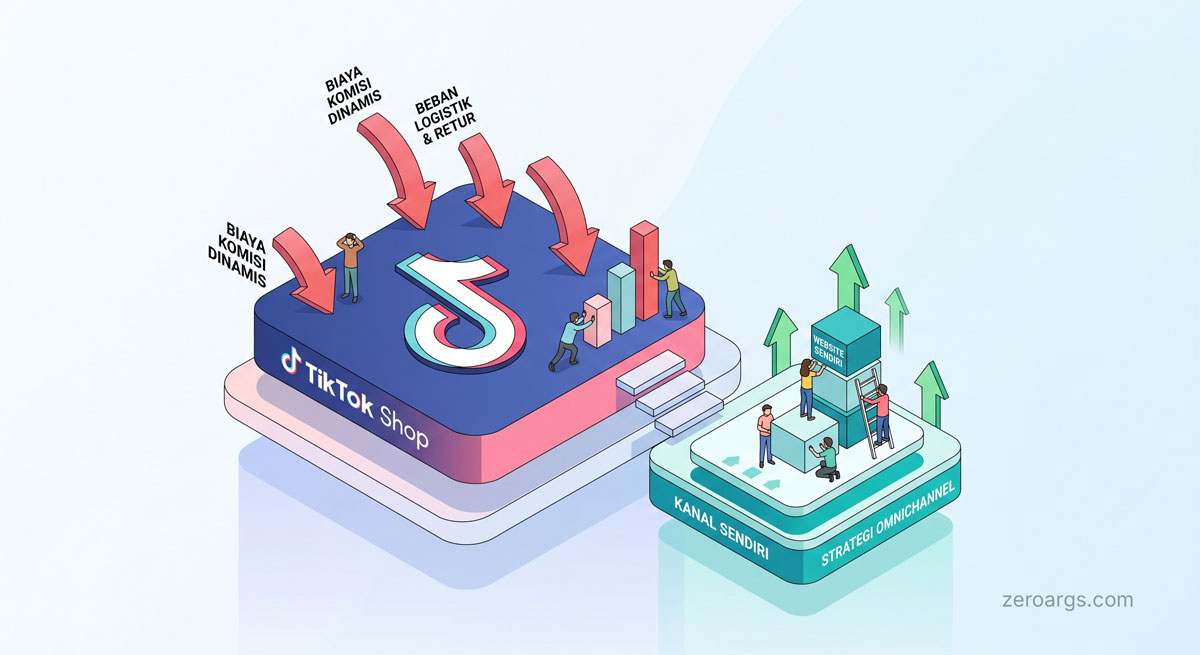
Starting in May 2026, TikTok Shop rolled out a new Dynamic Commission Fee structure and added logistics and return charges that cut directly into TikTok margin for sellers. For Indonesian SMEs that depend on live shopping and viral content, the TikTok Shop commission increase is not just a dashboard number — it is a signal that a single-channel strategy is fragile. This article covers the fee changes from an engineering and operations angle: what you actually pay per transaction, which products are hit hardest, and how to build an owned sales channel without abandoning TikTok discovery.
1. What Changed in TikTok Shop Starting May–June 2026
The main policy shifts to track:
- Dynamic Commission Fee (effective 18 May 2026): category rates rose across many segments — for example beauty from roughly 4% to 7%, office supplies from 4% to 8%, and shoes from 5% to 8%. Base rates generally range from 6.97% to 10% depending on category.
- Per-item commission cap: the maximum rose from IDR 40,000 to IDR 650,000 per unit. For high-ticket products, the impact is far larger than a percentage bump alone.
- Order processing fee: IDR 1,250 per delivered order, charged even when a return occurs.
- Logistics service fee (from 1 May 2026): a fixed per-order charge based on weight and route, capped at roughly IDR 5,055 per order on TikTok Shop.
- Return shipping cost (from 1 June 2026): sellers may pay up to IDR 5,000 per shipping leg when buyers change their minds — total new return burden can reach IDR 10,000 per case.
Indonesia's Ministry of MSMEs has called TikTok in to review the policy. Whatever the outcome, the lesson for sellers is the same: your margin depends on platform rules that can change with little runway.
2. How to Calculate TikTok Margin
The most common mistake is seeing "8%" in a dashboard and treating that as the full burden. Healthy TikTok margin is profit after all deductions, not category commission alone.
Practical steps:
- Take the net selling price (after seller vouchers you fund).
- Subtract COGS (product cost + packing).
- Subtract all platform deductions: dynamic commission, IDR 1,250 processing, logistics fees, affiliate, Shop Ads, and an estimate for returns.
- Divide by selling price, then multiply by 100.
TikTok margin (%) = (Selling price − COGS − Total deductions) ÷ Selling price × 100
Effective cost (%) = Total deductions ÷ Selling price × 100
For monthly audits across SKUs, an effective-cost-vs-GMV formula also helps:
Effective GMV cost (%) = (Total platform deductions + ads + affiliate) ÷ net GMV × 100
If that number hits 15–30% — commonly reported by TikTok Shop sellers with affiliate and ad spend — the question is not "should I leave TikTok?" but "which transactions should I move to an owned channel?"
Typical components for an IDR 200,000 product:
| Component | Example | Notes |
|---|---|---|
| Dynamic commission 8% | IDR 16,000 | Higher if category is above average |
| Processing fee | IDR 1,250 | Flat per order |
| Platform logistics fee | IDR 260–5,055 | Depends on weight and route |
| Affiliate commission | 5–20% (optional) | If you use creators |
| Ads / Shop Ads | Varies | Often required for visibility |
For an IDR 20,000,000 product (e.g. a laptop), 8% commission = IDR 1,600,000 — still under the new IDR 650,000 cap? No: the cap is an upper bound, not a floor. But sellers were previously "protected" at IDR 40,000 in certain cases; the room for per-item deductions is now much wider.
3. Margin Comparison: Before vs After the Fee Hike
Use the same local skincare SKU — selling price IDR 200,000, COGS IDR 100,000, no affiliate and no ads — so the policy impact is easy to see.
| Component | Before the hike | After the hike (2026) |
|---|---|---|
| Selling price | IDR 200,000 | IDR 200,000 |
| COGS | IDR 100,000 | IDR 100,000 |
| Category commission (beauty) | 4% = IDR 8,000 | 7% = IDR 14,000 |
| Processing fee | IDR 0 | IDR 1,250 |
| Platform logistics fee (example) | IDR 0 | IDR 3,000 |
| Total deductions | IDR 8,000 | IDR 18,250 |
| Gross profit | IDR 92,000 | IDR 81,750 |
| TikTok margin | 46.0% | 40.9% |
| Effective cost | 4.0% | 9.1% |
That is roughly a 5-point margin drop per unit — before affiliate, Shop Ads, or returns. Add a 10% affiliate (IDR 20,000) and IDR 10,000 in ads, and TikTok margin can fall to about 26% (~IDR 51,750 profit). At that point, repeat orders via website + QRIS (~2–3% gateway) often beat endless live-price increases.
4. Which Products Are Hit Hardest by the Cap Increase
Not every SKU is affected equally. Patterns we see in the field:
- High-price, thin-margin products (electronics, furniture, equipment): the IDR 650,000 cap and category commission can destroy unit economics that were previously acceptable.
- Low-price, high-volume products (snacks, accessories): flat IDR 1,250 + logistics + IDR 5,000–10,000 returns can hurt more than the commission percentage.
- High-return categories (fashion, variable sizing): new return fees from June 2026 directly cut profit on failed orders.
- Healthy-margin repeat-purchase products (coffee, local skincare, spices): best candidates to shift to website + WhatsApp because customers already know the brand.
Identify the 20% of SKUs generating 80% of margin complaints. That is your priority list for direct channels.
5. Keep Marketplaces for Discovery — Use Your Website for Margin
TikTok Shop still wins on awareness: live streams, short-form content, and creator integrations. Closing your shop out of frustration usually cuts off new-customer pipeline.
A more resilient strategy is a hybrid channel model:
- TikTok / TikTok Shop → content, viral reach, entry-level products, or promo bundles with repriced margins.
- Website + WhatsApp → repeat orders, bundles, pre-orders, light B2B, and high-ticket SKUs.
- Other marketplaces (Shopee, Tokopedia) → diversify policy risk, not duplicate every SKU.
This aligns with the argument in why Indonesian SMEs still need a website beyond marketplaces — except the 2026 TikTok fee hike provides a concrete operational deadline, not just an abstract strategic reason.
6. A Realistic Minimum Hybrid Architecture for SMEs
You do not need enterprise ERP. A minimum version shippable in a few weeks:
| Layer | Role | Realistic options |
|---|---|---|
| Storefront | Catalog, product pages, policies | Custom website or headless storefront |
| Checkout | Orders + payment | Midtrans / Xendit Snap + QRIS |
| Notifications | Confirmation and follow-up | WhatsApp Business API or structured manual WA |
| Inventory | Prevent overselling | Spreadsheet + simple webhook, or omnichannel sync |
| Discovery | New traffic | TikTok Shop + organic content |
Typical flow: TikTok content → bio link / landing page → checkout with QRIS or virtual account → payment webhook → WhatsApp confirmation → stock from one source of truth (see the omnichannel inventory sync guide). For Nganjuk, Kediri, and other East Java businesses, host in asia-southeast2 (Jakarta) or Singapore edge for fast mobile checkout.
7. Payment and Logistics Integration on Your Own Channel
Owned-channel costs are typically much lower than marketplace fees:
- Payment gateway (Midtrans, Xendit, Doku): roughly 2–3% per successful transaction, without 8–10% platform commission.
- QRIS for carts IDR 50,000–500,000; virtual accounts (BCA, BRI, Mandiri, BNI) for larger or light-B2B orders.
Logistics can still use JNE, J&T, SiCepat, or GoSend — you choose the courier per order. Integration details are in the payment gateway integration guide. Do not go live until settlement or capture webhooks are tested with failed and duplicate payments.
8. Comparison Table: TikTok Shop vs Owned Website
| Aspect | TikTok Shop (2026) | Website + payment gateway |
|---|---|---|
| Per-transaction cost | 8–10% commission + IDR 1,250 + logistics + potential returns | ~2–3% gateway + fixed hosting |
| Discovery / traffic | Very strong (algorithm + live) | Needs SEO, content, or traffic from TikTok |
| Customer data | Limited to platform context | Yours (with consent / Indonesia's PDP law) |
| Pricing and bundling control | Platform discounts, seller vouchers | Fully flexible |
| Policy risk | High — changes quarterly | Low — you set the rules |
| Setup time | Hours (if already verified) | 2–6 weeks for a solid MVP |
| Best for | Viral products, entry price, SKU testing | Repeat orders, thin margins, B2B |
A website is not free. You "pay" with marketing effort and development cost — realistic estimates are in website development cost for Indonesian businesses 2026, and for East Java project scope see website development services (including Surabaya). But if your monthly TikTok Shop GMV is already tens of millions of rupiah, saving 10–15 margin points per transaction often pays back the website investment within months.
9. 30-Day Plan After the Fee Increase
An operational playbook you can run without stopping sales:
Week 1 — Margin audit
- Export TikTok Shop fee reports for the last 30 days.
- Calculate effective cost per SKU (including returns and ads).
- Flag the 10 SKUs with the lowest net margin.
Week 2 — Channel triage
- Raise prices on TikTok for affected SKUs, or pause SKUs that lose money.
- Pick 3–5 SKUs with proven demand for a direct channel.
- Prepare a minimal landing page or catalog section.
Week 3 — Payment and notifications
- Integrate a payment gateway (start in sandbox).
- Test flow: order → pay → webhook → email/WA confirmation.
- Add your website link to TikTok bio and pinned live comments.
Week 4 — Measure and iterate
- Compare margin per channel for the same SKU.
- If website conversion is low, improve trust signals (photos, testimonials, clear return policy).
- Consider WhatsApp Business API if manual chat volume becomes a bottleneck.
Conclusion
TikTok margin in 2026 forces SMEs to rethink unit economics — not by abandoning social commerce, but by building sales channels you control for SKUs most exposed to platform deductions. Calculate effective cost per transaction, compare before vs after the fee hike, move repeat-order products to a website with a local payment gateway, and let TikTok keep doing what it does best: discovery.
If you want to design a hybrid architecture — from landing pages to QRIS webhooks — without over-engineering, start a conversation with us. We help MSMEs and growing businesses in Nganjuk, East Java, and across Indonesia build digital channels that withstand marketplace policy shifts.
Frequently asked questions
How do you calculate TikTok Shop margin?
Subtract COGS and all platform deductions (commission, processing, logistics, affiliate, ads, and returns) from the selling price. Divide gross profit by selling price and multiply by 100 to get TikTok margin as a percentage.
How much did the 2026 TikTok Shop fee hike cut margins?
On a sample IDR 200,000 product with IDR 100,000 COGS, margin can drop from about 46% to 41% after higher commission plus processing and logistics fees—before affiliate and ads.
Should SMEs leave TikTok Shop because of higher fees?
No. TikTok remains strong for discovery. A more resilient approach is hybrid: keep TikTok for new traffic, then move repeat orders and thin-margin SKUs to a website plus WhatsApp.
What is the difference between commission percent and effective TikTok cost?
Commission percent is only one line item. Effective cost includes commission, the IDR 1,250 processing fee, platform logistics, affiliate, ads, and potential return costs—often totaling 15–30% of GMV.
Which products are hit hardest by the higher commission cap?
High-price, thin-margin products take the biggest hit because the cap rose from IDR 40,000 to IDR 650,000 per unit. Low-price, high-volume SKUs also suffer from flat fees and return charges.