- umkm
- mvp
- engineering
- seo
Website Development Cost in Indonesia 2026: A Scope-Based Guide
Website development cost for Indonesian businesses in 2026, broken down by scope, QRIS integrations, and maintenance—not vague marketing quotes.
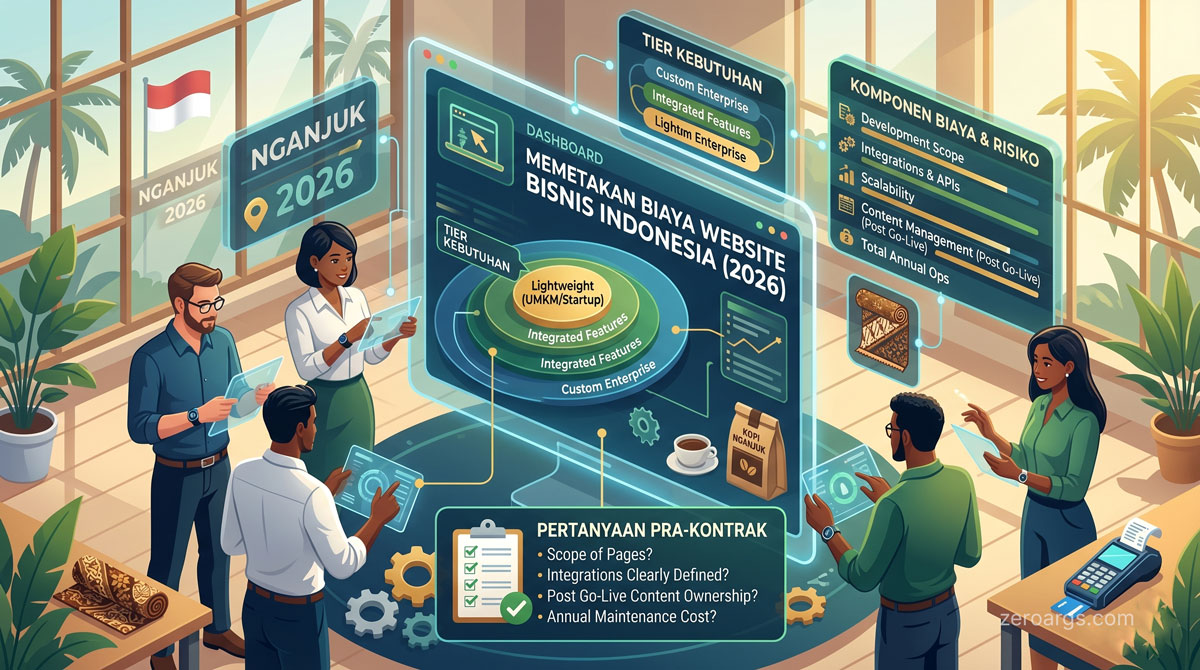
You searched for website development cost in Indonesia 2026 and found quotes from IDR 800 thousand to IDR 200 million on the same results page. Both can be legitimate — for completely different projects. The problem is rarely the number on a brochure; it is whether the vendor explains scope: which pages ship, which integrations are included, who updates content after launch, and what annual operating costs everyone forgets to budget.
This article maps cost the way an engineering team maps features: by tier, by risk component, and by the questions you should answer before signing. It reflects how we estimate work for MSMEs, startups, and service businesses from Nganjuk in East Java to clients selling across Indonesia who want a site that is light to operate but does not go stale in a year.
1. Why a Single "Fixed Price" Almost Always Misleads
A website is not a commodity like a .id domain. Two proposals for an "IDR 5 million company profile" might mean:
- five static pages from a template, with no technical SEO; or
- ten semi-custom pages, heading structure ready to index, a basic privacy policy, and full handover of access.
Without a deliverable list, you are comparing apples and oranges. In Indonesia's 2026 market, commercial queries such as SME website price, website development services, and online store cost stay active as MSME digitalization and programs like UMKM Go Digital push owners toward managed digital presence — not just a marketplace storefront link.
Search intent here is usually commercial-investigation: you are budgeting, not buying on the spot. Posts that paste a price table without cost drivers rarely support a decision; you need an estimation framework.
2. Four Website Tiers Most Indonesian Businesses Actually Need
Before discussing millions of rupiah, agree on what you are building. These four patterns cover most projects we see:
| Tier | Typical use | Typical upfront investment (2026)* | Typical timeline |
|---|---|---|---|
| Landing / campaign | Product promo, event, short lead form | IDR 1–4M | 1–2 weeks |
| Company profile | Services, clinic, contractor, light B2B | IDR 4–15M | 2–5 weeks |
| Catalog + ordering | Product catalog, WA checkout, order forms | IDR 8–25M | 3–8 weeks |
| Store / web app | Cart, stock, admin, payment integration | IDR 15–80M+ | 6–16 weeks |
*Ranges assume professional delivery with clear handover; DIY builders can lower CAPEX but shift cost to internal time.
Tiers are not a prestige ladder. A coffee brand already selling on Shopee and WhatsApp often fits tier 2 with a solid shipping FAQ. Cost spikes when you want app-like behavior (logins, dashboards, stock sync) on top of a marketing site.
3. Cost Components Cheap Quotes Often Hide
Build price is incomplete until you add cost to keep the site alive:
Domain and hosting. A .id domain is often IDR 200k–800k per year; .com is cheaper. Shared hosting at IDR 300k–1M per year can work for low traffic; businesses targeting all of Indonesia with heavy images or video may need cloud in a nearby region — e.g. GCP asia-southeast2 (Jakarta) or AWS ap-southeast-3 — at roughly IDR 200k–3M per month depending on traffic.
SSL and baseline security. TLS certificates are often free (Let's Encrypt), but server hardening, automated backups, and routine patches may sit in a maintenance package of IDR 300k–2M per month. If you process customer data, align with a practical security baseline — see our website security checklist for Indonesian businesses in 2026.
Content and SEO. Professional copy might run IDR 500k–5M depending on page count. Technical SEO setup (URL structure, meta, sitemap, performance) is often IDR 1–5M as part of the project or a retainer. Without it, a cheap site can go live and never rank for queries like catering services Surabaya or packaging supplier Kediri.
Maintenance. A reasonable rule for many businesses: 10–20% of build value per year, or a monthly retainer of IDR 500k–3M for plugin updates, backups, and uptime monitoring. Unmaintained sites drift into security holes and stale content — an operations problem, not just a design issue.
Light compliance. Privacy pages and form consent aligned with Indonesia's Personal Data Protection Law (UU PDP) do not have to be expensive, but they take design time. Our practical UU PDP guide for business websites and apps clarifies what is necessary versus overkill at MSME scale.
4. Builder, WordPress CMS, or Custom: What Moves the Needle?
| Approach | When it fits | Strengths | Hidden cost risks |
|---|---|---|---|
| Builder / template (Wix, etc.) | Short campaigns, fast validation | Quick launch, low CAPEX | Platform lock-in, limited SEO, weak deep integrations |
| WordPress + theme | Company profile, blog, light catalog | Plugin ecosystem, editable content | Premium plugins, plugin security, slow themes |
| Headless / modern stack (Next.js, etc.) | High performance, unique UI, APIs | Scalability, good DX for dev teams | Needs developers for big changes; higher build cost |
| Custom web app | Internal admin, multi-role workflows | Matches business process | Scope creep, server and API OPEX |
Most MSMEs do not need headless commerce — a hot topic in 2026 but more relevant to brands with in-house engineering. For many, a fast Lighthouse score and a clean WhatsApp Business handoff beats architecture buzzwords.
If you are unsure you need a site beyond marketplaces, read why Indonesian SMEs still need a website beyond marketplaces before budgeting for tiers 3–4.
5. Features That Expand Scope (and Budget) Fastest
Each item below can add weeks and tens of millions of rupiah when bundled without prioritization:
- Checkout with QRIS / virtual accounts — Midtrans, Xendit, or Doku integrations need sandbox testing, webhooks, and payment status handling; not a decorative button.
- User accounts and dashboards — registration, password reset, admin roles, audit logs.
- Omnichannel stock sync — connecting the site to Tokopedia, Shopee, and a physical warehouse; see omnichannel order and inventory sync for Indonesian SMBs.
- Multilingual content — duplicated content workflows, not only a language switcher.
- CRM / WhatsApp API automation — order notifications; see our WhatsApp Business API integration guide.
- Personalization / AI — recommendations, chatbots; validate whether data and operations are ready.
Our recommended MVP principle: ship the ordering flow you already run daily (for example form → WhatsApp), then add automated payments when volume justifies the complexity.
6. How to Write a Scope Brief Vendors Can Price Accurately
Good vendors will ask the following; prepare answers so mid-project surprises stay rare:
- 90-day business goal — leads, B2B credibility, or direct transactions?
- Page list — home, services, portfolio, FAQ, contact, privacy policy.
- Required integrations — Google Maps, WhatsApp click-to-chat, Meta Pixel, spreadsheets, ERP?
- Who updates content — is your team comfortable with WordPress, or do you need a custom panel?
- Performance target — mobile-first (important: Indonesia mobile search share exceeds 80%).
- Asset ownership — contract must state you own the domain, code repository, and hosting access.
A tight scope example that yields a firm quote:
Eight-page company profile in Indonesian, contact form to email + WhatsApp, optional blog with four posts, baseline technical SEO, Jakarta-region cloud hosting, admin handover docs, payment gateway excluded from phase 1.
That beats asking for "the cheapest website possible."
7. Red Flags: Quotes That Are Too Low or Too High
Too low if:
- there is no contract or final page list;
- "free maintenance forever" with no hour cap;
- you do not receive domain, hosting, or code access;
- stock images and copy lack clear licensing;
- they promise page-one Google rankings in 30 days.
Too high for your actual need if:
- they propose headless microservices for a 20-SKU catalog;
- you get an enterprise stack with no internal team to operate it;
- discovery workshops cost more than the build without measurable deliverables;
- monthly retainers rival staff salaries without a written SLA (response time, backups, patches).
For businesses in mid-sized cities such as Nganjuk, Madiun, or Kediri, a local or remote vendor with clear MSME portfolio work often beats a metropolitan agency charging corporate overhead for a simple company profile — as long as scope and asset ownership stay equally strict. See website development in Nganjuk or our East Java city pages for scope-based estimates.
Conclusion
Website development cost for Indonesian businesses in 2026 depends on the tier you choose, integration features (especially payments and omnichannel), and yearly domain, hosting, and maintenance — not the lowest headline price on Google. Start from business goals, write a one-page scope, compare proposals on identical deliverables, and defer expensive features until daily operations can absorb them.
If you want an honest estimate for a company profile, catalog, or store MVP — including realistic QRIS and WhatsApp flows for the Indonesian market — start a conversation with us. We will split phase 1 and phase 2 so your budget tracks business growth, not an agency feature brochure.