- engineering
- umkm
- mvp
Website Security Checklist for Indonesian Businesses 2026
A practical website security checklist for Indonesian businesses: HTTPS, backups, MFA, hardening, and UU PDP alignment for SMBs and small product teams in 2026.
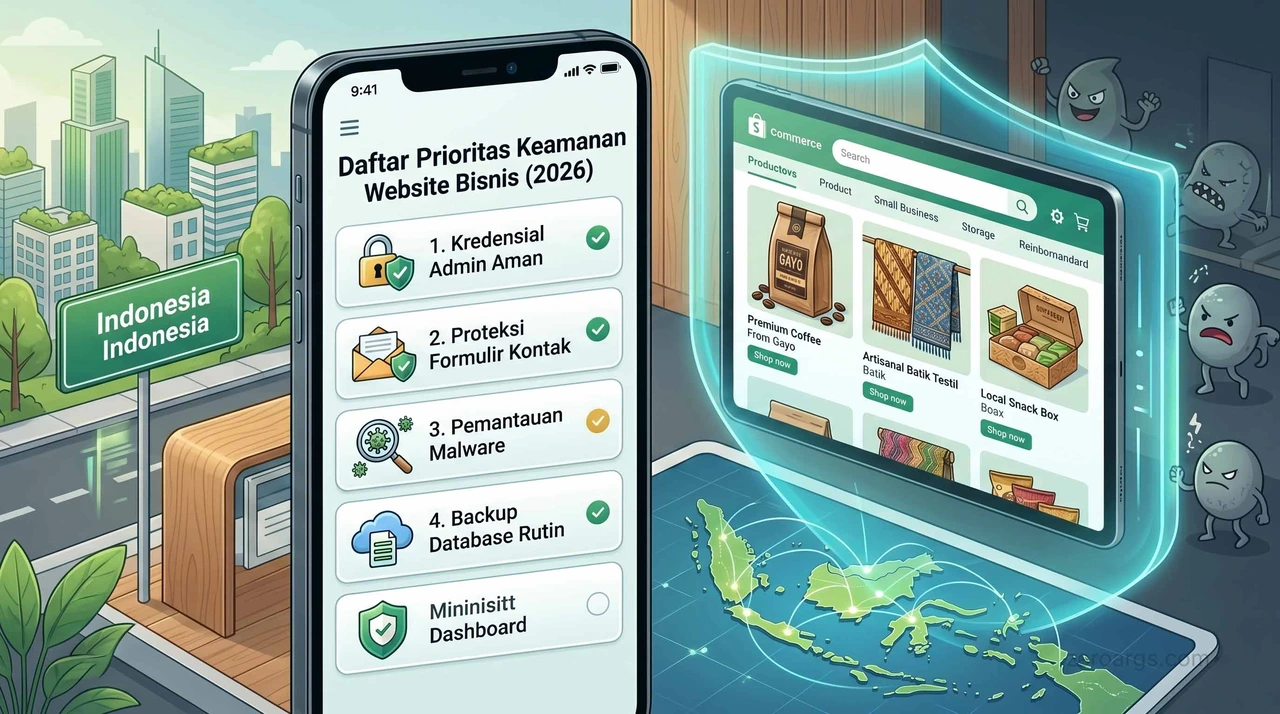
A website security checklist for Indonesian businesses is no longer a topic reserved for banks or fintech startups. In 2026, online shops, local service brands, and anyone running contact forms or digital payments face the same risks: defaced pages, injected malware, or stolen admin credentials. One customer database leak can erase years of trust built on Instagram or marketplaces.
This article summarizes the technical priorities we apply when launching or maintaining sites for SMBs and small product teams — an order that balances cost, impact, and operational readiness, not an endless list that never gets finished.
1. Why website security is a 2026 priority
Three digital waves collide for small businesses in Indonesia. First, most e-commerce traffic is mobile on connections that are not always stable — your website is often the only asset you fully control, regardless of platform algorithms. Second, payment integrations (QRIS, virtual accounts, e-wallets) and WhatsApp Business expand the attack surface: every webhook, API token, and admin panel is an entry point.
Third, regulatory and customer expectations have risen. Indonesia's Personal Data Protection Law (UU PDP) pushes you to document how data is processed; browsers mark sites without encryption as not secure. Global reporting continues to show rising cyber incidents against small businesses — you do not need precise local statistics to conclude that delaying security until you are “big enough” is an expensive bet.
2. HTTPS and SSL: the foundation you cannot postpone
SSL/TLS certificates encrypt traffic between visitors' browsers and your server. Without HTTPS, login passwords, form submissions, and session cookies can be read on public Wi-Fi. Google also treats HTTPS as a baseline trust signal.
Practical steps:
- Enable a valid certificate (free Let's Encrypt or commercial validation if you need organization-level assurance).
- Enforce HTTP → HTTPS redirects across the domain, including
wwwsubdomains. - Fix mixed content: images or scripts still loaded over
http://break the padlock indicator. - Set basic security headers such as HSTS once you are sure no legacy assets depend on plain HTTP.
SSL is not an “SEO checkbox.” It is the minimum bar before you promote checkout or customer login.
3. Backups and recovery: plan for when, not if
Ransomware, a bad deploy, or an operator deleting the wrong table does not care about company size. The 3-2-1 strategy still applies: three copies of data, two media types, one copy offsite (another cloud region or separate storage).
For dynamic sites (CMS, custom e-commerce):
- Schedule backups of database plus uploads, not theme files alone.
- Test restores at least monthly — backups that are never restored often fail in a crisis.
- Separate backup credentials from production; a compromised admin should not instantly wipe every copy.
If you are still building digital foundations, the investment order in our digital transformation guide for Indonesian MSMEs usually puts catalog and payments first — but backups should follow as soon as the first customer record lands.
4. Strong authentication: passwords, MFA, and admin access
Brute force and credential stuffing (reusing leaked passwords from other sites) remain the cheapest attack paths. For WordPress admin, custom dashboards, or hosting panels:
- Require long, unique passwords; store them in a team password manager.
- Enable MFA/2FA on all admin accounts, domain email, DNS, and cloud consoles.
- Limit login attempts and consider CAPTCHA after repeated failures.
- Use per-person admin accounts; avoid one shared
adminuser.
Remove former staff accounts and rotate API keys when projects end. MFA adds slight friction but stops most account takeovers we see in the field.
5. Securing forms, payments, and third-party integrations
Every integration extends your attack surface:
- Contact forms and CRM: server-side validation, rate limiting, and sanitization to prevent stored XSS.
- Payment gateways (Midtrans, Xendit, Doku): verify webhook signatures; never trust payloads without cryptographic validation.
- WhatsApp or transactional email: treat tokens like production secrets; never commit them to public repositories.
Store only what you need. If payment is fully handled by a third party, document what remains on your server — this aligns with our UU PDP practical guide for web apps and limits blast radius if one system is breached.
6. Updates, patches, and application hardening
Most incidents at SMB scale are not Hollywood zero-days; they are unpatched plugins or dependencies. Routine discipline:
- Enable security updates automatically where your stack allows (with staging first).
- Remove unused plugins and themes; every extension is code to audit.
- For custom apps: watch framework advisories (Laravel, Next.js, etc.) and schedule
npm audit/composer auditeach sprint. - Disable directory listing, debug mode, and default admin endpoints in production.
- Add WAF or edge rate limiting (Cloudflare, cloud load balancers) when traffic or risk profile warrants it.
Hosting near users — for example GCP asia-southeast2 (Jakarta) — helps latency, but security still depends on your configuration, not server geography alone.
7. Monitoring, logs, and a simple incident response
You do not need a 24/7 SOC on day one, but you do need early signals:
- Uptime and SSL expiry notifications.
- Admin access and DNS change logs.
- Alerts for repeated failed logins or anomalous traffic spikes.
Draft a one-page response playbook: who can take the site offline, how to force password resets, when to notify customers, and when to bring in forensic help. Limited transparency beats silence when customer data is clearly exposed.
8. Priority table: quick wins vs next investments
Use this table to align founders, marketing, and engineering — especially if you are still asking why Indonesian SMBs need their own website beyond marketplaces.
| Priority | Action | Effort | Impact |
|---|---|---|---|
| P0 (this week) | Full HTTPS + redirects | Low | High |
| P0 | MFA on admin and email | Low | High |
| P0 | Automated backups + restore test | Medium | Very high |
| P1 (this month) | Patch/plugins and remove unused code | Medium | High |
| P1 | Rate limit login and forms | Medium | Medium–high |
| P2 (quarter) | WAF, advanced headers, dependency audit | Medium–high | High |
| P2 | Data-flow documentation + privacy policy aligned with UU PDP | Medium | High (compliance and trust) |
Security is not a one-off project; it follows every new feature. Before adding an AI chatbot or analytics dashboard, make sure the P0 row is green.
Conclusion
A website security checklist for Indonesian businesses in 2026 starts with HTTPS, recoverable backups, and MFA on critical access — then moves to application hardening, verified payment integrations, and data operations that respect regulation. You do not need enterprise posture; you need to close the gaps attackers most often exploit at your scale.
If you want a quick review of a site or app you are building, see our portfolio, website development in Nganjuk, and start a conversation — we can help prioritize P0–P2 for your stack and budget.