- umkm
- e-commerce
- mvp
- engineering
AI Store Platforms vs Custom Websites for Indonesian SMEs
AI store website builders vs custom development for Indonesian SMEs: cost, data ownership, QRIS integrations, and when to hire engineers instead of subscribing.
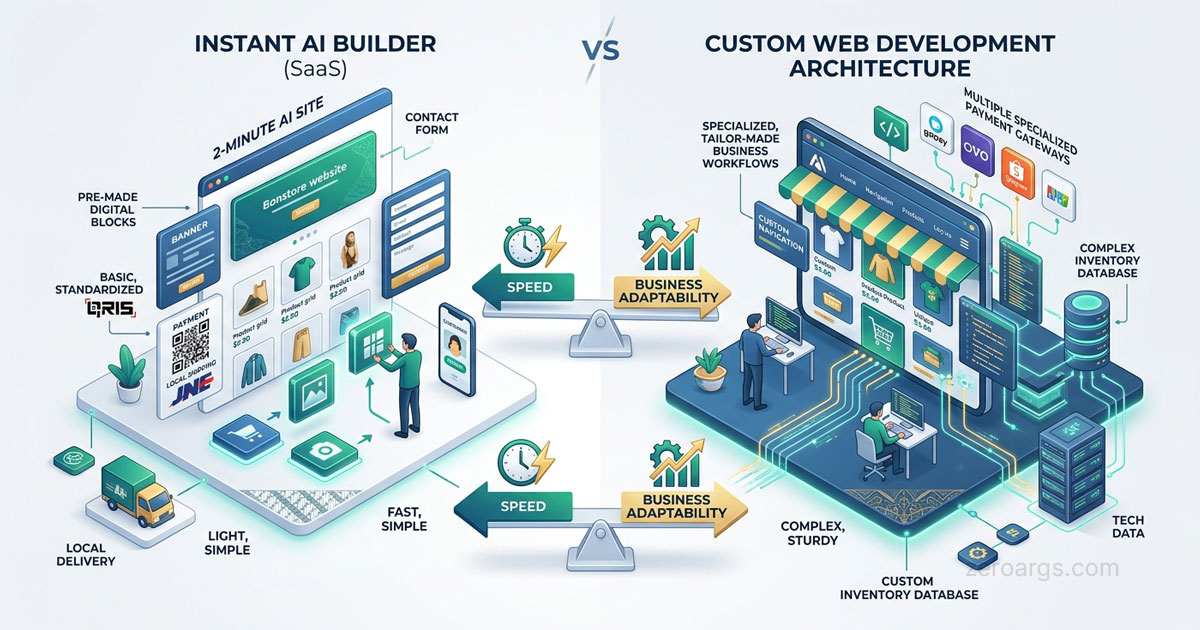
You have probably seen ads for an AI store website builder that launches in minutes — two AI agents wiring shipping and payments, or a subdomain live before lunch. In 2026 that pitch resonates in Indonesia for good reasons: marketplace fees keep climbing, QRIS merchant adoption is accelerating, and programs such as UMKM Go Digital push owners beyond Instagram profiles and Tokopedia listings toward owned channels. The real question is not whether AI is involved, but whether a ready-made SaaS storefront is enough — or whether you need custom website development shaped around how you actually fulfill orders.
This article compares both paths with an engineering lens: what you buy, what you do not own, and when delaying custom work becomes the expensive option.
1. Why AI-powered store platforms dominate SME conversations in 2026
Three forces keep this topic trending:
- Margin pressure on marketplaces — commissions, promos, and ads push sellers toward owned checkout with transparent payment gateway pricing (QRIS, virtual accounts, e-wallets).
- Merchant onboarding — industry signals show surging interest in accepting digital QR payments; owners search for "create QRIS" and a catalog page in the same workflow.
- Speed expectations — platforms promise same-day subdomains, responsive templates, and courier integrations (JNE, SiCepat via aggregators) without hiring developers.
Popular AI store products in 2026 usually blend content or layout generation with ecommerce basics: catalog, cart, WhatsApp alerts, sometimes white-label mobile apps. That is different from vibe coding (you build with AI) and different from internal low-code tools like Retool — here you subscribe to a finished product.
2. What you actually get from each path
AI store website platforms (SaaS) typically provide:
- Hosting, SSL, templates, and an admin panel in one subscription.
- Pre-wired payment and shipping integrations through the vendor to Xendit, Midtrans, or similar — with configuration limits.
- Automatic feature updates; you do not run servers.
What you often do not fully own:
- Source code and architectural freedom (fork, deploy on your own cloud).
- Order data models that export cleanly into ERP, POS, or custom BI.
- Full control over technical SEO, edge-case performance, or checkout flows the template does not support.
Custom development typically provides:
- A written scope per feature: pages, integrations, admin roles, webhooks.
- Ownership of repositories, domains, and (when agreed) infrastructure near users — for example GCP asia-southeast2 or AWS ap-southeast-3.
- Room to align with regulation (Indonesia's Personal Data Protection Law (UU PDP), Government Regulation 33/2026 operational rules) and bespoke integrations (POS, marketplace APIs, SIAPIK-ready exports).
The trade-off is longer build time and higher upfront cost. For tiered budgeting, see our website development cost guide for Indonesian businesses (2026).
3. Comparison table: AI platform vs custom storefront
| Dimension | AI store platform | Custom build |
|---|---|---|
| Time to go-live | Hours–days | Weeks–months |
| Upfront cost | Low (often free trial) | Medium–high |
| Monthly cost | Subscription + % per order | Hosting + maintenance |
| UI customization | Templates + AI prompts | Unique design system |
| Deep integrations | Vendor menu only | APIs, webhooks, legacy |
| SEO and speed | Fine for small catalogs | Tuned to your traffic |
| Data ownership | Tied to vendor ecosystem | First-party database |
| Vendor price or shutdown risk | Present | Lower if you hold code |
This is not a winner-take-all scorecard. Many SMEs run profitably on SaaS for years — until volume or operations force a migration.
4. Business scenarios that fit an AI platform first
An AI store website builder is rational when:
- You have fewer than ~200 active SKUs and stock is manual or on a single marketplace.
- No IT staff; the owner also packs orders and answers chats.
- The 6–12 month goal is margin validation on an owned channel, not building a tech product.
- Standard checkout (QRIS, VA, e-wallets) and aggregator shipping are enough.
- The brand can live on a vendor subdomain temporarily, with a plan for your own domain.
Typical examples: home bakeries, small fashion labels, or service businesses with tight catalogs that already sell on TikTok Shop and need an official page for repeat orders — aligned with our owned-channel strategy for marketplaces and websites.
5. Signals it is time for custom or hybrid architecture
Move (or start custom) when:
- Omnichannel inventory sync — website, Shopee, Tokopedia, and a physical warehouse must show one number; the platform lacks the webhooks you need.
- Non-standard order workflows — split payments, long pre-orders, B2B POs with credit limits.
- Compliance and audits — sensitive customer data, access logs, or partner requirements that need a DPIA; see our PP 33/2026 website compliance checklist.
- Performance and campaigns — traffic spikes (for example before Harbolnas), dynamic landings, or shoppable video flows that templates cannot carry.
- Long-run margin — platform fee + gateway + subscription approaches custom maintenance cost; similar math in our marketplace vs website net margin guide.
A common hybrid: keep marketplaces for discovery, use a custom site for members, repeat orders, and POS integration — see POS and website integration for hybrid retail.
6. Due diligence checklist before you subscribe
Before you bind payment volume to a vendor:
- Domain — can you use your own domain fully (DNS), not only a redirect?
- Data export — CSV for products, customers, orders; backup frequency.
- Processing agreement — who is controller versus processor under UU PDP; server region.
- Fee stack — subscription, platform fee, gateway fee, shipping API charges; compare with our payment gateway integration guide.
- Exit plan — what you lose if you cancel (URLs, reviews, SEO history).
- Security — admin 2FA, staff roles, price change logs.
- Support — SLA when checkout fails at peak hours.
If export and own-domain answers are "no" or "later", treat that as business risk, not a minor technical detail.
7. Getting the most from an AI platform without locking your future
Even on SaaS, you can lower migration cost:
- Turn on your brand domain early; keep name consistency on Google Business Profile and Instagram bios.
- Publish a privacy notice and checkout consent aligned with PDP practice — even for small stores.
- Maintain a master catalog in a spreadsheet or simple PIM; do not rely only on the vendor dashboard.
- Point paid campaigns at pages you control, not only social profiles.
- After expanded zero MDR QRIS rules for certain transactions, make sure your site captures that channel — not only a static QR at the counter; see our October 2026 QRIS MDR guide.
When volume grows, plan phase two: order webhooks into internal systems or a rebuild on a modern stack with deliberate 301 redirects so SEO does not reset.
8. Quick decision frame: platform, custom, or blended
Answer three questions:
- Is the website your core product (startup, franchise platform, B2B portal) or a sales channel for physical goods or services?
- How many hours per week can the team spend on digital ops without burning out?
- Within 18 months, will you need integrations the platform does not list?
If (1) is a sales channel, (2) is low, and (3) is not yet — start on an AI platform with data discipline. If (1) is the product or (3) is yes — discuss custom earlier; see also when to choose low-code vs custom development.
Conclusion
An AI store website builder is a sensible market response for many Indonesian SMEs in 2026: fast, cheap to start, and already wired into digital payments. Custom website development still wins when checkout and data become competitive advantages — not just an online brochure. Decide based on data ownership, integrations, and an 12–18 month horizon, not the flashiest demo.
If you want a second opinion on whether your current platform is nearing its limits, or you want a custom store with QRIS and omnichannel hooks from day one, start a conversation. We help SMEs in Nganjuk, East Java, and across Indonesia build digital channels that can grow without replacing the foundation every year.
Frequently asked questions
Is an AI store website builder enough for an Indonesian SME?
For a small catalog, standard QRIS checkout, and no in-house IT, an AI-powered SaaS store is often enough for the first 6–12 months. When you need multi-marketplace stock sync, custom workflows, or strict data compliance, custom or hybrid builds are usually safer.
How does AI platform pricing compare to custom website development?
AI platforms often start free or at a few hundred thousand rupiah per month plus transaction fees. Serious custom storefronts commonly range from IDR 15–80 million upfront plus maintenance. SaaS is cheaper to start; custom is more predictable as scale and integrations grow.
Is customer data on an AI store platform compliant with Indonesia's PDP law?
You remain the data controller when the platform processes orders on your behalf. You still need a clear privacy notice, a processing agreement with the vendor, and procedures when customers request deletion or export.
Can we migrate from an AI platform to a custom site later?
Yes, but product URLs, catalog history, and order data need a planned migration. Use your own domain early, back up catalog exports regularly, and avoid features that lock records only inside the vendor dashboard.