- umkm
- engineering
- e-commerce
- mvp
WhatsApp Flows and Website Integration for Indonesian SMEs
Guide to WhatsApp Flows website integration for Indonesian SMEs: webhook architecture, Meta message costs, SKU sync, and Flows vs chatbot vs web checkout.
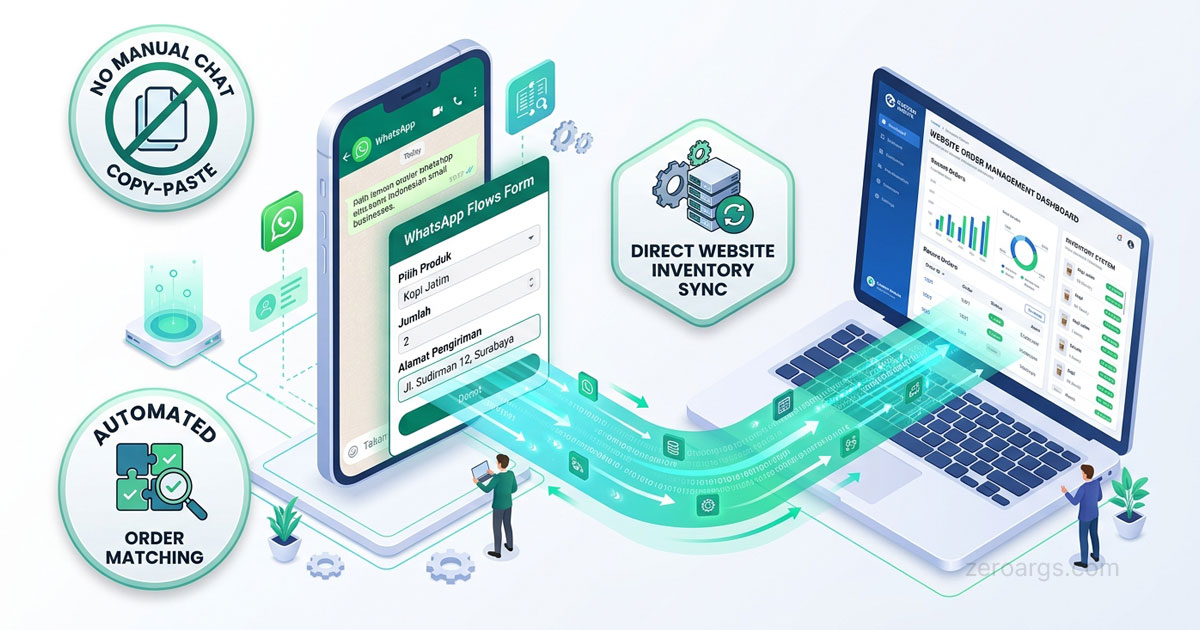
WhatsApp Flows and website integration is a practical answer for Indonesian SMEs drowning in unstructured chat: customers retype addresses, staff misread SKUs, and transfer screenshots never match an order ID. In 2026, Meta is pushing structured in-chat experiences—order forms, reservations, lead capture—without forcing users to open a browser. The missing piece for most businesses is wiring Flow completions into the same system that powers their website, not another spreadsheet tab.
This guide covers Flow → webhook → order database architecture, when Flows beat AI chatbots, and how to budget the two-layer cost model (BSP platform fees plus Meta per-message pricing) before you scale broadcasts.
1. Why Flows Matter for Indonesian Operations in 2026
Several signals make Flows an operational topic, not just a marketing gimmick:
- WhatsApp remains the primary sales channel for many SMEs handling 50–200 chats per day; repetitive questions consume time better spent on fulfillment.
- Meta optimizes in-chat conversion — ad campaigns can open a Flow directly, reducing drop-off from long URLs typed on mobile.
- “Go productive” digitalization — Indonesian policy discourse increasingly stresses efficiency beyond “go online.” Structured forms create the data you need for stock and cash discipline.
- 24-hour service windows — customers complete forms anytime; your team processes batches from a dashboard instead of replying one-by-one at night.
Flows do not replace your website. They close the chat conversion gap while the site remains the source of truth for full catalogs, SEO, and checkout with QRIS or bank virtual accounts.
2. Flows, AI Chatbots, and Web Checkout: When to Use What
A common mistake is buying an expensive AI chatbot for a job that needs three fixed fields.
| Need | Best fit | Why |
|---|---|---|
| Product FAQs, return policy, open-ended advice | AI chatbot + knowledge base | Unpredictable intent; natural language helps |
| 5–8 field orders, slot booking, surveys | WhatsApp Flows | Structured data; Meta-hosted validation |
| Large carts, complex discounts, accounts | Website checkout | Rich catalog UX and payment gateways |
| Status and tracking after payment | Utility API messages + /orders/[id] on web | Customers can self-serve without chat |
A hybrid pattern we often ship for SMEs in East Java (including Nganjuk and nearby cities): Flows for entry intent (quick order, booking), the website for payment and records, one webhook layer for inventory.
If you are already evaluating chat automation, see our AI WhatsApp customer service chatbot guide—Flows and AI complement each other rather than compete.
3. Minimum Architecture: Flow → Webhook → Website
Assume your site has a backend (Next.js API routes, Laravel, or serverless in Jakarta region). The minimum path:
- The customer completes a Flow in WhatsApp.
- Meta posts to
POST /api/webhooks/whatsappwith a JSON body. - Your backend verifies the signature, maps flow fields to an internal order schema.
- The system writes to the database, decrements stock (or flags pre-order), sends a utility confirmation.
- Optional: link to
https://yourstore.com/en/checkout?order=ABC123for QRIS payment via Midtrans or Xendit.
A compact order schema shared by Flows and the website:
order:
  id: "ORD-2026-1042"
  channel: "whatsapp_flows"
  customer:
    name: "Dewi"
    phone: "+6281234567890"
  lines:
    - sku: "KOPI-250G"
      qty: 2
      unit_price_idr: 45000
  fulfillment:
    address: "Jl. Merdeka No. 12, Nganjuk"
    courier: "JNE REG"
  payment_status: "pending"
  created_at: "2026-10-07T08:15:00+07:00"
Webhook handlers must be idempotent: Meta may retry the same event. Store message_id or a flow token as a unique key before creating a new order.
4. Designing Flows That Customers Actually Finish
Flow UX drives conversion more than backend choice.
- Limit fields — under eight steps for typical SME orders; combine city and district when possible.
- Prefill from catalog — show three to five bestsellers, not two hundred variants; send the rest to the website.
- Validate in-flow — Indonesian phone formats, minimum order value, serviceable delivery areas.
- Consistent copy — match labels on the website (“Shipping fee” vs “Delivery cost”) so support staff stay aligned.
- Human escalation — a “Talk to admin” path for edge cases; do not force everything through the form.
For peak events like Harbolnas, run a separate flow with a constrained SKU list and stock synced from the website—not manual Meta Manager edits at midnight.
5. Two-Layer Pricing: BSP and Meta Message Categories
Flows require the WhatsApp Business Platform. Real SME costs usually include:
- BSP subscription (local providers, or self-managed Cloud API) — often hundreds of thousands to a few million IDR per month depending on seats and features.
- Meta per-message category fees — marketing, utility, authentication, and service replies inside the 24-hour window (typically free for service responses).
Cost-conscious practices:
- Use utility templates for order confirmation and shipping updates, not repeated marketing blasts.
- Open Flows from ads only when you already measure ROAS.
- Model monthly volume before large broadcasts; marketing per-message fees can exceed margin on low-ticket products.
This transparency matters when comparing Flows with web-only checkout—post-payment utility messages from your site are often cheaper than an entire journey through paid marketing chat templates.
6. SKU and Inventory Sync with Your Website
Flows disconnected from web stock are an oversell machine. Decide at minimum:
- Stock source of truth — usually the website database or an omnichannel hub if POS is integrated.
- Refresh strategy — per-transaction webhooks suffice for many SMEs; for flash sales, trim SKUs in the flow via API when stock drops below a threshold.
- Pricing parity — display the same prices as the website; even a small mismatch triggers complaints when customers compare Shopee, Tokopedia, or TikTok Shop listings.
For hybrid retail, patterns in our POS and website integration guide apply: one inventory ledger, many inbound channels including Flows.
7. Compliance and Indonesia's Personal Data Protection Law
Flows collect names, addresses, and phone numbers—all personal data under UU PDP (Indonesia's Personal Data Protection Law). A short checklist:
- State the purpose of collection on the first screen (fulfillment, delivery).
- Do not paste submissions into public spreadsheets or internal WhatsApp groups.
- Retain webhook logs only as long as needed for order audit.
- If you sync to a third-party CRM, document processing agreements clearly.
Webhook security: HTTPS only, verify Meta tokens, rate limit, and avoid logging full production payloads without redaction.
8. Comparison: Free WhatsApp App vs Flows + API vs Full Web Checkout
| Aspect | WhatsApp Business app | Flows + API + webhook | Full website checkout |
|---|---|---|---|
| Upfront cost | IDR 0 | BSP + technical setup | Hosting + payment gateway |
| Structured forms | Limited (catalog) | Strong | Strong (cart) |
| Team inbox | Weak | Strong (via BSP) | N/A (email/tickets) |
| SEO and large catalogs | No | No | Yes |
| Centralized stock | Manual | Yes, with clean webhooks | Yes |
| Best for | < 50 chats/day | 50–500 structured orders/day | Large catalogs, repeat buyers |
9. A 30-Day Implementation Roadmap
Week 1: Map the fields your ops team actually needs; choose a BSP; pilot one product category.
Week 2: Deploy a staging webhook; test idempotency and failed-payment paths.
Week 3: Connect to the website database; send utility confirmations; publish an order status page.
Week 4: Measure admin minutes per order, address error rate, and flow completion; decide whether an AI FAQ layer is worth adding.
Conclusion
WhatsApp Flows and website integration turns chat from a data black hole into structured orders in the same system as your owned channel—ready to reconcile with QRIS payments and operational reporting. Start with one simple flow, an idempotent webhook, and stock sync—not with marketing broadcasts you cannot measure.
If you want Flows, webhooks, and checkout wired together without hiring a full internal IT team, start a conversation with us—we help Indonesian SMEs and growing businesses design integrations that match today's scale, not yesterday's spreadsheets.
Frequently asked questions
Can I use WhatsApp Flows without the WhatsApp Business API?
No. Flows are part of the WhatsApp Business Platform and require an API account through an official Meta BSP or Cloud API. The free WhatsApp Business app does not support custom Flows with webhooks to your website.
How are WhatsApp Flows different from an AI chatbot on WhatsApp?
Flows are structured in-chat forms for fields you define. AI chatbots handle free-form questions with language models. They work well together: Flows for orders or bookings, AI for FAQs after structured data is captured.
How does Flow submission data reach my website or order system?
When a customer completes a flow, Meta sends a JSON payload to your webhook endpoint. Your backend verifies the signature, persists the order, then sends a utility confirmation message or a payment link on your site.
Which Meta message categories matter most with Flows?
Utility messages for order confirmation and shipping updates are usually cheaper than marketing. Replies within the 24-hour service window are typically free. Ads that open a Flow often use paid marketing templates.