- e-commerce
- engineering
- umkm
- mvp
QRIS Zero MDR October 2026: Website Guide for Indonesian SMEs
QRIS zero MDR takes effect October 1, 2026. A technical guide for Indonesian SMEs: merchant category rates, website integration, webhooks, and financial reconciliation.
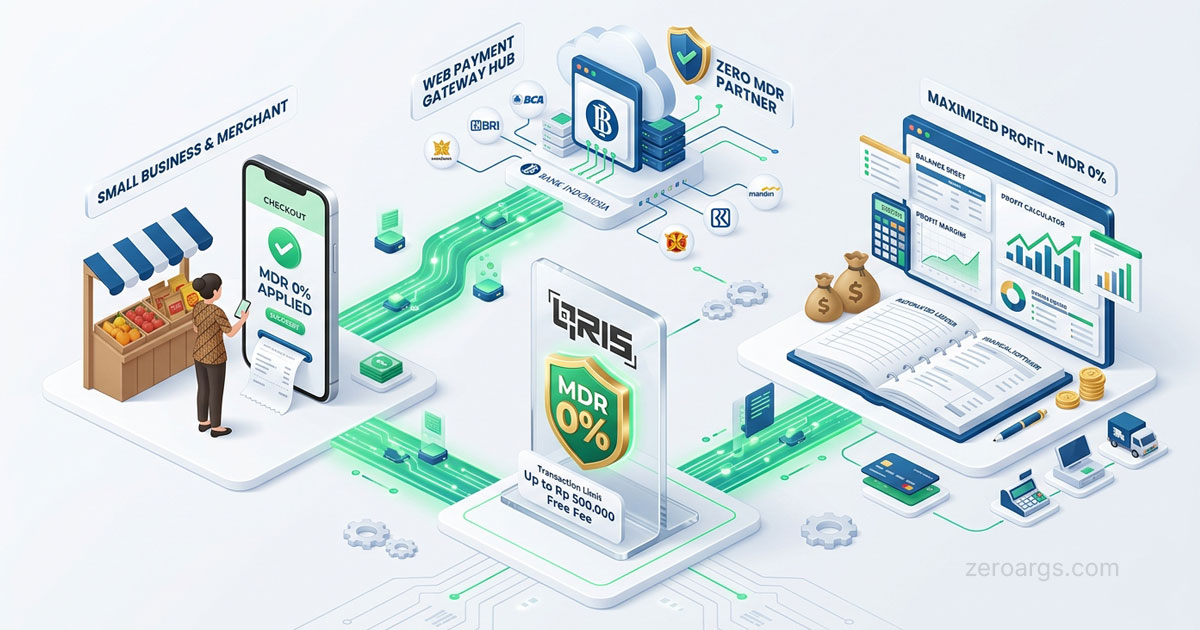
QRIS zero MDR starting October 1, 2026 changes the margin math for millions of merchants across Indonesia — but the full benefit only reaches businesses with clean digital payment flows, not just a QR poster taped near the register. Bank Indonesia expanded this policy so small, medium, and large merchants now receive fee-free transactions up to IDR 100,000, while micro merchants keep their IDR 500,000 threshold. For SMEs in East Java (including Nganjuk) and nationwide that sell through owned websites, this is the moment to audit payment gateway integration, webhooks, and financial records before the effective date.
1. What the QRIS Zero MDR October 2026 Policy Means
Merchant Discount Rate (MDR) is the service fee charged by Payment Service Providers (PSPs) — banks or fintechs — to merchants for each processed QRIS transaction. MDR is deducted from the gross amount before funds reach your account.
On August 17, 2026, Bank Indonesia launched the expanded QRIS zero MDR policy, effective October 1, 2026. Key points:
- Micro merchants (UMi): Zero MDR on transactions up to IDR 500,000 (existing rule retained).
- Small, medium, and large merchants (UKE/UME/UBE): Zero MDR on transactions up to IDR 100,000 — previously this category paid roughly 0.7% MDR on all amounts.
- Transactions above the nominal threshold still incur MDR based on category.
As of June 2026, QRIS had 65.77 million users and 44.86 million merchants — 96.68% of them SMEs. The new policy aims to expand cost efficiency while accelerating broader digital payment adoption.
2. MDR Rate Table by Merchant Category
Understand the nominal thresholds before optimizing your website checkout. These rates apply from October 1, 2026:
| Merchant category | Zero MDR transactions | Above threshold |
|---|---|---|
| Micro (UMi) | Up to IDR 500,000 | 0.3% MDR |
| Small (UKE) | Up to IDR 100,000 | 0.7% MDR |
| Medium (UME) | Up to IDR 100,000 | 0.7% MDR |
| Large (UBE) | Up to IDR 100,000 | 0.7% MDR |
Bank Indonesia also sets permanent zero MDR for specific transaction types: public service agencies (BLU), Government to Person (G2P), Person to Government (P2G) such as taxes and passports, and social or nonprofit donations.
Practical implication for online stores: if you are registered as UKE and sell a IDR 150,000 product, only the first IDR 100,000 is MDR-free — the remaining IDR 50,000 incurs 0.7%. Cart design and bundling strategy should account for this threshold.
3. Why Your Business Website Needs Preparation Now
The MDR policy is not BI news you can ignore. Two weeks before October 1, 2026 is the right window for a technical audit, because rate changes directly affect per-transaction margins on your website — especially when most orders fall in the IDR 50,000–200,000 range.
Three reasons owned-channel websites are more MDR-sensitive than marketplaces:
- You bear MDR directly — on marketplaces, platform commission hides inside fee structures. On your own site, MDR appears clearly in PSP settlement reports.
- Per-transaction amounts are optimizable — with dynamic QRIS, you control how large each generated QR is per order, not a single static QR without context.
- Transaction data becomes a financing asset — automatic reconciliation from webhooks supports digital bookkeeping for Indonesian SMEs and SIAPIK integration emphasized by BI at KKI 2026.
If your website lacks integrated checkout, start with payment gateway integration for Indonesian business websites — the same foundation applies to capturing the new MDR benefit.
4. Dynamic vs Static QRIS Architecture on Websites
Not all QRIS on websites works the same way. Choose architecture based on volume and reconciliation needs:
Static QRIS (MPM static):
- One permanent QR code; customers enter the amount manually in their banking app.
- Fits low volume or WhatsApp-led orders with manual confirmation.
- Risks: wrong amount entry, hard to reconcile automatically, no tied
order_id.
Dynamic QRIS (MPM dynamic):
- Backend generates a QR per transaction with a fixed amount — one QR, one payment.
- Required for website checkout with catalogs and limited stock.
- PSPs like Midtrans, Xendit, or Doku provide generate-QR APIs plus notification webhooks.
Minimal dynamic QRIS flow on a website:
Customer checks out → Backend creates order (pending)
Backend → PSP API: generate dynamic QRIS (amount = order total)
Frontend displays QR → Customer scans & pays
PSP → POST settlement webhook → Backend updates status → decrement stock
For fixed-price products under IDR 100,000 (e.g., chips at IDR 25,000), dynamic QRIS on a landing page speeds conversion — a pattern we cover in smart packaging QR code guide for Indonesian SMEs.
5. Payment Gateway Integration Checklist Before October 1
Use this checklist to ensure your website is ready for QRIS zero MDR:
- Verify merchant category — check your PSP dashboard whether you are registered as UMi, UKE, UME, or UBE. Category determines the zero MDR threshold.
- Confirm effective rates on October 1 — contact your PSP account manager or check official announcements; some aggregators may need sync time.
- Test dynamic QRIS in sandbox — create transactions at IDR 99,000, IDR 100,000, and IDR 101,000; compare MDR deducted after settlement.
- Webhooks active and verified —
settlementstatus must update your database automatically, not wait for manual bank checks. - Webhook idempotency — duplicate calls must not double-allocate stock or WhatsApp notifications.
- Show final total at checkout — MDR cannot be passed to buyers; displayed price must match the QR amount.
- Log every transaction — store
order_id, gross amount, MDR deducted, net settlement, and timestamp for weekly audits.
If you still use static QRIS with manual confirmation, consider phased migration: start with bestseller products at fixed prices, then expand to full checkout.
6. Reconciliation and Impact on SIAPIK and Financing
Bank Indonesia is not only pushing QRIS adoption — the e-financing strategy through SIAPIK requires digital transactions that are recorded, visible, and measurable. BI Deputy Governor Aida S. Budiman emphasized payment digitalization as the foundation for financing access: SME credit grew 1.62% YoY in July 2026, far below overall banking credit growth of 13.58%.
Weekly reconciliation we apply for SME clients:
| Field | Source | Purpose |
|---|---|---|
order_id | Website database | Order matching |
gross_amount | PSP webhook | Gross revenue |
mdr_fee | PSP settlement report | Operating cost |
net_settlement | Bank account | Actual cash in |
payment_method | Webhook (qris) | Channel segmentation |
This data can feed SIAPIK to strengthen financial reports banks trust — see our SIAPIK digital financial data integration guide. Sync your Sapa UMKM profile so you are ready when the KUR door opens.
7. Common E-Commerce Mistakes When MDR Policy Changes
From building checkout for Indonesian businesses, these five mistakes appear most often:
- Assuming all transactions are free — zero MDR has nominal limits. A IDR 300,000 order as UKE still incurs 0.7% MDR on IDR 200,000 above the threshold.
- Not updating merchant category — businesses that graduated from UMi to UKE lose the IDR 500,000 limit if unnoticed.
- Passing fees to customers — violates BI rules and erodes checkout trust.
- Relying on "Thank you" pages without webhooks — payment status unconfirmed, stock not decremented, data never reaches SIAPIK.
- Ignoring website vs marketplace margin comparison — after MDR drops, owned channels become more competitive; dual-channel strategy needs recalculation.
8. Comparison: Marketplace vs Owned Website After Zero MDR
After October 1, 2026, recalculate per-transaction costs for channel decisions:
| Aspect | Marketplace (Shopee/Tokopedia/TikTok) | Website + dynamic QRIS |
|---|---|---|
| Transaction cost | 5–15%+ commission + other fees | 0% MDR (below threshold) + gateway fee |
| QR amount control | Platform generates | You control per order |
| Customer data | Limited (platform) | First-party (email, WA, address) |
| Auto reconciliation | Manual export / limited API | Webhook directly to database |
| Margin on <IDR 100k orders | Commission still applies | 0% MDR for UKE/UME/UBE |
| Margin on IDR 200k orders | Commission + promo pressure | 0.7% MDR on remainder (UKE) |
For entry-level products under IDR 100,000, owned websites become more attractive on margin. For virality and traffic, marketplaces remain relevant — see our owned-channel strategy for Indonesian SMEs.
Conclusion
QRIS zero MDR in October 2026 is a real cost-efficiency opportunity — but only for businesses with correct digital payment infrastructure. Verify your merchant category, migrate to dynamic QRIS on your website, activate webhooks with automatic reconciliation, and connect transaction data to SIAPIK and Sapa UMKM. Two weeks before the effective date is enough for audit and sandbox testing if you start now.
If you need help integrating dynamic QRIS, webhooks, and checkout flows ready for the new policy, start a conversation with us — we help SMEs and businesses in Nganjuk and across Indonesia build websites that do not just accept payments, but produce financial data banks trust.
Frequently asked questions
When does QRIS zero MDR take effect?
Bank Indonesia's expanded QRIS zero MDR policy takes effect on October 1, 2026. Micro merchants (UMi) receive zero MDR on transactions up to IDR 500,000, while small, medium, and large merchants (UKE/UME/UBE) receive zero MDR on transactions up to IDR 100,000.
Does QRIS zero MDR apply to all transactions?
No. Zero MDR only applies below the nominal threshold for your merchant category. Transactions above the limit are charged 0.3% (UMi) or 0.7% (UKE/UME/UBE). Certain transaction types such as BLU, G2P, P2G, and donations remain at zero MDR permanently.
How do I ensure my website gets the correct MDR rate?
Verify your merchant category with your payment service provider, use dynamic QRIS with per-order amounts, and reconcile settlements weekly. Compare gross amount, MDR deducted, and net settlement in your PSP dashboard.
Can MDR be passed on to customers?
No. Bank Indonesia states MDR is the merchant's responsibility and must not be charged to consumers or buyers. Prices on your website must be final with no additional fees at checkout.
How does QRIS MDR relate to SME financing access?
Well-recorded QRIS transactions become financial data you can enter into SIAPIK and your Sapa UMKM profile. Automatic reconciliation from payment gateway webhooks strengthens bank financing and KUR eligibility.