- engineering
- mvp
- startup
- umkm
When to Choose Low-Code vs Custom Development
Low-code vs custom development for Indonesian businesses: when each approach fits, hybrid strategies, vendor lock-in risks, and a practical decision framework for SMBs and startups.
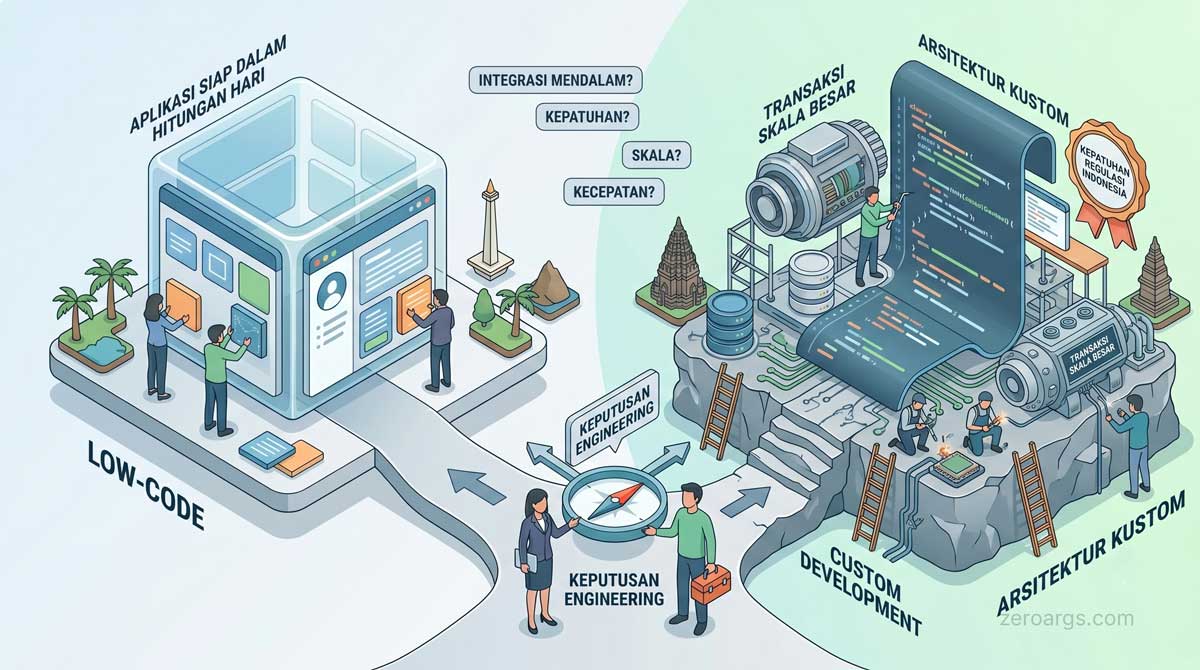
Low-code vs custom development comes up in almost every product conversation we have with business owners and startup founders in Indonesia. On one side, low-code platforms promise working apps in days without a full engineering team. On the other, many products that start fast on visual builders hit a wall when they need deep integrations, regulatory compliance, or transaction volume that grows faster than the platform allows.
This is not a debate about which approach is universally better. It is an engineering-minded decision guide to help you pick the right path — including when a hybrid of both makes the most sense.
1. What Low-Code, No-Code, and Custom Development Actually Mean
Before comparing options, align on terms that often get mixed together:
- No-code: build applications through a visual interface without writing code. Best for simple workflows, internal forms, or basic automation. Examples: Bubble for web apps, Glide for spreadsheet-backed tools.
- Low-code: visual builders plus the ability to write code for custom logic, API integrations, and extensions. Examples: Retool for internal dashboards, FlutterFlow for mobile, Mekari Officeless for enterprise apps with local compliance.
- Custom development (pro-code): applications built from scratch with a team-chosen stack — for example Next.js, PostgreSQL, and cloud services in the Jakarta region. Full flexibility, but typically higher upfront time and cost.
The real difference is not just "code or no code." It is who controls the architecture, how painful migration would be, and how far integrations can go with your existing business systems.
2. Signals That Low-Code or No-Code Is Enough
Several situations where a visual platform is usually the rational choice:
- Internal tools that do not face customers directly — a simple stock dashboard, approval forms, or operational task tracking.
- Fast idea validation before committing full engineering. If you are not sure whether feature X matters to the market, a no-code prototype can save months of work.
- Teams without dedicated developers who need to own their workflows — for example HR building an internal leave system.
- Very tight deadlines with limited scope and a controlled internal user base.
For small businesses just starting digital operations, this approach often makes sense on the operational layer — especially when your main focus is still daily sales, not building a technology product. Our guide to digital transformation for Indonesian MSMEs covers those priorities in more detail.
3. Signals That You Need Custom Development
We see a recurring pattern: businesses start on a low-code platform, then come to us when one of these limits is reached.
- Core revenue product — your own marketplace, subscription service app, or B2B platform that is your competitive edge. This is where custom code usually pays off.
- Deep integration with existing systems — internal ERP, specialized POS hardware, or IoT devices without standard APIs. Visual platforms rarely handle these edge cases cleanly.
- Strict compliance requirements — fintech, healthcare, or apps processing sensitive personal data under Indonesia's Personal Data Protection Law (UU PDP). You need full control over encryption, audit logs, and data residency.
- Scale and performance — thousands of transactions per hour, real-time inventory sync across channels, or complex job queues. Custom architecture allows optimizations that boxed platforms cannot offer.
- Branded experience — mobile apps with distinctive UX, offline mode, or native features unsupported by visual builders.
If the workflow is "how you make money" — not just back-office administration — custom development is usually worth considering from the start, or at least planning as the next phase.
4. The Hybrid Approach: What Most Teams Actually Need
In practice, the healthiest decision is rarely all-or-nothing. Hybrid patterns we apply often look like this:
| Layer | Typical approach | Example |
|---|---|---|
| Internal tools & ops | Low-code / no-code | Approval dashboard, weekly reports |
| Website & sales channels | Custom or headless CMS | Online store with QRIS integration |
| Core product & business logic | Custom development | Pricing engine, matching, or scoring |
| Payments & logistics | Custom SDK/API layer on providers | Midtrans, Xendit, JNE, SiCepat |
For example, a mid-sized food business might build a custom ordering and inventory system while using Retool for an operational dashboard that non-technical staff can adjust. Or a fintech startup uses low-code for an internal admin portal, but builds core banking logic in full code.
The key to hybrid is restricting low-code to layers you can replace without breaking the product foundation.
5. Hidden Risks: Vendor Lock-In, Security, and Scale
Low-code platforms trade speed for trade-offs that rarely appear in large print on pricing pages:
- Vendor lock-in: apps built on one platform are hard to migrate. Business logic lives in a proprietary format. When pricing rises or a required feature never ships, your options shrink.
- Long-term subscription cost: low upfront cost, but per-seat pricing can exceed custom build cost within 2–3 years for growing teams.
- Customization ceilings: integrating Tokopedia, Shopee, or TikTok Shop often requires webhooks, retry logic, and SKU mapping that most visual builders cannot handle reliably.
- Security and data residency: for Indonesian businesses, "where is data stored?" and "who can access it?" must be answered before go-live. Global platforms do not always offer Jakarta region hosting (
asia-southeast2) or the audit controls you need.
If website security is already on your radar, our website security checklist for Indonesian businesses is a useful companion before deciding where operational data will live.
6. Local Ecosystem Factors in Indonesia
Build-vs-buy decisions in Indonesia cannot ignore tools the market already uses:
- Payments: QRIS, virtual accounts (BCA, BRI, Mandiri), e-wallets (GoPay, OVO, DANA), Midtrans, Xendit.
- Marketplaces & social commerce: Tokopedia, Shopee, TikTok Shop, WhatsApp Business catalog.
- Logistics: JNE, J&T, SiCepat, GoSend.
- Regulation: business registration (NIB) through OSS, BPOM/BPJPH certification for F&B, and personal data protection obligations.
Global low-code platforms often lack ready-made connectors for this combination. Custom development — or local low-code such as Mekari Officeless that understands Indonesian context — can integrate faster with real operational stacks.
For the payments layer specifically, our payment gateway integration guide explains the technical patterns you need regardless of build approach.
7. A Practical Decision Framework
Use this table as a starting filter — not rigid rules, but a quick check before spending budget in the wrong direction:
| Question | "Yes" → lean low-code | "Yes" → lean custom |
|---|---|---|
| Is this a product sold to external customers? | No (internal tool) | Yes |
| Do you need integration with 3+ third-party systems? | No | Yes |
| Do you process sensitive data (financial/health)? | No | Yes |
| Do you need to go live in under 2 weeks? | Yes | No |
| Does your team have developers who can maintain code? | No | Yes |
| Are you planning 10,000+ users/transactions per month within 12 months? | No | Yes |
If the results split, start with low-code for validation, but design migration boundaries from day one: structured data export, documented business flows, and a list of integrations that will eventually need to be rebuilt.
8. From Fast MVP to a Long-Term Product
A realistic roadmap for many businesses in Indonesia:
- Phase 0 — Validation (2–4 weeks): no-code prototype or spreadsheet plus simple automation to test whether the problem is real.
- Phase 1 — MVP (4–8 weeks): custom development for one core flow — for example order + payment + WhatsApp notification — with deliberately narrow scope.
- Phase 2 — Operations (ongoing): low-code for internal dashboards that change often; custom code for stable business logic.
- Phase 3 — Scale: refactor bottlenecks; consider omnichannel and inventory sync if you sell across multiple channels.
This aligns with how we help startups choose a tech stack for an MVP: speed early without sacrificing a foundation that becomes expensive to fix later.
Remember that "cheap at the start" can mean "expensive at migration" if you never define when a visual prototype should be replaced with production code.
Conclusion
Low-code vs custom development is not a technology contest — it is a business decision about where you place risk, speed, and control. Low-code wins for internal tools, fast validation, and teams without engineers. Custom development is needed when your product is the differentiator, integrations are complex, or data compliance is non-negotiable.
Most digitally successful businesses in Indonesia do not pick one side forever. They use visual platforms to move fast, then invest custom engineering in the parts that create the most value.
If you are considering an app, website, or operational system and want an objective view of which approach fits your team and budget, we can help you build a phased plan you can actually execute — including custom website development in Nganjuk.