- umkm
- e-commerce
- engineering
Net Margin: Marketplace vs Website for Indonesian SMEs 2026
How to calculate net margin for marketplace vs owned website sales in Indonesia 2026: Shopee and TikTok Shop fees, QRIS costs, and per-SKU data for channel routing.
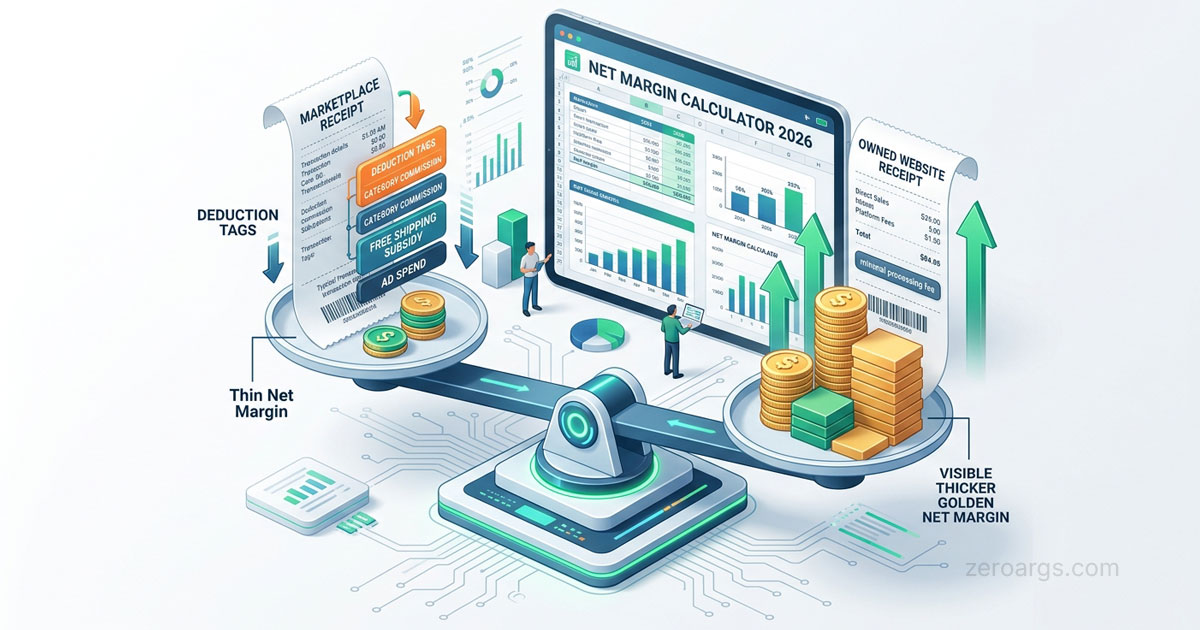
Knowing how to calculate net margin for marketplace vs website sales separates Indonesian SMEs that are merely "online" from businesses that are actually profitable in 2026. Seller Center dashboards show revenue and released earnings, but many owners only see how thin margin really is after category commission, order processing fees, shipping subsidies, and algorithm ads are combined per order. This article gives you the same calculation framework for Shopee, TikTok Shop Tokopedia, and your owned website—not generic benchmarks, but a template you fill with your store's numbers.
If you have already chosen a dual-channel direction, start with our owned channel strategy for Indonesian SMEs. Here we focus on per-order math and simple routing rules: which SKUs stay on marketplaces and which belong on QRIS checkout on your site.
1. Why Revenue Rises but Cash Does Not
Public discussion throughout 2026—including analysis of brands strengthening owned channels while still using marketplaces—highlights one pattern: digital presence ≠ profitability. Common gaps we see when reviewing MSME stores:
- COGS calculated without packaging, labels, and proportional packing labor.
- Ad spend booked as "monthly marketing" instead of attributed to promoted SKUs.
- Comparing only the commission % on help pages, ignoring fixed processing fees and seller-funded free-shipping programs.
- Treating Seller Center earnings as margin, even though not every operating cost is visible there.
Net margin per channel answers: "If I sell this SKU at the same price, where do I keep the most money after all deductions?"
2. Marketplace Cost Components for Your Spreadsheet
Each platform structures fees differently; what matters is that you list every line, not a single commission rate.
Shopee (seller policy summary, 2026)
- Administration fee by category (commonly roughly 2.5%–11.7% depending on sub-category and seller type).
- Order processing fee of Rp1,250 per completed transaction (per platform terms, including VAT treatment as stated).
- Optional programs (Promo XTRA, free-shipping XTRA, Shopee Live XTRA, etc.) that add service fees when you opt in.
- Seller-funded discounts or shipping reduce net earnings even when they are not labeled "commission."
TikTok Shop Tokopedia
- Platform commission by category (non-mall vs mall differ).
- Dynamic commission on discounted selling price by category; from mid-September 2026, the maximum dynamic commission per item was reduced to about Rp60,000—a major change from earlier caps. High-ticket, thin-margin products need a fresh calculation.
- Order processing at Rp1,250 per transaction plus logistics components per active Seller Center rules.
Website + WhatsApp channel
- Payment gateway (Midtrans, Xendit, Doku): typically 2–3% for QRIS or virtual accounts, plus small fixed fees depending on your plan.
- Hosting and domain: allocated per order (monthly fixed cost ÷ estimated website orders).
- Shipping and COD per your policy—not platform fees, but they affect net margin.
Always confirm category-level rates in each platform's official seller education pages; this article is a framework, not a substitute for your product category schedule.
3. Data Model: One Row per SKU per Channel
To repeat the exercise monthly, keep fields consistent. Minimum example:
sku_id: "coffee-250g"
selling_price_idr: 85000
cogs_idr: 42000
packaging_idr: 3500
seller_shipping_subsidy_idr: 0
channel: "shopee"
commission_percent: 9.5
processing_fee_idr: 1250
program_service_fee_idr: 4500
ads_per_order_idr: 8000
payment_gateway_percent: 0
Duplicate the row for channel: website with commission_percent: 0, processing_fee_idr: 0, and payment_gateway_percent: 2.5 (match your gateway contract).
Net margin per unit:
net_margin = selling_price - cogs - packaging - seller_shipping - commission_idr - processing - program_fees - ads_per_order - gateway_fee
Connect these figures with our marketplace algorithm data dashboard guide: CTR and conversion explain volume; net margin explains whether that volume is worth keeping.
4. Three Illustrative Calculations
The numbers below are fictional but realistic for F&B MSMEs—replace them with your data.
Product A — snack at Rp45,000, COGS Rp18,000
| Component | Shopee (with ads) | Website + QRIS |
|---|---|---|
| Selling price | 45,000 | 45,000 |
| COGS + packing | 19,500 | 19,500 |
| ~9% commission + processing | ~5,300 | — |
| Ads per order | 6,000 | 1,500 (traffic to site) |
| Gateway ~2.5% | — | ~1,125 |
| Net margin | ~14,200 | ~22,875 |
Product B — craft item at Rp280,000, COGS Rp120,000
TikTok Shop dynamic commission can approach per-item caps in some categories; after the September 2026 cap update, per-item deductions are more predictable than under very high previous ceilings, but category rates still matter. Compare with website gateway fees around Rp7,000 vs marketplace stacks that can exceed Rp40,000–Rp80,000 including ads.
Product C — entry price Rp25,000
A Rp1,250 processing fee alone is ~5% of selling price. Marketplaces can still make sense for acquisition, but net margin pushes you toward bundles or minimum orders on the website—not loss-leader single SKUs without volume.
5. QRIS Zero MDR from October 2026 and Your Website
Expanded zero MDR QRIS policy effective 1 October 2026 (with nominal caps by merchant category) changes economics for small tickets on owned channels. For orders under applicable thresholds, QRIS costs on your site can drop sharply compared with prior years—widening the margin gap vs marketplaces for low-price SKUs.
Before October: verify merchant category with your gateway, test checkout webhooks, and reconcile weekly so spreadsheet margin matches bank reports. Technical steps are in our QRIS zero MDR October 2026 integration guide.
6. SKU Routing Rules (Without Quitting Marketplaces)
Use net margin results, not gut feel:
- Stay on marketplace — high-converting SKUs with strong reviews and acceptable net margin after ads; or cheap discovery products that need platform traffic.
- Hybrid — first purchase on marketplace; repeat via packaging inserts, QR codes (smart packaging guide), or website member vouchers as in our marketplace-to-website migration funnel.
- Website-first — negative marketplace net margin or below your floor (e.g. under 15% of selling price after all costs); customers already know your brand; bundles that do not fit listing templates.
Do not migrate the entire catalog at once. Move the worst-margin or highest-repeat 20% of SKUs, measure for 30 days, then expand.
7. Common Net Margin Mistakes
- Ignoring ads per order — divide campaign spend by orders from that campaign, not organic orders only.
- Comparing mismatched prices — use the same pricing scenario per channel or document intentional differences.
- Mixed personal and business accounts — without separation, net margin cannot be verified; see digital bookkeeping for Indonesian SMBs.
- Assuming TikTok Shop fees are "just a small %" — on expensive items, dynamic and category commissions stack; always check Earnings Details per order in Seller Center.
8. Decision Table: Marketplace vs Website vs Hybrid
| Business situation | Marketplace | Website | Hybrid (recommended) |
|---|---|---|---|
| New, no traffic yet | Primary | Simple landing | Marketplace + WA catalog |
| Repeat orders >40% | Acquisition only | Main checkout | QR insert + web member |
| Marketplace net margin <10% | Reduce ads on SKU | Focus that SKU | Shift repeat buyers |
| Products >Rp200k, thin margin | Watch dynamic commission | QRIS + VA | Educate via content |
| No developer on team | Spreadsheet + Seller Center | Template + gateway | Phased integration |
Conclusion
Net margin for marketplace vs website starts with one discipline: every order has a different deduction stack per channel. In 2026—with fixed processing fees, updated dynamic commission rules, and more merchant-friendly QRIS MDR on owned checkout—dual-channel choices should be SKU-level math, not "leave marketplace" headlines. Keep marketplaces as discovery engines; use your website for transactions you control.
Zero Args Technology helps SMEs in Nganjuk and across Indonesia ship checkout, payment gateway integration, and simple margin dashboards without over-engineering. Start a conversation if you want this spreadsheet model automated on your website or POS.
Frequently asked questions
What is the difference between gross margin and net margin in online stores?
Gross margin is selling price minus COGS. Net margin subtracts all variable per-order costs: marketplace commission, order processing fees, seller-funded shipping subsidies, ads per transaction, payment gateway fees, packaging, and shipping you absorb.
How do owned-website transaction costs compare to marketplaces?
A website with QRIS or virtual accounts through a payment gateway is typically 2–3% plus a small fixed fee per transaction. Marketplaces often stack category commission, Rp1,250 processing, promo programs, and ads into 15–30% or more per order.
Which SKUs should move to the website first?
Prioritize repeat-order products, SKUs with thin marketplace margin after all deductions, or items above roughly Rp200,000 on TikTok Shop where dynamic commission applies. Keep discovery SKUs on marketplaces for new buyers.
Do I still need a spreadsheet if I use Seller Center?
Seller Center shows net earnings per order but rarely splits ad spend per SKU or compares website channels in one row. One row per SKU per channel makes routing decisions objective.