- umkm
- e-commerce
- engineering
GS1 Barcode Guide for Indonesian SME Products and Websites
GS1 barcode guide for Indonesian SMEs: Kemendag certification, GTIN on your website, marketplace sync, and product data ready for modern retail and TEI 2026.
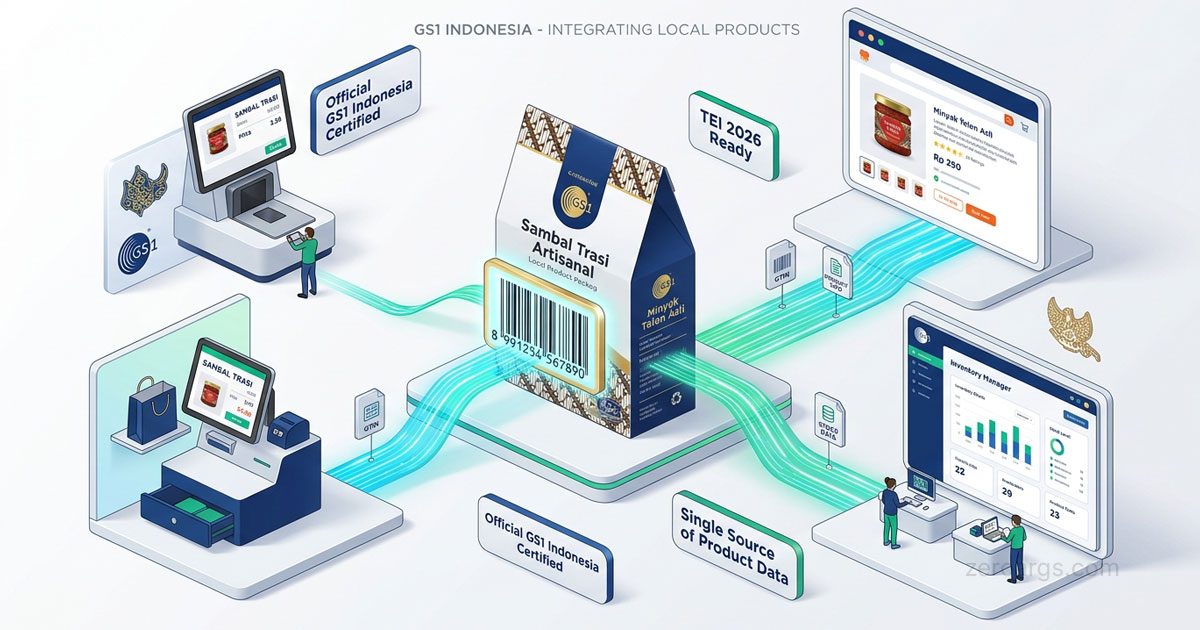
A GS1 barcode and GTIN are no longer vocabulary reserved for large FMCG brands. In early October 2026, Indonesia’s Ministry of Trade and GS1 Indonesia began facilitating barcode certification for packaged food and beauty-care MSMEs so products can enter modern retail more easily—the same week Trade Expo Indonesia (TEI) 2026 opens at ICE BSD. If you sell from Nganjuk, East Java, or anywhere else in Indonesia, the question is not only “how do I get a barcode?” but how that number lives on your website, marketplaces, and packaging without three conflicting versions of the truth.
This guide covers a practical path: barcode versus marketing QR codes, the product master data model we use with MSME clients, wiring GTINs into your website and Tokopedia/Shopee listings, and label compliance (BPOM, halal) that often blocks deals after the barcode itself is issued.
1. Why GS1 Barcodes Are Back on the MSME Agenda in 2026
Several demand signals make GTINs more than a sticker on the side of a box:
- Kemendag–GS1 facilitation — an initial cohort targets dozens of packaged-food and cosmetics companies, with the program expected to scale as retail buyers ask for scan-ready products.
- Modern retail runs on consistent scans — minimarket and supermarket POS systems expect EAN-13 or other GS1 symbologies, not a seller-invented marketplace SKU.
- Trade shows and export — TEI 2026 week stresses auditable product catalogs; GTIN is the cross-border identity language buyers already understand.
- Digital legality — a Kemendag–Lazada forum on 12 October 2026 highlighted business licensing and responsible AI under Ministry of Trade Regulation No. 19/2026; clean product data supports credibility on electronic commerce platforms, not only on physical shelves.
If you still sell only online, read why Indonesian SMEs still need a website beyond marketplaces. Barcodes become the bridge when the same SKU sells on your website, marketplaces, and partner retail stores.
2. GS1 Barcodes, GTINs, and Internal SKUs: Keep Them Separate
| Term | Role | Who uses it |
|---|---|---|
| GTIN (from GS1) | Global product identity on the pack | Retail, distributors, logistics |
| Internal SKU | Your warehouse code (flavor, size) | Production, spreadsheets, website backend |
| Marketplace listing ID | Platform-specific shop listing | Ads, algorithms, seller center |
A common failure mode: printing a random number on packaging without GS1 registration, then pasting it into a marketplace “barcode” field. Retail scanners reject it, and B2B buyers lose trust. One sellable variant (one size, one flavor) = one GTIN; a new variant needs a new GTIN, not just a new photo.
3. Certification Flow: From NIB to Issued GTIN
The official path through GS1 Indonesia typically includes:
- Business legality — active NIB, business data aligned with product category (packaged food and cosmetics often need BPOM marketing authorization or category-appropriate notification).
- GS1 membership — choose a tier that matches how many variants you sell; small catalogs do not need enterprise pricing.
- Company prefix — you receive a number range to allocate GTINs per variant.
- Packaging design — barcodes must meet size, quiet zone, and contrast specs; designers need vector barcode art, not a screenshot.
- Sample verification — some retail partners test scans before the first purchase order.
The October 2026 Kemendag program accelerates education and access for selected groups; if you are outside the first batch, direct registration with GS1 Indonesia follows the same steps. Budget for packaging redesign, not only the registration fee.
4. Packaging Barcode vs Smart-Packaging QR Codes
A QR code on packaging often points to a landing page, catalog, or WhatsApp thread—we cover that in our smart packaging QR code guide for Indonesian SMEs. A GS1 barcode does not replace that job:
- Barcode = machine-readable product identity (checkout, WMS, invoices).
- Marketing QR = consumer engagement (promo, reviews, repeat orders on your site).
Both can coexist: barcode on the standardized scan face, QR in an area that does not break the barcode quiet zone. Do not shrink the barcode to fit a large QR—failed retail scans mean zero shelf sales, not just lower landing-page conversion.
5. Website Product Master Data: YAML as Source of Truth
Before reprinting labels, we ask clients for one product master shared by website, marketplaces, and PDF catalogs:
products:
  - internal_sku: "SM-KRK-ORIG-150"
    name_en: "Original Crackers 150g"
    gtin13: "8991234567890"
    net_weight_g: 150
    shelf_life_days: 180
    bpom_reg: "MD 123456789012"
    halal_id: "ID01234567890123"
    channels:
      website_slug: "/products/original-crackers-150g"
      shopee_item_id: "12345678901"
      tokopedia_product_id: "987654321"
    packaging:
      barcode_symbology: "EAN-13"
      qr_marketing_url: "https://brand.co.id/p/crackers?utm_source=packaging"
The gtin13 field feeds three places: website product templates, marketplace feeds (where supported), and packaging artwork. A flavor or net-weight change means a new YAML row—not a silent edit on one channel only.
6. Technical Website Implementation: Schema, Checkout, and PDPs
On a custom or headless storefront:
- Database — unique
gtincolumn per variant; validate digit length (8, 12, 13, or 14 as appropriate). - Product detail page — show GTIN in specifications for B2B buyers; hide from consumer UI if irrelevant, but keep it in HTML for crawlers.
- Schema.org — use
Productwithgtin13so search engines and AI assistants map your offer to a stable entity (complementing how Indonesian SMEs get recommended by AI). - Checkout — GTIN does not replace SKU in QRIS/Midtrans/Xendit payment webhooks, but both should appear in order payloads for warehouse integrations.
Hosting near users (GCP asia-southeast2, AWS ap-southeast-3, or Singapore edge) still matters when TEI buyers abroad load image-heavy catalogs.
7. Marketplace Sync and Omnichannel Stock
After GTINs live on your website, the next risk is overselling because retail partner stock never hits your online systems. We recommend the same patterns as in omnichannel order and inventory sync for Indonesian SMBs:
- One master SKU + GTIN in a database or lightweight OMS.
- Decrement stock when website orders are paid (payment gateway callbacks) and when retail POs are confirmed—even if retail starts as manual rows in a central spreadsheet.
- Marketplace mapping — identical internal SKU on Shopee and Tokopedia; never use product titles as keys.
| Scenario | Without centralized GTIN | With GTIN master + website |
|---|---|---|
| Distributor onboarding | Email ping-pong, wrong SKU | Product URL + GTIN |
| Packaged-food batch recall | Hard to trace packs | Query orders by GTIN + batch |
| Harbolnas multi-channel | Promo stock collisions | One reserved-stock rule |
| BPOM/halal audit | Label ≠ database | One YAML for label and web |
8. Label Compliance, Personal Data Law, and Legal Pages
Barcodes do not replace regulation:
- BPOM — marketing authorization numbers must match your website and marketplace listings.
- Halal certification — BPJPH logo and ID consistent on pack and PDP.
- Nutrition and allergen facts — for packaged food, the same fields appear on the website PDP, not a hidden PDF.
- Indonesia’s Personal Data Protection Law (UU PDP) — B2B buyer data (email, tax ID) on website PO forms needs a clear privacy policy; see the checklist in PP 33/2026 website compliance for Indonesian businesses.
Kemendag frames licensing as a trust investment—a barcode without valid authorization accelerates retail rejection, not approval.
9. 30-Day Roadmap: From Spreadsheet to Scan-Ready Packaging
| Week | Focus | Deliverable |
|---|---|---|
| 1 | Audit variants and marketing authorization | SKU → GTIN requirement list |
| 2 | GS1 registration + vector barcode files | Packaging artwork v2 |
| 3 | Update website PDPs + GTIN schema | Deployed YAML master |
| 4 | Scan tests + marketplace stock alignment | Scan report on three devices |
If you are preparing for Harbolnas or marketplace incentive programs, align timing with our Harbolnas 2026 brand registration and website hub guide so promos do not fight freshly cleaned product data.
For export-oriented catalogs, extend the same GTIN fields into your digital export catalog website so international buyers see one identifier from TEI meetings through follow-up email.
Conclusion
GS1 barcodes are product-data infrastructure when MSMEs move from marketplace-only sales into modern retail, distributors, and trade-show buyers at TEI 2026. A GTIN only works when it is identical on your website, stock systems, and packaging—not three separate spreadsheets. Keep marketing QR codes separate from retail barcodes; they complement each other.
If you need a bilingual catalog, product master modeling, and QRIS checkout that respects internal SKUs aligned with GTINs, start a conversation with Zero Args Technology. We help MSMEs in Nganjuk and across Indonesia build channels that pass audits—not just social feeds.
Frequently asked questions
What is the difference between a GS1 barcode and a QR code on MSME packaging?
A GS1 barcode carries a GTIN for product identity at modern retail checkouts and in distributor warehouses. A marketing QR code usually points shoppers to a landing page or checkout. Both can appear on the same pack, but they solve different problems.
How much does GS1 barcode certification cost for MSMEs?
Fees depend on GS1 Indonesia membership tiers and how many GTINs you need. The October 2026 Kemendag facilitation program targets specific MSME cohorts; outside that batch, register directly with GS1 Indonesia and compare the cost to a one-time packaging redesign if barcodes fail retail verification.
Do I have to publish GTINs on my online store?
Not every category is legally required to show GTINs online, but modern retail chains and many B2B buyers expect consistent GTINs on labels, invoices, and digital catalogs. A website field for GTIN speeds distributor onboarding and reduces wrong SKU entry.
How do I add a GTIN to a product page on my website?
Store the GTIN in your product database, show it on the detail page when relevant, and emit schema.org Product markup with gtin13 or gtin14. When syncing to marketplaces, map an internal SKU to the same GTIN on every channel.