- e-commerce
- umkm
- engineering
- mvp
QRIS Cross-Border Payments: A Practical Guide for Indonesian Businesses
QRIS cross-border is live for Indonesian merchants. A practical guide to prepare offline stores and websites to accept international tourist payments in 2026.
QRIS cross-border payments are no longer a policy slide deck. In June 2026, full two-way QR interoperability between Indonesia and China went live — international visitors can scan your QRIS code with a payment app from their home country while you receive settlement in rupiah. For MSMEs in East Java, tourism towns, and retail corridors from Nganjuk to Surabaya, that is a direct opportunity: you do not need expensive international card terminals or a foreign-currency account just to serve tourists. The opportunity only converts when your checkout, website, and daily reconciliation are ready — not when you merely tape a QR poster near the register.
This article explains cross-border QRIS from an operational and engineering angle: how it works, who can use it today, and concrete steps so offline and online channels do not lose sales to slow manual processes.
1. Why Cross-Border QRIS Is Trending in 2026
Bank Indonesia reports more than 44 million active QRIS merchants — mostly MSMEs — alongside tens of millions of domestic users. At the same time, the government is pushing MSME export and digitalization through international forums such as APEC SMEWG, with cross-border payment infrastructure and e-commerce listed as core instruments.
Recent developments that matter for you as a business owner:
- Indonesia–China: two-way QR interoperability is fully operational; Chinese tourists can pay at Indonesian QRIS merchants and vice versa.
- Other partner countries: Thailand, Singapore, Malaysia, and South Korea are connected or expanding under similar schemes.
- No separate registration: merchants who already hold QRIS from a Bank Indonesia–licensed Payment Service Provider (PSP) can generally accept foreign tourists through the same QR — provided your PSP supports cross-border settlement.
Infrastructure is largely in place. What often lags is the business layer: bilingual price boards, clear invoices, daily reconciliation, and websites that do not confuse international buyers.
2. How Cross-Border QRIS Works for Merchants
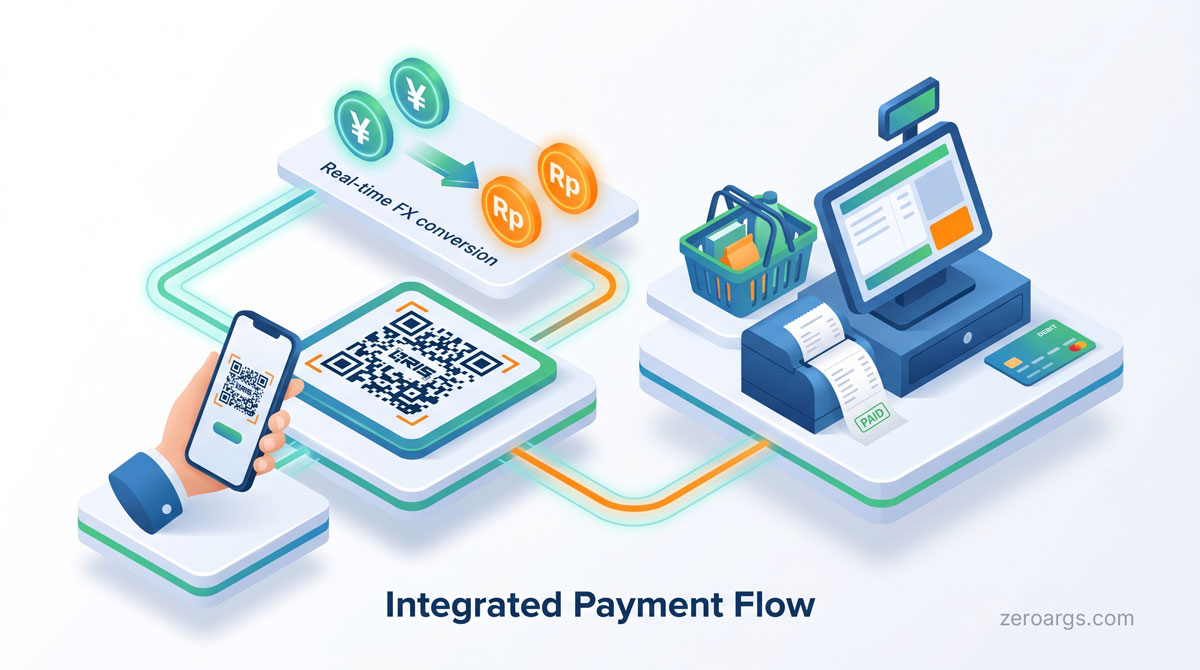
Technically, the model follows switch interconnection between countries: the tourist scans your QRIS, their domestic app shows the amount in local currency, conversion to IDR happens automatically, and settlement reaches your merchant account through an Appointed Cross Currency Dealer (ACCC) bank.
A simplified in-store flow:
- Staff enter the transaction amount in rupiah, or the customer scans a dynamic QR with the amount pre-filled.
- The visitor pays using a home-country app (for example UnionPay, Alipay, or another participating wallet).
- The customer confirms the amount in their currency and enters a PIN.
- The merchant receives a success notification; funds settle on the PSP’s schedule.
You do not manage exchange rates manually. Conversion risk sits in the payment layer. Your job is to charge the correct amount, record proof, and update stock or order status.
3. Who Can Use It Today — and Minimum Requirements
Official Bank Indonesia guidance states Indonesian merchants do not need special registration to accept tourists from partner countries — an active QRIS account is enough. Field reality adds nuance:
| Scenario | Typical readiness | Your action |
|---|---|---|
| Physical shop with static QRIS | Can accept scans; amounts often manual | Add dynamic QR (soundbox/display) if tourist volume is high |
| Store with digital POS | Automatic notifications, fewer input errors | Confirm with PSP: cross-border enabled on your Merchant ID |
| Online store + website checkout | Needs gateway integration, not a pasted QR | See section 5 — engineering work |
| Marketplace-only sales | Marketplace settlement, not store QRIS | Cross-border QRIS does not apply directly |
Before advertising “We accept international QR payments,” call your PSP or issuing bank — Midtrans, Xendit, Doku, Netzme, or whichever institution onboarded you. Ask two questions: whether your Merchant ID is cross-border eligible, and whether webhook/API notifications are available for internal systems.
4. Preparing In-Store Operations for Foreign Customers
Payment rails are only half the experience. On-site clarity determines whether a tourist actually scans or walks away.
An operational checklist we recommend for tourism and retail MSMEs:
- Clear rupiah amounts — avoid ambiguous totals; use a display or pre-printed ticket.
- One active merchant QR — do not mix personal and business codes; reconciliation will break.
- Visual instructions — a small “Scan with your payment app” sign helps; a photo example at the counter helps more.
- Settlement timing — train staff that funds may arrive D+1, not always instantly in the bank account.
- Fallback logbook — when signal is weak, record invoices manually to match when notifications arrive.
For businesses near East Java destinations — Bromo, Malang, or the Nganjuk–Kediri corridor — these small steps often outperform replacing the entire POS stack.
5. Websites and Checkout: Where Payment Gateway Integration Fits
If you only collect payment on-site, static QRIS or a dynamic QR via soundbox may suffice. But businesses selling tickets, tour packages, crafts catalogs, or online pre-orders need integrated checkout — a topic we cover in payment gateway integration for Indonesian business websites.
Important distinctions for cross-border QRIS online:
| Method | Best for | Cross-border caveat |
|---|---|---|
| Static QR on a “Pay here” page | Low volume | Hard for overseas buyers to complete remotely |
| Dynamic QRIS via Snap/Core API | Domestic e-commerce | Cross-border scan is often in-person first; confirm online support with PSP |
| Cards + VA + e-wallets via gateway | International orders | More natural for cross-border e-commerce |
| Invoice links (Xendit/Midtrans) | B2B, pre-orders | One link, multiple methods; webhook QA required |
Do not assume “we integrated QRIS” automatically means your website is tourist-ready. Ask your gateway explicitly: which methods support cross-border QR, whether they are in-person only, and what webhook payloads look like.
Minimal engineering flow for an online shop:
# Pseudocode order flow — not vendor-specific config
order:
  id: "ORD-20260622-0042"
  amount_idr: 250000
  channel: "qris_dynamic"  # or card / va — after PSP QA
  customer_locale: "zh-CN"
  webhook_url: "https://yourstore.com/api/payments/callback"
Webhooks must be idempotent: if a success notification arrives twice, inventory should decrement only once. That pattern holds for domestic and cross-border payments alike.
6. Fees, Settlement, and Daily Reconciliation
One appeal of cross-border QRIS is cost: fees are generally lower than international credit cards with double FX markup. Exact pricing depends on your PSP, but the principles are consistent:
- MDR (merchant discount rate) is deducted from gross amount before settlement.
- Settlement follows PSP schedules — daily, T+1, or per contract.
- Reporting should tag cross-border rows if you analyze margin by channel.
For small teams, a simple reconciliation spreadsheet is enough when columns stay consistent:
| Date | Order ID | IDR amount | Method | Cross-border? | Status | Notes |
|---|---|---|---|---|---|---|
| 22/06/2026 | ORD-0042 | 250,000 | QRIS | Yes | settled | CN tourist, soundbox |
At higher volume, webhook automation into your database — the pattern we build for omnichannel clients — saves admin hours. See omnichannel order and inventory sync for Indonesian SMBs if you sell on marketplaces and your own site.
7. Customer Data, UU PDP, and Trust
Accepting international payments often means storing personal data — names, phone numbers, shipping addresses, language preferences. Under Indonesia’s Personal Data Protection Law (UU PDP), you must collect data proportionally, secure storage, and be transparent about processing purposes.
Minimum practice before promoting to overseas buyers:
- A privacy policy explaining what checkout data you collect.
- HTTPS across the entire site — not only the payment page.
- Never store card data or PINs; leave that to the PSP layer.
- Document transfers if you send data to foreign analytics or CRM tools.
Our practical UU PDP guide for web apps and business sites covers technical steps without overbuilding.
8. Quick Comparison: Stay on Marketplaces vs Build an Owned Channel
| Aspect | Marketplace only | Cross-border QRIS + owned website |
|---|---|---|
| Foreign tourist access | Depends on global platforms (Alibaba, international Shopee, etc.) | Direct control in-store plus owned digital channel |
| Customer data | Limited | First-party — CRM and repeat orders possible |
| Per-transaction cost | Platform commission + dynamic rules | PSP MDR, no marketplace fee |
| Upfront investment | Low | Moderate — QRIS is cheap; website needs budget |
| Engineering | Minimal | Webhooks, QA, security — or a dev partner |
Government programs and global B2B marketplaces rightly push export discovery. That is a valid top-of-funnel channel. Cross-border QRIS in-store plus a clean website checkout is your margin and trust channel — both can run in parallel.
Conclusion
QRIS cross-border payments open the door for international tourists without expensive infrastructure, as long as your merchant account is active and your PSP supports cross-border settlement. The highest-impact next steps: confirm eligibility with your QRIS provider, tighten register operations, and if you sell online, ensure checkout and webhooks are production-ready — not just a page that says “scan the QR below.”
At Zero Args Technology we help MSMEs and startups across Indonesia build websites with QRIS, virtual account, and secure order flows — from MVP to omnichannel scale. Start a conversation and tell us whether your focus is physical retail, online sales, or both; we will map realistic technical steps for your case.