- umkm
- e-commerce
- engineering
Shopee Tax Invoices from November 2026: Seller Checklist
Shopee tax invoices from November 2026 cover service, affiliate, and ad fees: fix your tax ID before the month turns and keep input VAT separate from PPh 22.
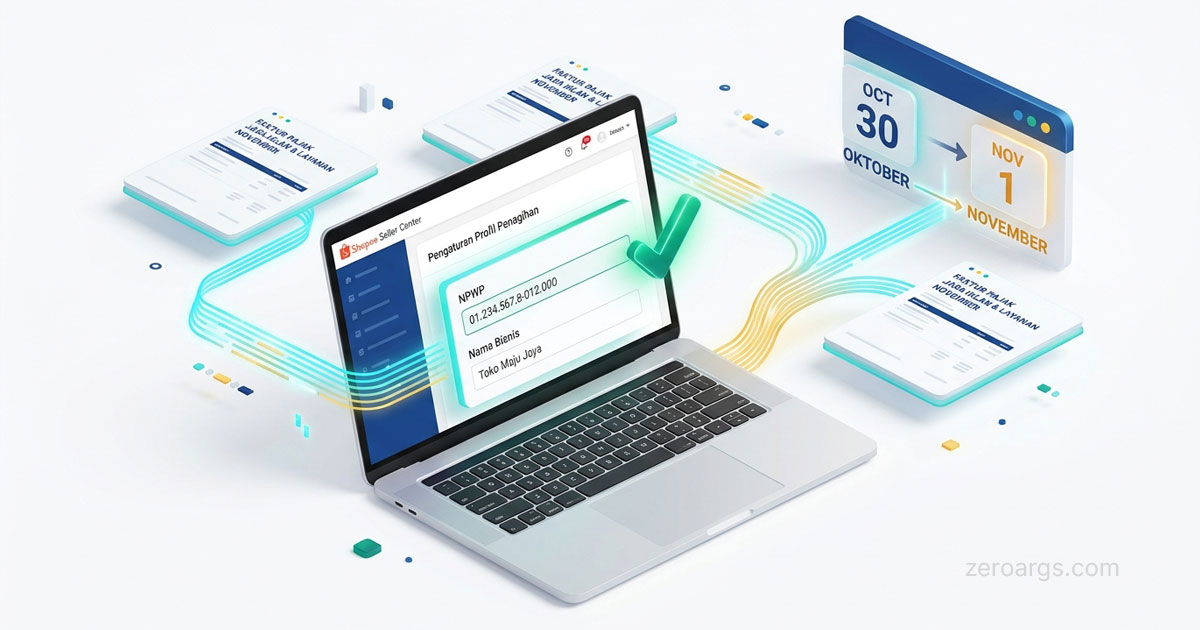
You are topping up a Shopee ad balance before 11.11, and the tax document for that spend will not exist until next month. Shopee tax invoices from November 2026 are not VAT on the goods a customer bought. Shopee will issue them in stages for services it bills to you: service fees, affiliate commission, and ad-balance purchases. If the name or tax ID on the account is wrong, that month's invoice does not change after the period closes. Today is 30 October, so the billing profile needs to be clean before November opens.
1. This Document Is Not a Tax on Turnover
Since 1 October 2026, four appointed marketplaces have withheld Article 22 income tax (PPh 22) at 0.5% of gross turnover. A PDF from Shopee is not automatically that deduction.
The November 2026 invoice is Shopee's output VAT invoice to you: Shopee charges VAT on a service it sells you. PPh 22 withholds tax on your sales income. DDTCNews quoted Shopee's page on 28 October 2026, and the Indonesian Tax Consultants Association summarized it on 27 October: this wave is three fee lines, built from the shop account. Do not add every Income deduction and call the total "Shopee VAT."
2. The Three Fees in the First Wave
| Line in the November 2026 notice | What is actually billed | What this document is not |
|---|---|---|
| Service fee | A platform service Shopee charges the seller | The product price the buyer paid |
| Affiliate commission | Affiliate Marketing Solution commission already paid | Every "admin fee" collapsed into one payout line |
| Ad-balance purchase | A top-up or purchase of ad balance | The 0.5% PPh 22 withholding |
Shopee's billing-information page lists a longer set: platform fees, the Gratis Ongkir XTRA shipping program, promo programs, shipping protection, and pre-order. That list shows which charges change when you edit company data. It does not promise that all of them are invoiced from 1 November. Treat the three lines in the notice as this wave, then check My Invoices by fee type.
Download dates differ. The affiliate FAQ says that tax invoice is available by the 10th of the next month. The November notice uses the 12th, and a report deadline on the 15th. Open My Invoices on the 10th, check again by the 12th, and open a ticket before the 15th if a document from that period is missing.
3. Fix the Billing Identity Before November Opens
- If Billing Information is filled in, that data is used.
- If it is empty, Shopee uses the shop identity.
- The name, national ID (NIK) or tax ID (NPWP), and address must match official documents. A mismatch follows the shop-identity verification flow.
- Shopee Mall sellers are registered as invoice recipients, but company information still has to be complete and match the NPWP.
- Sellers who are not registered as recipients submit a tax-invoice request form by the end of the month.
Edits through Billing Information apply only to invoices Shopee issues. A request approved inside the same month updates that month's invoice. A request after the period closes does not. Shopee's example: a change for the January invoice must be submitted and approved between 1 and 31 January.
Shopee reviews company-data changes within 7 working days, excluding weekends and public holidays. A request filed on 30 October may only be approved in the first week of November. An issued invoice does not update automatically because you changed identity after the period closed, and Shopee says it is not responsible if an invoice fails because the data was invalid.
4. When the Tax Invoice Shows Up: Month-End, the 12th, and the 15th
Apply three dates to the month you are in.
- Month-end. Sellers who are not yet invoice recipients file the request form by the last day of that month.
- The 12th of the next month. The invoice should be in Seller Centre. Shopee's example, quoted by DDTC, puts a September 2026 commercial invoice on 12 October 2026. November 2026 fees land on 12 December 2026.
- The 15th of the next month. If it is still missing, contact customer service by the 15th. For November, that is 15 December 2026.
With no request by the 15th, Shopee treats the invoice as properly received and will not process a complaint for that period. An 11.11 ad top-up falls inside November, so the input invoice arrives in early December only if the NPWP is already correct.
5. A PKP Credits the VAT; Everyone Else Books a Cost
A Taxable Entrepreneur (PKP) credits the VAT on this invoice as input VAT only when the invoice is valid, the identity matches, and the fee relates to the business. Credit the VAT printed on the invoice, and report it on the monthly VAT return for that date. Do not credit an invoice whose name or NPWP is wrong.
A seller who is not a PKP does not credit that VAT. Record the whole charge, VAT included, as a service cost. Receiving the invoice does not make you a PKP. The threshold in the guide to 11% PPN on a business website is still Rp4.8 billion of gross turnover in a fiscal year, unless you register earlier on purpose.
Example: the invoice prints a tax base (DPP) of Rp100,000 and VAT of Rp11,000. A PKP records input VAT of Rp11,000. A non-PKP seller records a cost of Rp111,000. Do not take a payout line of Rp111,000, multiply by 11% again (Rp12,210), and credit that. The 2026 effective rate on most goods and services is still 11% (statutory 12% with an alternative base of 11/12). If Seller Centre has not split the lines yet, wait for the invoice and use the printed figures.
A separate trap: PT Shopee International Indonesia holds an Article 23 exemption, KET-00002/PPUT-CT/KPP.3010/2026, from 15 January 2026 through 31 December 2026, covering ad balance and affiliate fees. Do not withhold PPh 23 on those fees while the letter is in force. Shopee will not refund a withholding made anyway. The November invoice is VAT, not a PPh 23 slip.
6. Three Columns in the Sales Ledger
A single field called shopee_tax will break reconciliation. Store the three documents as different rows.
tax_document:
  period: "2026-11"
  channel: "shopee"
  kind: "input_vat"
  source: "shopee-tax-invoice"
  fee_type: "ad_balance"
  seller_npwp: "00.000.000.0-000.000"
  dpp: 100000
  ppn: 11000
  creditable: true
  available_by: "2026-12-12"
  complain_by: "2026-12-15"
  invoice_ref: ""
kind is input_vat, pph22_withholding, or output_vat. Fill input VAT only from Shopee's fee invoice. PPh 22 still follows the marketplace PPh 22 withholding guide: 0.5% of gross turnover, not of ad spend. Output VAT is only for sales you invoice, including website orders through Coretax. Set creditable to false when the NPWP on the PDF does not match the one you file. Download every month so a tax period is not assigned in April from a stack of PDFs. On a DPP of Rp100,000, marketplace PPh 22 is Rp500. Adding that to Rp11,000 of input VAT on ad fees produces a number that is on neither document.
7. Three Documents Sellers Mix Up
| Shopee fee invoice | PPh 22 withholding record | Website sales e-Faktur | |
|---|---|---|---|
| What is taxed | Shopee's service to you | Your gross sales turnover | Your sale to the buyer |
| Who issues it | Shopee | An appointed marketplace, via the billing document | You, through Coretax, if you are a PKP |
| Direction for a PKP | Input VAT, if valid | A tax credit or part of income-tax settlement | Output VAT |
| For a non-PKP | Part of cost, not creditable | Can still be withheld if there is no turnover statement | Usually no VAT charged |
| Operating deadline | Request by month-end; download by the 12th; report by the 15th | Monthly withholding-slip reconciliation | Monthly VAT return on the invoice date |
| Own website | Not issued | No third party withholds | Your own order data |
Website ad spend never shows up in Shopee's My Invoices. A marketplace-only export loses that half of the ledger.
Conclusion
Shopee tax invoices from November 2026 are VAT on three services Shopee bills to the seller, not a new tax on turnover. Credit the VAT only when the identity was right before the period closed, the figures come from the invoice, and you download between the 12th and the 15th. Sellers who are not PKPs keep the document as a cost.
How to show output VAT on your own store is in the guide to 11% PPN on a business website. The 0.5% charge on turnover stays in the PPh 22 guide above, so the two amounts are not added together. If the ledger does not yet separate input VAT, withholding slips, and website orders, website development services that store the tax base, VAT, and channel on each transaction remove the copy-paste on the 12th. Start a conversation if you want that structure to follow how the shop already sells.
Frequently asked questions
Are Shopee tax invoices from November 2026 VAT on your sales?
No. The invoice is VAT on services Shopee charges the seller: service fees, affiliate commission, and ad-balance purchases. Sales turnover stays with Article 22 income tax withholding and, if you are a PKP, with the output invoices you issue yourself.
Which fees are in the November 2026 wave?
Shopee's notice, quoted on 28 October 2026, names three items: service fees, affiliate commission, and ad-balance purchases. Other fees listed on the billing-information page are not automatically part of the same wave.
When should the invoice appear, and when is the complaint deadline?
Under that notice, the invoice should be in Seller Centre by the 12th of the following month. If it is missing, contact customer service by the 15th. After that, Shopee treats the invoice as accepted and will not process a complaint for that period.
Can a seller who is not a PKP credit the VAT on this invoice?
No. Input VAT is only for a registered Taxable Entrepreneur with a valid invoice tied to the business. A non-PKP seller records the VAT as part of the cost. Receiving an invoice does not make you a PKP.
Does a sale on your own website get this Shopee fee invoice?
No. This invoice covers only fees Shopee charges on the shop account. Sales on your own website use the output e-Faktur you issue through Coretax if you are already a PKP.