- umkm
- e-commerce
- engineering
- logistics
Shipping and Courier Integration for Indonesian SME Websites
A practical shipping and courier integration guide for Indonesian SME websites: realtime rates, package tracking, COD versus QRIS, and peak season readiness.
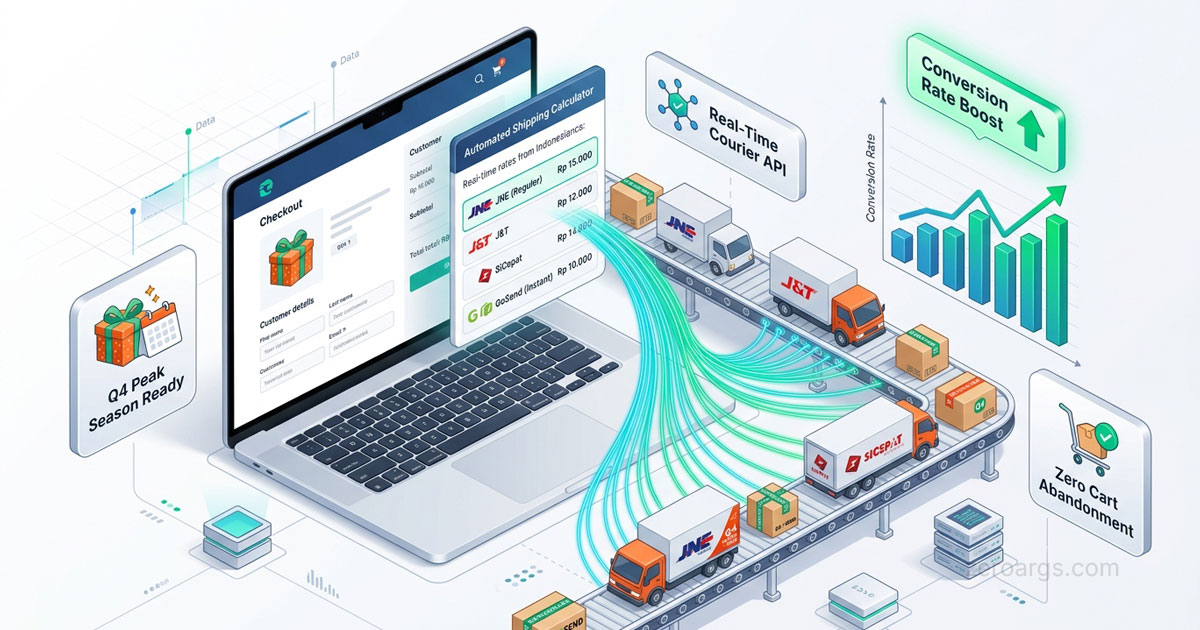
The Q4 peak season is underway: the 10.10 sale just passed, 11.11 and 12.12 are ahead, and Harbolnas, Indonesia's national online shopping festival, follows on December 10 to 16. On marketplaces, buyers see shipping cost estimates automatically before checkout. But when they land on your own website and have to guess the delivery fee, most of them stop at the cart page. A clean shipping and courier integration is the most direct technical work you can do to lift conversion before this year's sales peak.
1. Peak Season Reality: Shipping Cost Is a Buying Decision, Not a Technical Detail
Indonesian e-commerce research consistently ranks delivery cost among the top reasons carts are abandoned. The logic is simple: buyers compare the final total, not the product price. On marketplaces that total is visible from the product page. On their own websites, many store owners take a shortcut that quietly kills conversion: a line reading "contact admin for shipping rates," or a flat national rate that overcharges nearby buyers and undercharges distant ones.
The damage doubles during peak season. First, hesitant buyers drift back to marketplaces where they trust the total price. Second, your admin drowns in repeated "how much to Surabaya?" chats exactly when orders flood in. Shipping integration fixes both at once: the numbers appear automatically, and admin chats are left for questions that genuinely need a human.
2. Three Ways to Calculate Shipping on Your Website: Manual, Aggregator, or Direct Contracts
Before touching any code, pick the architecture. Three patterns dominate Indonesian online stores, with very different trade-offs:
| Approach | How it works | Strengths | Weaknesses | Best for |
|---|---|---|---|---|
| Manual / flat rate | Admin sets rates per zone, or one national flat rate | Zero API cost, fast to launch | Often wrong, tedious for admins, no arrival estimates | Small catalogs, one origin city |
| Courier aggregator | One API for dozens of couriers: Biteship, RajaOngkir, KiriminAja and similar | Integrate once, many couriers, pickup without volume contracts | Per-shipment fees or API quotas, standard courier rates | SMEs taking their website seriously |
| Direct courier contracts | Integrate each courier's API: JNE, J&T, SiCepat, AnterAja, Lion Parcel | Special rates at high volume, direct SLA and claims handling | Repeated integration per courier, separate billing, needs a technical team | Hundreds of parcels per day |
For most Indonesian SMEs, the aggregator pattern is the right starting point. Costs are transparent per shipment, setup takes days, and when volume grows you can move your busiest couriers to direct contracts without changing the checkout flow.
3. Per-SKU Logistics Master Data: Weight, Dimensions, and Origin Warehouse
Realtime rates are only as accurate as your data. The most common mistake is not in the API but in sloppy product records: final packaged weight never recorded, dimensions not recorded at all. The result is a checkout total cheaper than the courier's invoice, and the difference eats your margin just like marketplace fees do, as we broke down in our net margin guide.
Follow the same single-source-of-truth principle as our GS1 barcode guide: one logistics record per SKU.
sku: "KOP-ARABICA-250G"
weight_grams: 300
dimensions_cm: { length: 15, width: 10, height: 8 }
origin_warehouse: "NGJ-01"
warehouses:
  NGJ-01:
    city: "Nganjuk"
    postal_code: "64411"
courier_notes: ["instant", "sameday"]
Two notes matter here. First, couriers charge based on whichever is greater between physical weight and volumetric weight: length x width x height in centimeters divided by 6,000. In the example above, 15 x 10 x 8 / 6,000 = 0.2 kg, so the physical 0.3 kg is charged. Pillows, lamps, and bulky packaging almost always hit volumetric weight, and if it is not recorded, you absorb the difference. Second, record the origin postal code per warehouse, because rates and arrival estimates are computed from the origin-destination postal code connection, not from city names.
4. A Checkout That Shows Realtime Rates and Arrival Estimates
With clean master data and an aggregator API, a healthy checkout flow looks like this:
- The buyer selects province, city, and postal code, or pastes the address and the system completes the postal code.
- Your website calls the rates API with the combined weight and dimensions of the whole cart.
- A courier list appears with prices and arrival estimates, sorted by cheapest or fastest according to your store's preference.
- The buyer picks a courier, proceeds to payment, and the final total is final from that page onward.
Do not show rates alone. Arrival estimates often decide the sale more than a two-thousand-rupiah difference, especially in gift season. For light carts, consider a cheap flat rate for buyers in neighboring cities like Kediri, Madiun, and Jombang when your warehouse is in Nganjuk, East Java, because real local rates sit far below the national flat rate most stores use. Small touches like these keep regional buyers on your site instead of sending them back to marketplaces.
5. Tracking Numbers, a Tracking Page, and Automatic Notifications
Shipping integration solves half the job. The other half happens after the buy button, and it is where your website can outperform marketplaces on experience:
- Every order receives its airway bill automatically from the aggregator API as soon as the parcel is picked up, with no manual admin entry.
- Build a tracking page at
/trackthat reads delivery status from the API and shows a simple timeline: ordered, processed, shipped, out for delivery, received. - Send the tracking number and link via WhatsApp and email automatically, not through manual chat replies.
- Set an internal alert when a parcel has not moved for more than 48 hours, so your team chases the courier before the buyer chases you.
The biggest benefit shows up exactly in peak season: "where is my package?" chats drop sharply because buyers can check the status themselves. And because this is your own channel, the tracking data and buyer contacts stay with you, not on a platform.
6. COD or QRIS: A Healthy Payment Mix for Peak Season
Cash on delivery is why many first-time buyers trust a website they have never used, but it is also the most expensive channel when volume is high. Compare the characteristics:
| Aspect | COD | QRIS / virtual account / e-wallet |
|---|---|---|
| Cash arrival | After the package is received | Seconds to minutes after payment |
| Channel cost | COD fee per transaction from the courier | Merchant discount rate; since October 1, 2026, QRIS MDR is zero percent for small merchants |
| Return risk | Higher, parcels often refused | Low, funds already received |
| Peak season impact | Cash tied up exactly when you need stock | Healthy cash flow for restocking |
Because the zero percent QRIS MDR for small merchants took effect on October 1, 2026, the incentive to shift buyers to digital payments is at its highest. We cover the policy in detail in our QRIS zero MDR guide. A healthy mix: keep COD for cities with new buyers, but nudge buyers toward QRIS with a clear benefit such as free shipping above a minimum order value, then monitor the share weekly.
7. Daily Fulfillment Operations When Orders Surge
Great integration does not help if parcels sit still on the table. During 11.11 and Harbolnas, your warehouse SLA decides your reputation as much as the courier's does. The daily routine we recommend:
- One combined order queue. Marketplace and website orders enter the same work list, not two different tabs. The sync pattern resembles our POS and website integration guide for hybrid retail.
- A clear cutoff. Orders after 3:00 PM are processed the next day; state it explicitly on the product page so buyer expectations stay safe.
- Scheduled pick-pack, at least two waves per day, with packaging stock topped up well before the peak.
- Courier buffer. When courier capacity tightens, do not depend on a single provider; make sure your aggregator allows fallback to an alternative courier when pickup fails.
- Proactive communication. If arrival estimates worsen, tell buyers first through the tracking link and WhatsApp before they have to ask.
8. A 30-Day Checklist Before 11.11 and Harbolnas
If your website still says "contact admin for shipping rates," the following 30-day sequence is enough to be fully ready before the December peak:
- Days 1–5: audit logistics data. Complete final packaged weight, dimensions, and origin postal codes for every active SKU in the master data.
- Days 6–10: choose a courier aggregator. Compare per-shipment fees, courier coverage, and COD support, then test rates from your warehouse postal code to your top ten destination cities.
- Days 11–16: integrate checkout. Wire the rates API with combined cart weight, display prices plus arrival estimates, and make sure the final total is final before payment.
- Days 17–21: tracking. Enable automatic airway bills, build the
/trackpage, and connect WhatsApp and email notifications. - Days 22–25: payments. Test QRIS and virtual accounts end to end, set incentives to shift the COD share, and confirm order reconciliation runs as described in our sales data pipeline for Coretax filing.
- Days 26–28: load-test the flow. Order your own products to several cities, measure how many minutes pass from checkout to a tracking number, and fix the bottlenecks.
- Days 29–30: peak standby. Agree with the whole team on cutoffs, pick-pack schedules, courier fallback, and delay-communication templates.
Conclusion
In the 2026 Q4 peak season, shipping cost and couriers are no longer an after-checkout concern; they are part of why buyers complete checkout. The technical work is clear: per-SKU logistics master data, realtime rates with arrival estimates at payment, automatic tracking numbers and a tracking page, a payment mix shifting COD toward QRIS, and warehouse SLAs ready for 11.11, 12.12, and Harbolnas. It all fits in one sprint, and the foundation keeps paying off long after the season ends.
If your team is chasing year-end sales targets, we at Zero Args Technology can build the shipping integration, package tracking page, and fulfillment queue from warehouse to buyer in a single sprint. Start a conversation to assess how ready your website checkout is before the December peak.
Frequently asked questions
What is a shipping rates API and why does an online store website need one?
A shipping rates API connects your website checkout to many couriers at once, so delivery cost and arrival estimates are calculated automatically from package weight, dimensions, and origin-destination postal codes instead of manual input.
How do I calculate volumetric weight for a package?
Volumetric weight equals length times width times height in centimeters divided by 6,000. Couriers charge based on whichever is greater between physical and volumetric weight, so record both in your product master data.
Is cash on delivery still worth offering during peak season?
Yes, as a complementary channel, but keep its share under control. COD ties up cash until packages are received, raises return rates, and every failed delivery wastes packing cost and return shipping when volume is already at its peak.
What is a courier aggregator and how is it different from direct courier contracts?
A courier aggregator offers one API for many couriers with pickup rates and no minimum volume contract, which suits early-stage stores. Direct contracts give cheaper rates at high volume but require separate integration, billing, and claims handling per courier.
What delivery SLA is realistic during peak season?
Aim to hand packages to couriers within 24 hours, then communicate longer arrival estimates than usual because courier capacity tightens during the November and December sales and Harbolnas from December 10 to 16.