- seo
- umkm
- engineering
Google Review Velocity for SMEs: Website + GBP Playbook
Google review velocity for Indonesian SMEs: ethical review requests from your website, QRIS checkout, and WhatsApp—plus monthly KPIs for Maps and AI local answers.
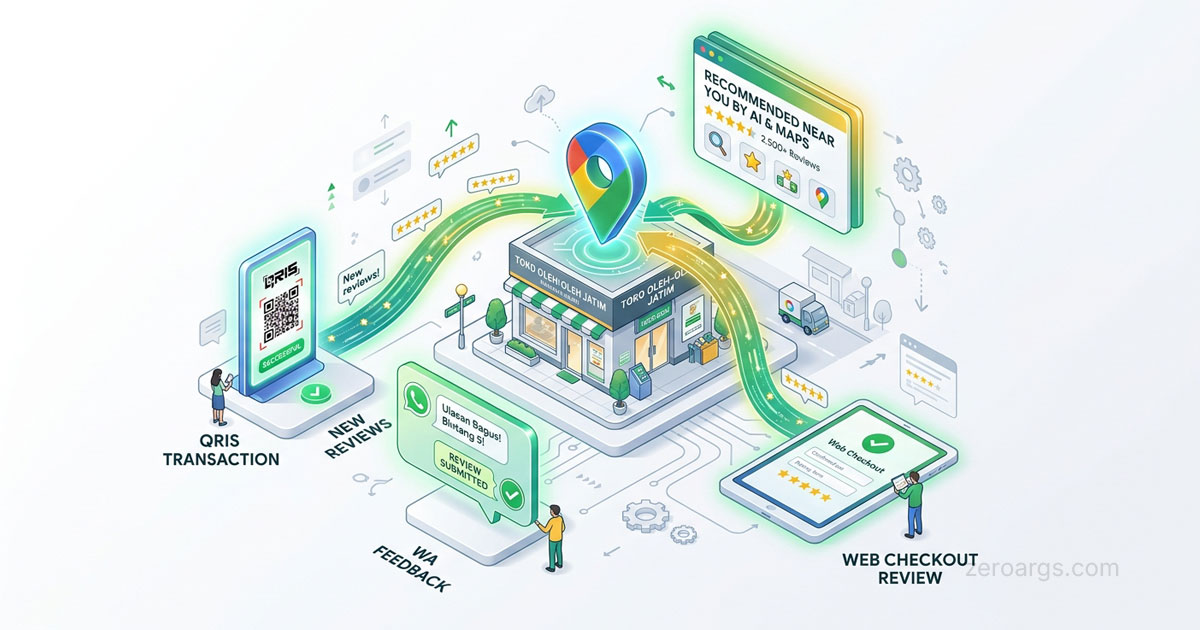
Google review velocity—not your lifetime star count—is what separates Indonesian SMBs that show up in Google Maps, AI Overviews, and ChatGPT or Gemini local recommendations from businesses that look frozen in time. Many shops still show 4.5 stars but have not earned a new review in months; local algorithms in 2026 treat that as a stale profile. This playbook shows how to build a steady review flow from your website, QRIS checkout, and WhatsApp Business without breaking Google’s policies.
If your local SEO foundation is shaky, start with our local SEO guide for Indonesian SMBs. Here we focus on operations: when to ask, where to place links, and how to track velocity every month.
1. Why Review Velocity Matters More Than Total Stars in 2026
Local SEO conversation has shifted from “collect 100 reviews once” to “prove the business is still active.” Industry local studies consistently show businesses with recent review activity can outperform competitors with larger but aging totals—search systems weight freshness and relevance, not a static trophy rating.
For SMBs in Indonesia, the practical impact is:
- Cafés, workshops, and home-service brands can slip out of the Local Pack despite a high average.
- AI Overviews and assistants often combine rating, review count, recent text, and owner responses—not just a number on Instagram.
- Shoppers read the latest reviews to judge quality today (new menu, new staff, post-holiday service).
Velocity is an operational habit after every transaction that deserves it—not a one-week marketing stunt.
2. Velocity vs Volume: What Maps and AI Actually Read
Teams stay focused when they separate these metrics:
| Metric | Meaning | Misleading example |
|---|---|---|
| Volume | All-time review count | 240 reviews, none in 8 months |
| Velocity | New reviews per period | 6 reviews/month for 3 months |
| Response rate | Share of reviews you reply to | 90% answered within 48 hours |
| Recency | Age of newest review | Last review 3 days ago |
Google also reads review text: product names, neighborhoods (“near Nganjuk market”), or specific services help map local queries—you do not need to ask customers to stuff keywords.
External AI tools often pull snippets from Google Business Profile when answering “best X in Y.” A Google review program complements getting recommended by AI: consistent NAP on your site is mandatory, but continuously updated reputation gives models a reason to pick you.
3. Prerequisites: Align GBP and Your Website Before You Ask
Asking for reviews before entity data is clean creates conflicting signals. Minimum checklist:
- One legal business name in site header, footer, signage, and GBP—without keyword-stuffing the name (a Google policy violation).
- Primary GBP category matches core services; service pages use aligned titles.
- One WhatsApp number on GBP, site buttons, and invoices.
- Direct review link from GBP saved as a constant in your CMS or ops spreadsheet.
Then complete verification (phone, video, or whatever Google offers). Unverified profiles cannot manage reputation fully.
4. Design the Review Request Moment (Checkout, QRIS, POS, WhatsApp)
Timing drives ethical conversion. Patterns that work for Indonesian SMBs:
- Offline retail & F&B: staff ask in person after a good experience; counter QR opens your official review URL (not the generic Maps homepage).
- Field services (AC repair, contractors, clinics): WhatsApp message 1–2 hours after the visit with one short template and one link.
- E-commerce on your site: trigger after
deliveredorcompleted—not at payment, because the customer has not received the order yet. - Hybrid POS + website: reuse the same order ID on receipts and thank-you emails so support can fix issues before a public review.
Example WhatsApp template (customize name and link):
Hi [Name], thanks for choosing [Product/Service] from [Business Name].
If you have a minute, a Google review helps us a lot:
[OFFICIAL_REVIEW_LINK]
If anything went wrong, reply here first—we will fix it before you post publicly.
That last line is ethical hygiene: solve problems in private before they become one-star stories.
5. Website Touchpoints: Thank-You Pages, Packaging, and Follow-Up
Your site is the channel you control—use it without spamming:
- Thank-you / order-complete page: one paragraph plus a “Leave a Google review” button (new tab to the official GBP link).
- Transactional email: neutral subject (“Order #1234 completed”) with the review CTA in the footer—not clickbait subjects.
- Smart packaging: package QR codes that land on
/reviewson your site; the page explains steps then sends users to Google—especially if you already use smart packaging QR patterns. /reviewslanding page: no fake embedded widgets; show 2–3 real quotes (with permission) and a button to GBP.
If you settle payments with Midtrans, Xendit, or QRIS on your site, fire follow-ups from delivery or fulfillment webhooks—not from payment alone.
6. Replying to Reviews: Scripts and SLAs Without Sounding Robotic
Response rate is a measurable input. Set an internal SLA: reply to every review within 48 hours; prioritize 1-star threads within 24 hours.
Reply patterns:
- Positive (4–5 stars): thank them, reference a specific detail they mentioned, invite them back without over-promising discounts.
- Neutral (3 stars): acknowledge their point, offer your WhatsApp line for resolution.
- Negative (1–2 stars): stay calm, apologize for the experience, move troubleshooting to DM/WhatsApp using the same number on your site—do not argue in public.
Your replies can surface in snippets and AI answers; treat them as customer service content, not checkbox work.
7. On-Site Testimonials vs GBP Reviews (AggregateRating Policy)
Founders often want stars on the homepage. Practical rules:
- Quote reviews that actually exist on GBP or in writing with customer permission.
- If you use JSON-LD
AggregateRating,ratingValueandreviewCountmust match what visitors see—never aspirational marketing numbers. - Do not create FAQ pages only for markup; write answers that help humans (see also AI-readable website foundations for consistent structure).
Conservative markup example (replace with your real data):
{
  "@context": "https://schema.org",
  "@type": "LocalBusiness",
  "name": "Official Business Name",
  "url": "https://example.id",
  "aggregateRating": {
    "@type": "AggregateRating",
    "ratingValue": "4.7",
    "reviewCount": "86"
  }
}
Only include aggregateRating when those figures are visible on the page and traceable to your review source.
8. Manual vs Semi-Automated Programs and Monthly KPIs
| Aspect | Manual (staff + WhatsApp) | Semi-automated (site + webhooks) |
|---|---|---|
| Setup | Low; needs daily discipline | Medium; needs order/POS integration |
| Velocity | Depends on staff memory | Steadier after delivery events |
| Spam risk | Low when personal | Cap at one request per order |
| Best for | F&B, on-site services | Online stores, hybrid retail |
Monthly KPI worksheet (track in a spreadsheet):
| Month | New reviews | Avg stars this month | % replied <48h | Link clicks from site | Ops notes |
|---|---|---|---|---|---|
| Oct 2026 |
Realistic targets for small SMBs: 4–12 new reviews per month per location—not a burst of 50 followed by silence. Raise targets only when transaction volume supports it.
Conclusion
Google review velocity is a business habit, not a one-off campaign. Align Google Business Profile and your website, ask at the right moment after service is done, reply to every piece of feedback, and count new reviews monthly. That combination strengthens Maps, feeds AI local answers, and builds trust with shoppers who read what happened last week—not three years ago.
If you want a /reviews landing page, checkout webhook integration, or a reputation KPI dashboard on a custom site, start a conversation with our team at Zero Args Technology.
Frequently asked questions
What is review velocity for a local business?
Review velocity is how steadily new Google Business Profile reviews arrive over time—not your lifetime star average. Profiles that earn a few fresh reviews each month often look more relevant than profiles with hundreds of old reviews and no recent activity.
When should you ask customers for a Google review?
Ideally one to two hours after the service or delivery is complete, while the experience is still fresh. For online orders, trigger the request after delivered or completed status—not at payment.
Can you show Google reviews on your website with AggregateRating schema?
Yes, if displayed quotes are real and markup matches what visitors see. Google penalizes misleading structured data; link to your official profile and keep counts accurate.
Do TikTok or marketplace reviews replace Google reviews?
Not for Google Maps and many AI local answers. Marketplace reviews still matter on those channels, but Google Business Profile remains the primary reputation source for near-me search and Google AI Overviews.
Is buying Google reviews safe for small businesses?
No. Google can suspend profiles and remove fake reviews. The reputational risk outweighs any short-term rating boost; build velocity through real service and ethical automation.