- umkm
- e-commerce
- engineering
How to Raise Prices During Inflation: A Guide for SMEs
A guide to how to raise prices during inflation: recalculate unit costs, cut channel fees first, and use your own sales data so loyal customers stay.
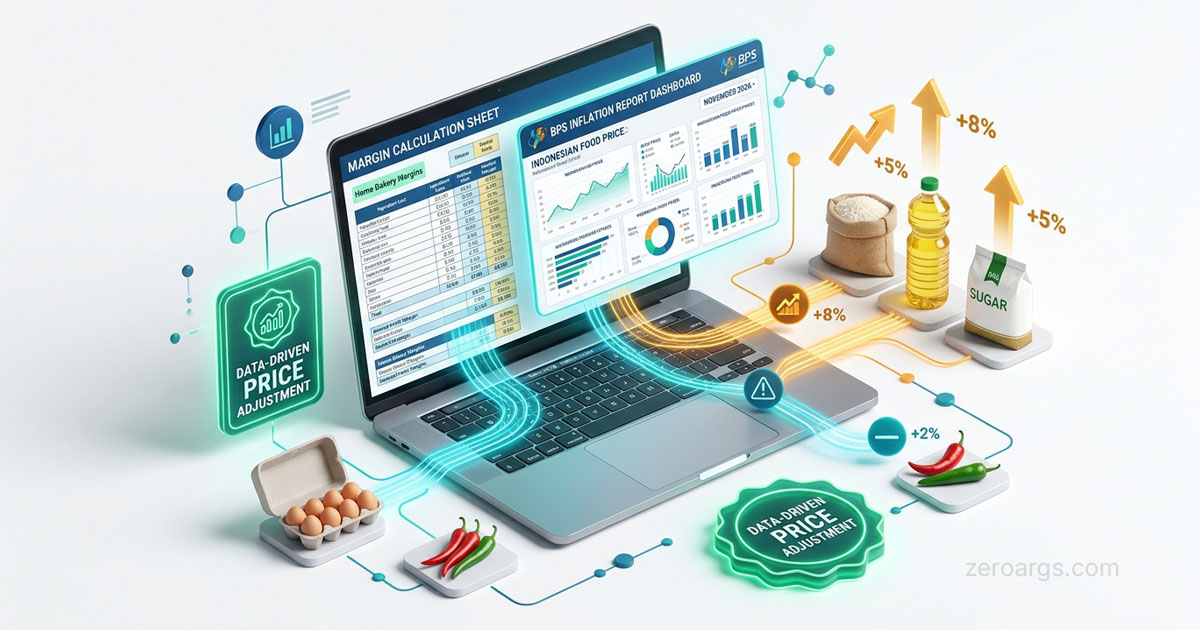
Indonesia's statistics bureau (BPS) releases October 2026 inflation data today, Monday 2 November. Behind the national average, sugar, cooking oil, rice, and beef crept up through October while chili and eggs actually fell in the last week. For warung and home-bakery owners, how to raise prices during inflation is not a question of courage — it is a question of order: calculate how much margin is truly eroded, cut the channel costs you can cut, and only then raise prices on the products whose data supports it.
1. Food Inflation, October 2026: What the Data Says About Your Costs
The national number is almost useless for your kitchen. In September 2026 annual inflation was 3.28% with the volatile-food component at 5.03%, and the consensus expected October to ease to around 3.25%. What actually erodes your costs is the specific basket you buy.
Through October 2026, Bank Indonesia's food price data showed sugar rising almost 1% to Rp19,600–Rp20,600 per kg and cooking oil holding at Rp23,000–Rp24,400 per kg, while red bird's-eye chili dropped 6.56% to Rp96,200 per kg and eggs to about Rp29,350 per kg. Not every ingredient rises together — your costs shift with your recipe mix, not the headlines.
The pressure is not over. Kontan reported that El Niño is expected to persist into early 2027, squeezing rice, chili, and shallot supply in several regions, and SME owners it quoted on 20 October said the last two years felt harder than the pandemic: raw materials up, purchasing power down, capital expensive. A tempeh producer covered by Kompas on 19 October shrank portions when soybeans rose Rp200–Rp400 per kg — and still drew complaints. Absorbing costs silently kills margin; raising prices without arithmetic drives customers away. Both are avoidable.
2. Recalculate Unit Cost Before Touching the Price
Recompute cost of goods sold (COGS) per unit using this week's ingredient prices, not the prices from when the business opened. Include every component: raw materials, packaging, wages including your own, overhead such as gas and electricity, delivery, and per-unit channel costs — marketplace deductions and payment fees count toward margin too.
A concrete example. A cake product with an old unit cost of Rp7,500 sold at Rp12,000 holds a margin of Rp4,500 (37.5%). Sugar and cooking oil rise; the new unit cost is Rp8,400. Leave the price alone and margin falls to Rp3,600 — eroded 20% even though ingredients "only" rose 12%. From there, two targets exist:
- Protect margin in rupiah. The new price only needs to be Rp12,900 (Rp12,000 plus the Rp900 cost gap), a 7.5% increase.
- Protect margin in percentage. The new price must be Rp8,400 ÷ (1 − 37.5%) = Rp13,440, a 12% increase.
The lesson: when your target is rupiah margin, the price increase you need is almost always smaller than the ingredient inflation rate. Many owners raise prices by the headline percentage — "everything up 10%" — and lose customers to protect a margin that only needed Rp900.
3. Raise the Price, Shrink the Portion, or Both
The four options below are not mutually exclusive; most businesses combine them. What separates outcomes is deciding from data, not panic.
| Option | Effect on margin | Risk to customers | Best when |
|---|---|---|---|
| One full increase | Recovers immediately | Most visible on shelves and marketplace listings | The increase is small (under 5%) and competitors have moved |
| Staged increases | Recovers gradually | Lower; customers adapt twice | Ingredients are still moving (El Niño not over) |
| Shrink portion or net weight | Recovers without touching price | Moderate; triggers complaints if done silently | Buyers are price-sensitive and the product sells per piece |
| Cut channel costs | Recovers without touching price | Almost none | Platform and payment fees still squeeze margin |
The tempeh story above is the warning for the third option: silently shrinking a portion does not avoid complaints, it only changes their shape. If you genuinely reduce size, print the true net weight on the packaging and in the product description. Products bought for orders and celebrations usually tolerate increases better than daily snacks.
4. Cut Channel Costs Before Passing the Burden to Customers
One percent of channel cost removed works like a one-percent price increase — without the risk of losing buyers. That is why cost cutting is always the first lever. Three are available right now:
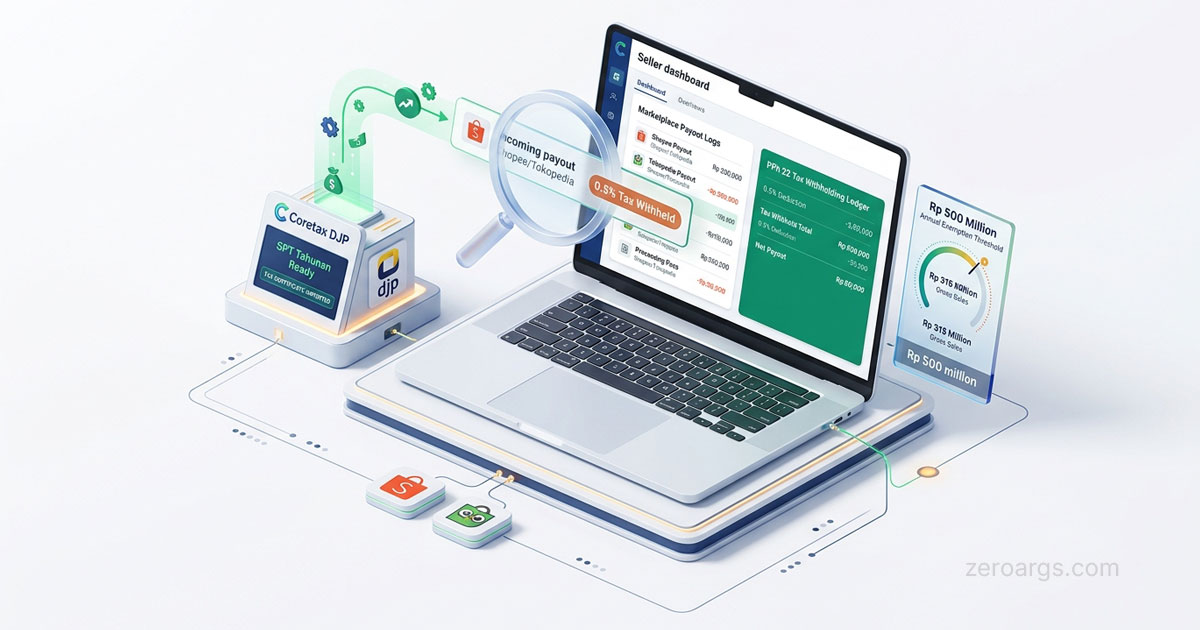
- The 50% marketplace fee discount. Since 25 October 2026, under Ministry of MSMEs Regulation No. 3/2026, platforms must give verified micro and small enterprises selling domestic products at least a 50% discount on admin, commission, or basic store application fees. The mechanics are in the Sapa UMKM 50% fee discount guide: register through the Sapa UMKM app; verification within 10 calendar days. The scheme excludes ready-to-eat food and electronics from large industry, and the e-commerce association is still asking for a transition period — check your payout slips instead of assuming the discount is live.
- Zero-MDR QRIS. Since October 2026, in-person QRIS payments no longer carry a merchant discount rate — details in the QRIS MDR 0% guide for Indonesian SMEs. Steer customers who still pay cash or by card toward QRIS.
- Your own channel. Orders arriving through your own website are not charged marketplace commission. The full math is in the net margin guide: marketplace vs website.
Work them in that order: recovering Rp900 of margin through channel costs is far cheaper reputationally than billing it to customers.
5. Your Own Channel's Sales Data Picks Which Products Can Rise
A marketplace dashboard shows price competition, but never how your customers behave — buyers there are the marketplace's users, not yours. The data you can trust for pricing comes from channels you own: website orders, WhatsApp conversations, the shop ledger.
That data answers three questions: who reorders, which products keep selling after a small increase, and how long the gap between orders is. Raise prices selectively from there: event products first, daily staples held longer, so price-sensitive customers always keep an economical option.
If all your sales sit on a marketplace, that data never becomes yours and every increase is a guess. A simple website with order records turns the guess into a table you can reread monthly.
6. Announce the Increase Through Channels You Control
A marketplace listing can only display the new number, with no room to explain. Announce through channels you control, 7–14 days before the price takes effect:
- A notice on your website or a banner at the stall.
- WhatsApp broadcasts and status updates for past customers.
- A small card at the counter for offline buyers.
The message template is simple: one honest sentence of reason, the effective date, a commitment that quality is unchanged, and a thank-you. For example: "Starting 10 November, our cake is Rp12,900 because sugar and cooking oil prices rose. The recipe and size stay the same. Thank you for continuing to support our small business." Give a few days of old-price grace for loyal customers — and say so.
7. Watch the First 30 Days with Numbers, Not Feelings
Set decision thresholds before the increase goes live, not after complaints arrive. Four numbers are enough:
| Metric | Safe signal | Correction signal |
|---|---|---|
| Units sold per SKU | Moving steadily within ±10% | Down more than 15% for two weeks |
| Repeat orders from regulars | Arriving as usual | Regulars starting to disappear |
| Direct complaints | One or two cases in week one | A wave of WhatsApp complaints |
| Margin per unit | On target around Rp4,500 | Still below target despite the new price |
The reading rule: one bad week can be noise — payday timing, weather, a holiday. Two consecutive declining weeks means the price crossed the pain point; roll back part of the increase or add small value such as tidier packaging. Record the decision and the numbers so next month does not restart the debate:
price_change:
  sku: "cake-piece"
  old_cogs: 7500
  new_cogs: 8400
  old_price: 12000
  new_price: 12900
  target: "rupiah_margin"      # rupiah_margin | percent_margin
  effective_from: "2026-11-10"
  announced_on: ["website", "whatsapp", "counter"]
  review_on: "2026-12-10"
Conclusion
Inflation lands monthly, and until El Niño ends, food prices keep moving. The working order stays the same: recalculate unit cost, cut channel costs through Sapa UMKM and QRIS, pick SKUs from your own sales data, raise prices in stages, announce through channels you control, then review after 30 days.
The full cross-channel margin math is in the net margin guide: marketplace vs website. And if your sales records are still scattered across three apps, website development services that store unit cost, channel, and margin per transaction turn the monthly pricing decision from a debate into one small table. Start a conversation if you want to build that owned channel.
Frequently asked questions
Should an Indonesian SME raise prices as soon as inflation picks up?
Not immediately. First recalculate your cost of goods per unit to see how much margin is actually eroded, then cut channel costs such as marketplace service fees and payment fees before passing the burden to customers.
How large should a price increase be when raw material costs rise?
If the goal is to protect margin in rupiah, the increase only needs to match the rise in unit cost. For a product sold at Rp12,000 with a Rp900 cost increase, Rp12,900 is enough — not the full percentage increase of the raw materials.
Is it better to raise prices or shrink portion sizes?
Both are legitimate, but never shrink portions silently. Print the new net weight on the label and product description, because a hidden size change triggers complaints, as tempeh producers found when soybean prices rose.
How do I tell customers about a price increase?
Announce it 7 to 14 days before the new price takes effect through channels you control: a notice on your website, WhatsApp broadcasts or status updates, and a card at the counter. State a short honest reason, the effective date, and confirm that quality is unchanged.
Do all Indonesian micro and small sellers automatically get the 50% marketplace fee discount?
No. Since 25 October 2026 platforms must give verified micro and small enterprises selling domestic products at least a 50% discount on basic service fees, but sellers must register through the Sapa UMKM app and wait up to 10 calendar days for verification. Ready-to-eat food and electronics from large industry are excluded.