- umkm
- e-commerce
- marketplace
Marketplace Fee Discount 50%: Which Product Categories Qualify
See which product categories qualify for the 50 percent marketplace fee discount starting October 25, 2026, and how to check your SKU eligibility first.
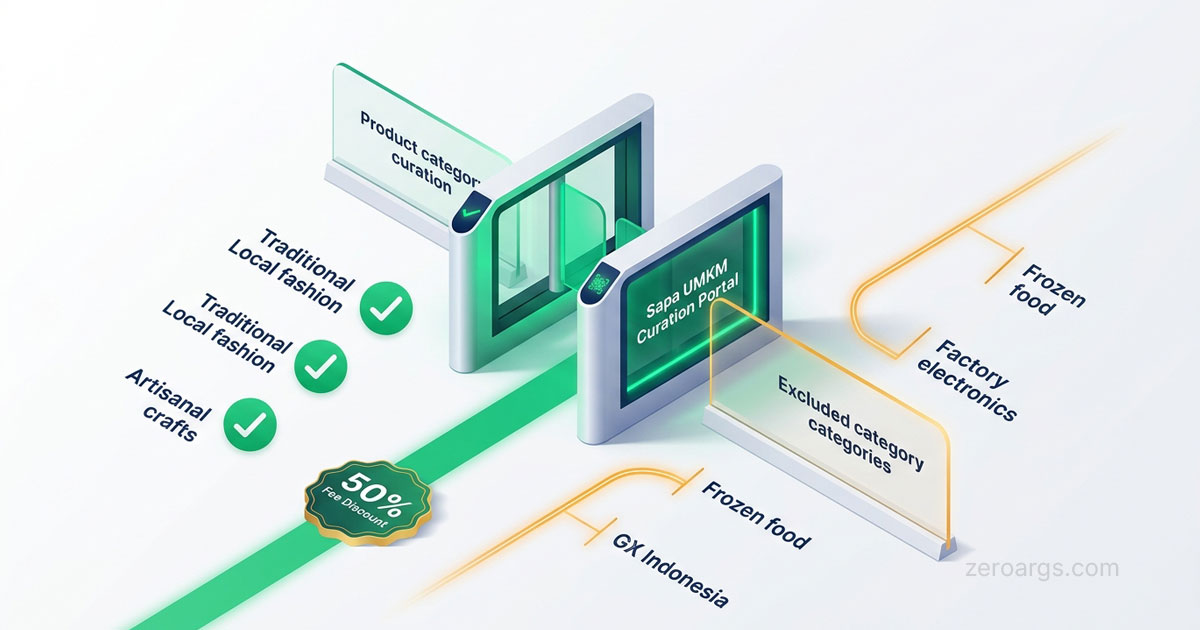
The 50 percent marketplace fee discount becomes usable by sellers on October 25, 2026, and at its October 22 press conference Indonesia's Ministry of MSMEs confirmed the policy is permanent. But one sentence from that briefing is easy to miss and matters most for your store: the incentive prioritizes fashion and craft products, while ready-to-eat food and electronics are excluded. If you sell frozen food, instant meals, or resell consumer electronics from large domestic factories, your application can stall at curation—not because your data is messy, but because your category sits outside the incentive's scope. This article maps which categories are in, which are out, where the gray areas are, and what sellers of excluded categories should do instead.
The 50 percent discount is now permanent, but not for every product
Two announcements from the October 22, 2026 press conference need to be kept apart. First, the minimum 50 percent service-fee discount applies with no time limit—MSMEs Minister Maman Abdurrahman described it as permanent for as long as the business stays micro or small and keeps selling domestic products. Second, the policy is selective about categories: craft and fashion products are prioritized, while ready-to-eat food and electronics are excluded.
Technically, the discount targets the service fees platforms charge on every transaction—administration fees, commissions, or base application fees. Before this regulation, service fees on major Indonesian marketplaces ranged around 10–18 percent of transaction value. A 50 percent cut therefore opens 5–9 percentage points of margin per transaction for sellers who qualify—a figure that is clearly not small change for an SME seller.
If you have not yet read the full application walkthrough, start with our Sapa UMKM 50 percent marketplace fee discount guide, which covers registration and the two-stage verification. This article answers the question that was only resolved this week: which product categories actually qualify.
The legal basis for exclusions: Article 15 of Permen UMKM 3/2026
The policy rests on Minister of MSMEs Regulation No. 3 of 2026, which governs the protection and competitiveness of micro and small enterprises in electronic commerce (PMSE). Its operational mechanism is set out in Ministerial Decree (Kepmen) UMKM No. 398 of 2026.
Three provisions matter for the category question:
- Article 15(1) — PMSE platforms that are not themselves MSMEs must grant a service-fee discount of at least 50 percent to verified micro and small businesses that sell only domestic products.
- Article 15(3) — the discount is excluded for businesses selling ready-to-eat processed food and/or electronic products manufactured by large domestic industries.
- Article 17 — a platform may reject or discontinue the incentive if a seller is found to sell non-domestic products, with the seller holding a right to clarify and object.
Note that the main gate to the incentive is not the category but the product's origin: a domestic product is defined by three parameters—production in Indonesia by a domestic company, use of domestic raw materials and components (wholly or partly), and employment of Indonesian workers. Category is only the second filter. A fashion seller importing stock fails at the first gate; a local frozen-food seller passes the first gate and stops at the second.
Priority categories: fashion and craft
The Ministry frames the policy as affirmative action: fashion (apparel) and craft are targeted because these two categories are squeezed hardest by cheap imported products on digital platforms. In practice, sellers in the following groups have the strongest position when applying:
- Apparel and fashion accessories: dresses, t-shirts, hijabs, batik, bags, locally made shoes, handmade jewelry.
- Craft and handmade goods: woodwork, ceramics, weaving, embroidery, home decor, souvenirs, handmade educational toys.
Priority does not mean automatic approval—SKUs still need to be clean and product origins still get checked. But by policy design, these two categories sit at the center of the incentive. If your store mixes apparel with big-brand electronics, the healthy workflow is to separate them from the start: clearly local SKUs in one account, or at least in one application list, rather than mixed with SKUs that are clearly excluded.
Excluded categories: ready-to-eat food and big-industry electronics
The two excluded categories deserve a careful reading, because the regulation's wording is narrower than the news headlines:
| Category | Incentive status | Notes |
|---|---|---|
| Apparel, craft, and other verified domestic products | Eligible | Prioritized: fashion and craft; must still be domestic products |
| Ready-to-eat processed food | Excluded | Examples: heat-and-eat frozen meals, packaged cooked food, ready-to-consume instant meals |
| Packaged shelf-stable food | Confirm first | Chips, shredded beef, packaged coffee, bottled sambal—not "ready to eat" by texture, but curation has the final say |
| Electronics from large domestic industry | Excluded | Resellers of big-brand devices (TVs, appliances, phones) are out of scope |
| Electronics/accessories made by small businesses | Confirm first | The article targets "large industry"; the small-vs-large criteria have not been detailed publicly |
Two emphases matter here. First, the electronics exclusion is not all electronics—the article targets electronics manufactured by large domestic industry, not the entire category. Second, "ready-to-eat processed food" is not the same as all processed food. It is reasonable to be unsure where your product lands; the next section covers how to pin that down before you apply.
Gray areas to confirm with your platform
Category boundaries in the real world are blurrier than in the regulation. These cases are confusing the most sellers this week:
- Frozen food — nuggets, sausages, and meatballs that only need heating sit close to the ready-to-eat definition; raw frozen meat or vegetables do not. Keep product cards that state the processing level.
- Dry packaged food — chips, ground coffee, and cooking seasonings are not ready-to-consume meals, but regulators may read them differently. The category assigned in your seller back-end is what curators see; make sure it matches what is inside the package.
- Accessories versus devices — cases, holders, and cables from small manufacturers sit differently from phones built by large industry. List the manufacturer and production location in each SKU description.
- Bundles — a gift hamper mixing packaged food with handicrafts should be broken down per SKU. Apply with SKUs whose status is clear; do not bundle them into one line.
- Dropshipping — goods shipped directly from a supplier are hard to prove as domestically produced. Without supporting documents, this is the most common rejection trigger.
The cheapest way to resolve this uncertainty: send a written question to your marketplace's support team citing the specific SKUs and their categories, then keep the answer. An official answer before applying is far cheaper than a rejection ten days into verification.
An eligibility checklist before you apply via Sapa UMKM
Before you hit submit in Sapa UMKM, run this list. It is ordered by how often each requirement kills an application:
- Check your business scale — micro: up to Rp1 billion in capital or Rp2 billion in annual sales; small: Rp1–5 billion in capital or Rp2–15 billion in annual sales (excluding land and business premises). Beyond that, this incentive is not for you.
- Make sure the store sells only domestic products — a single imported SKU in the list can delay the whole application. Separate or remove non-local SKUs before applying.
- Map the category status of every SKU — use the table above. SKUs that are clearly excluded do not need to be in the application list at all.
- Prepare the SKU list and product names — matching exactly what you sell, plus the merchant identity or username identical to your seller account.
- Attach certificates when available — certificate numbers and dates (PIRT, BPOM, halal) strengthen curation, especially for food.
- Apply and track the cycle — platforms pull Sapa UMKM data every Friday, verify within 10 days, and grant the discount within 5 days after both verification stages complete. Save your application date and a screenshot of the status.
If your application is rejected, the platform must state the reasons in detail, and you may reapply after fixing the gaps—as long as your account is not classified as a high-risk user.
If your category is excluded: three ways to protect margin
For sellers of ready-to-eat food and big-brand electronics, this news is not the end of the story—it is a reminder that fee relief on a rented platform is relief you do not control, while margin on a channel you own compounds with every transaction. Three steps you can execute this week:
- Optimize the fees you can still control on the marketplace — audit the optional service fees and promotional programs active on your account; switch off programs that do not pay for themselves before the month rolls over.
- Re-run your per-channel margin math — compare marketplace versus website net margin per transaction with our marketplace vs website net margin guide, then allocate promotion budget by the numbers, not by feel.
- Push transactions to your own channel through low-cost payments — QRIS with zero MDR on transactions up to Rp500,000 for micro businesses makes an owned channel far more competitive; we cover the integration in our QRIS zero MDR guide for SME websites.
This is our position at Zero Args Technology: government incentives are worth chasing, but a business that lasts is built on assets you control—customer data, your catalog, and your own checkout page.
Conclusion
Your product category decides the fate of your 50 percent marketplace fee discount application: fashion and craft sit at the center of the incentive, ready-to-eat processed food and electronics from large domestic industry are excluded, and everything else is a gray area best confirmed in writing with your platform before you apply. Run the eligibility checklist above, map the status of every SKU, and only then submit your application through Sapa UMKM.
If your category qualifies, make sure your data is clean enough to pass the two-stage curation—the full walkthrough is in our Sapa UMKM 50 percent fee discount guide. If you would rather close the margin gap with a channel you own, our team helps SMEs build measurable online stores—see our website development service, or start a conversation to discuss where your business stands today.
Frequently asked questions
Which product categories get the 50 percent marketplace fee discount?
Verified micro and small businesses that sell only domestic products and pass the two-stage verification via Sapa UMKM, with priority given to fashion and craft categories under Kepmen UMKM 398/2026.
Which categories are excluded from the marketplace fee discount?
Article 15(3) of Permen UMKM 3/2026 excludes ready-to-eat processed food and electronic products manufactured by large domestic industries.
Are all electronics excluded from the incentive?
No. Only electronics produced by large domestic industries are excluded. Electronics made by small businesses should be confirmed directly with the platform because the criteria have not been detailed publicly.
Is the 50 percent marketplace fee discount permanent?
Yes. Indonesia's Ministry of MSMEs says the incentive has no time limit as long as the business remains micro or small and keeps selling domestic products.
How long does verification take before the discount activates?
Platforms pull Sapa UMKM data every Friday and verify within 10 working days. The discount is applied within 5 days after both verification stages are complete.