- umkm
- engineering
- mvp
- ai
How to Turn AI Adoption Into Productivity in Indonesia
AI adoption in Indonesia has hit 92%, but productivity gains lag behind. A practical guide to turning AI experiments into measurable workflows for SMBs and startups.
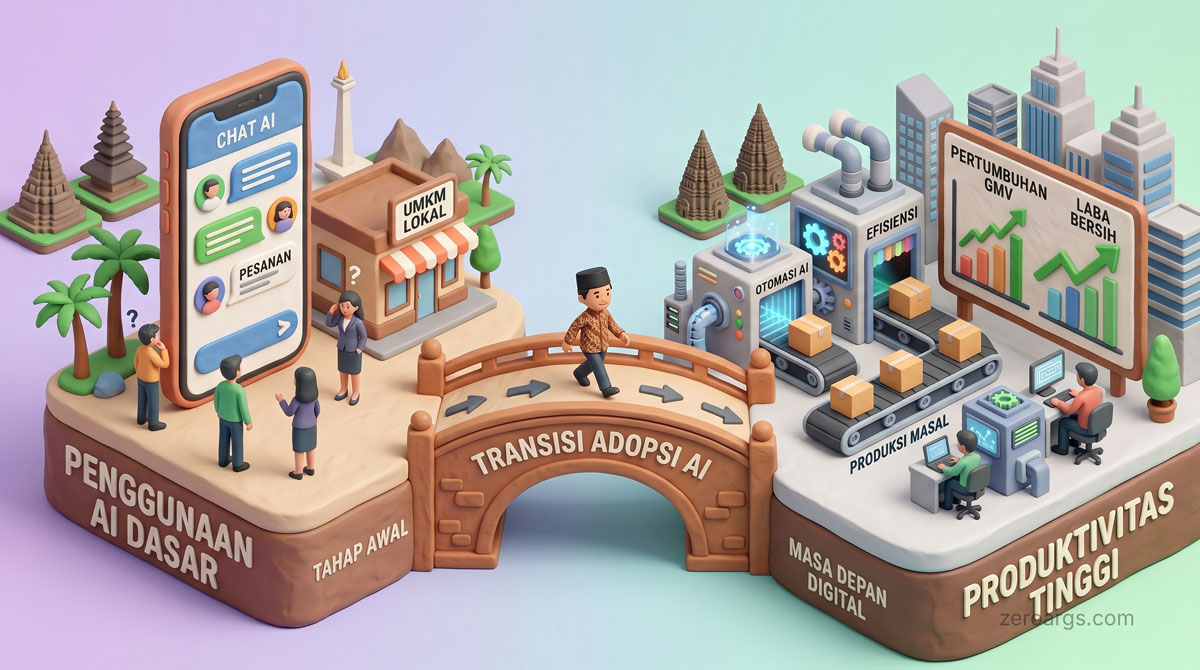
AI productivity for Indonesian businesses has become a headline topic since the Ministry of Communication and Digital Affairs reported that artificial intelligence adoption in the country has reached 92 percent — while productive use of the technology still lags behind. Many business owners already use ChatGPT to draft captions, summarize meetings, or reply to customer questions. But when you ask how many work hours were actually saved, or how many tickets were resolved without human intervention, the answer is often unclear.
This article helps you close the gap between "we use AI" and "AI genuinely speeds up our business" — with a framework that is realistic for SMBs, early-stage startups, and internal teams operating in Indonesia.
1. Why 92% AI Adoption Does Not Automatically Mean Higher Productivity
High adoption numbers are often mistaken for successful digital transformation. In practice, most AI usage is still ad hoc: copy-pasting into a chatbot, generating content without an editorial process, or testing a feature in an app with no success metrics.
Three patterns show up repeatedly in the field:
- Individual experiments — each team member uses a different favorite tool, with no data policy or quality standard for outputs.
- AI as a marketing label — an "Ask AI" button exists in the product but is not connected to a real operational workflow.
- No baseline — the business never measured how long a task took before AI, so claims of being "faster" cannot be verified.
Government initiatives and the startup ecosystem — including the Google for Startups Accelerator program that has graduated dozens of AI startups — emphasize that Indonesia's digital economy will only keep growing if technology adoption is followed by measurable value creation. For you as a business owner, the focus must shift from "do we use AI?" to "which workflows does AI actually improve?"
2. Audit Your AI Usage: Experiments versus Measurable Workflows
Before adding new tools, run a simple one-week audit. Ask everyone who uses AI to log: which task, how many minutes before, how many minutes with AI, and whether the output was used as-is or heavily edited.
Sort the results into two columns:
| Category | Characteristics | Action |
|---|---|---|
| Experiment | Not repeatable, no SOP, inconsistent output | Keep at individual level; do not build product on top |
| Measurable workflow | Same task recurs, clear input/output, auditable | Candidate for automation, API integration, or product feature |
Examples of measurable workflows we often see among SMBs in East Java and surrounding regions: answering shipping and stock questions on WhatsApp, summarizing chat orders into a spreadsheet, or drafting product descriptions from photos and short specs. All three have volume, repeating question patterns, and direct impact on team time.
If your digital foundation is still messy, prioritize basics such as digital transformation for MSMEs before investing in complex AI integration.
3. Three Fast-ROI Use Cases for Indonesian SMBs and Startups
Not every AI use case deserves priority. These three usually deliver the fastest results with controlled risk:
1. Repetitive customer service (FAQ, order status, business hours)
Similar questions on WhatsApp or Instagram DMs can be handled with a mix of reply templates and simple intent classification. You do not always need a large language model open to every topic — often 80 percent of inbound tickets are variations of the same 15 questions.
2. Operational content, not pure creative content
AI is useful for drafting product descriptions, promo summaries, or headline variations — as long as a human editor verifies pricing, stock levels, and legal claims. For businesses that also rely on marketplaces, align this strategy with our article on why Indonesian SMEs still need their own website so content does not live only on third-party platforms.
3. Data extraction from unstructured documents
Supplier invoices, manual forms, or order screenshots can be summarized into structured formats. This saves admin time more reliably than asking AI to "analyze business strategy" in the abstract.
Start with one high-volume use case. One workflow that works beats five half-finished pilots.
4. Generative Chatbot, RAG, or Simple Rules — When to Choose Which
After the audit, you will know whether the problem needs "smart" AI or just rule-based automation. A simple framework:
| Approach | Best when | Relative cost | Error risk |
|---|---|---|---|
| Rules + templates | Limited questions, deterministic answers | Low | Low |
| Classification + templates | Many phrasings, few intents | Low–medium | Medium |
| RAG (answers from internal docs) | Needs SOP, catalog, or long FAQ references | Medium | Medium — depends on source quality |
| Open generative chat | Idea exploration, internal brainstorming | Medium–high | High on customer channels |
Many Indonesian businesses jump straight to generative chat because it looks modern, when classification plus templates is enough for business hours, shipping estimates, or order status. If you are considering integration into an application, our guide to practical AI integration for business apps explains architecture patterns in more detail.
For multi-step automation — reading inbound email, checking stock, then drafting a reply — see also our article on AI agents for business automation, which covers when agent workflows make sense versus a simple chatbot.
5. Data, Indonesia's PDP Law, and Shadow AI Risk in Your Team
Productivity must not come at the cost of compliance. When employees paste customer data, financial summaries, or internal documents into public AI services without company policy, you face shadow AI — usage that is invisible, unmeasured, and potentially in breach of Indonesia's Personal Data Protection Law (UU PDP).
Minimum steps we recommend:
- Tool allowlist — define which services may be used for public data versus internal data.
- Anonymization — remove names, phone numbers, and identifiers before sending text to third-party models when possible.
- Limited logging — for AI features in your own product, store inference logs with a clear retention policy.
These policies do not block innovation; they let you scale AI workflows across the team without fear of data leakage.
6. Productivity Metrics That Actually Matter (Not Vanity Metrics)
"Saved 50% of time" without a baseline is an empty claim. More useful metrics:
- Cycle time — from inbound message to first reply, or from content request to publish.
- Escalation rate — what percentage of interactions still require a human after AI?
- Correction rate — how often must AI output be edited before it is usable?
- Cost per task — API tokens, tool subscriptions, divided by completed tasks per month.
Set realistic targets. For SMB customer service, cutting response time from 15 minutes to 5 minutes for 60 percent of routine questions is a real operational win — you do not need 100 percent automation in week one.
Track these numbers for 30 days before and after a change. That is the evidence that convinces investors, partners, or your own team.
7. A 90-Day Roadmap: From Pilot to Production
Here is the sequence we often use when helping clients in Indonesia:
Weeks 1–2: Pick one workflow and measure baseline Document volume, time, and failure points. Do not build a feature first.
Weeks 3–4: Limited prototype Test with a subset of questions or documents. Involve one operations person who knows the edge cases best.
Weeks 5–8: Integrate into channels you already use WhatsApp Business, an internal dashboard, or your website — wherever the team and customers are already active. Ensure payment gateway integration and order flows stay consistent if AI touches transactions.
Weeks 9–12: Evaluate and decide to scale If metrics hit targets, expand scope. If not, fix source documents, prompts, or downgrade to simple rules — do not force the wrong model.
| Phase | Focus | Output |
|---|---|---|
| Baseline | Observation | Time & volume numbers |
| Prototype | Quality validation | SOP + test set |
| Integration | Production channel | Live feature or workflow |
| Scale | Cost optimization | Data policy + monitoring |
The upfront investment for one measurable workflow is usually far cheaper than building a generic "AI platform" that does not solve a specific business problem.
Conclusion
AI productivity for Indonesian businesses is not about chasing the latest chatbot trend. It is about choosing repeatable workflows, measuring impact honestly, and establishing data policies before you scale. Ninety-two percent adoption is an opportunity — not proof that the work is done.
If you want to move AI from team experiments to measurable product features or operational automation, the Zero Args Technology team can help design a roadmap that fits your business scale — from SMBs in Nganjuk to startups preparing in-app integration. Start a conversation for an initial discussion with no commitment.


