- umkm
- e-commerce
- engineering
Is QRIS Taxed in Indonesia? The Nov 9 Facts for Sellers
A viral digital-tax rumor claims QRIS gets taxed from November 9 2026. The facts on SPP-TDLN, MDR, and what actually changes for Indonesian sellers.
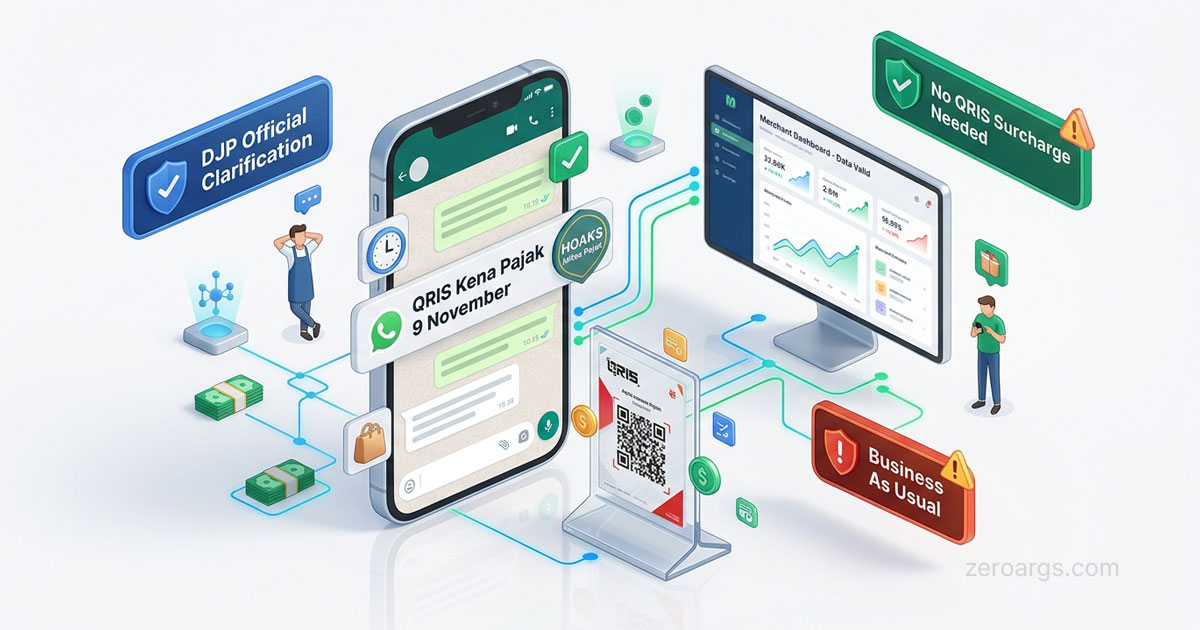
A forwarded message claiming that every bank transfer, digital-wallet top-up, and QRIS payment will be taxed starting November 9, 2026 has been circulating in Indonesian WhatsApp groups and on Facebook this week. Some merchants are asking whether to add a "QRIS tax" line at checkout — or switch QRIS off for a while. Indonesia's tax office (DJP) has publicly debunked the claim, but its clarifications are scattered across posts and press releases, and none explain what it means for a seller. This article sorts it out: what is true, what is a myth, and what you should actually do as a QRIS merchant and online store owner.
1. Where the "Digital Tax on November 9" Story Came From
It started with a speech by Hashim Djojohadikusumo, chair of Kadin's advisory council, at the opening of the 2026 Kadin National Meeting in Jakarta on October 29, 2026. He said that from November 9, all state banks, private banks, fintechs, and platforms such as Shopee, Lazada, and GOTO would have to "collect and remit the taxes that have not been collected so far".
The quote then circulated as Facebook posts on November 3, 2026, claiming a new digital tax would be charged on every marketplace transaction and bank transfer. Kompas's fact-checking team traced those posts and concluded the information was wrong.
Three official clarifications followed within three days:
- Finance Minister Suahasil Nazara, at the KSSK press conference on November 3, 2026, confirmed there is no new tax-collection scheme starting November 9, 2026 — "no new tax policy imposing VAT on every interbank transfer and digital wallet".
- DJP, through its Director of Counseling, Services, and Public Relations Inge Diana Rismawanti, explained that what was actually meant is SPP-TDLN — not a new tax and not a change to VAT rates.
- SME Minister Maman Abdurrahman confirmed that micro-businesses with turnover of up to IDR 500 million per year keep their 0 percent final income tax facility.
So the story is hot and search interest has spiked, but the substance is not a new tax on your daily transactions.
2. What SPP-TDLN and PMK 49/2026 Actually Say
SPP-TDLN (the Tax Collection System for Foreign Digital Transactions) is a mechanism for collecting VAT on digital products and services consumed in Indonesia but supplied from abroad. Its legal basis is Finance Minister Regulation Number 49 of 2026, and the system has been in force since September 25, 2026 — not starting November 9.
Its scope is specific: intangible taxable goods and taxable services used from abroad, such as software, applications, and AI services. What changes on November 9, 2026 is the list of appointed collection points — state banks, private banks, and fintechs start operating in that role.
Three boundaries make the "QRIS is taxed" claim miss the mark:
- Not every foreign transaction is subject to VAT. Collection applies only to transactions that meet the VAT-object criteria.
- Personal transfers and remittances are not in scope. The system was not designed to collect VAT on person-to-person transfers or family remittances.
- No double collection. VAT on a foreign digital transaction already collected through the PMSE mechanism is not collected again through SPP-TDLN.
3. QRIS Is a Payment Rail, Not a Tax Object
An official DJP article titled "QRIS Kena Pajak, Benarkah?" ("Is QRIS taxed, really?") frames it correctly: QRIS is a payment tool — a replacement for cash or a debit card — not a tax object. Paying for coffee with QRIS creates no additional tax obligation because of the payment method.
The parties around it are where tax actually lives:
- Payment service providers (PJSP) — the banks and fintechs offering QRIS. Their income from fees and commissions is subject to VAT (if registered as a taxable entrepreneur) and income tax.
- Merchants — you. Your tax obligations follow your line of business and turnover, regardless of payment method. A cash sale and a QRIS scan create identical obligations.
- Consumers — no new obligation. If a product is subject to VAT, that VAT is already part of the price, not a separate charge "for using QRIS".
One detail that actually works in a merchant's favor: the MDR you pay to your QRIS provider is an operating cost that can reduce gross income when calculating income tax. And since October 1, 2026, the rate for many cases has been zero.
4. Four Things the Rumor Blurs: MDR, Final Income Tax, VAT, and Withholding
Most of the panic comes from four different terms being treated as one "QRIS tax". This table separates them:
| Component | What it is | Who it applies to | Current rate |
|---|---|---|---|
| QRIS MDR | Provider fee charged to the merchant per transaction | The merchant, as a cost — passing it to buyers is prohibited | 0% for micro merchants up to IDR 500,000; 0.3% (micro) or 0.7% (small/medium/large) above the cap |
| Micro final income tax | Final income tax on micro and small business turnover | Individual sellers with turnover ≤IDR 500 million/year | 0% under Government Regulation 55/2022 |
| VAT on sales | Tax on sales of taxable goods and services | Only businesses registered as taxable entrepreneurs (PKP) | 11% — only if you are a PKP |
| Marketplace withholding (PPh 22) | Source withholding by appointed marketplaces | Sellers on Shopee, Tokopedia, Blibli, Lazada | 0.5% of gross turnover, running since October 1, 2026 |
Myths versus facts from this week's rumor cycle:
| Viral claim | Fact |
|---|---|
| Interbank transfers get VAT from November 9 | No — ruled out by the Finance Minister on November 3, 2026 |
| Wallet top-up balances get a tax deduction | No — VAT has only ever applied to certain admin fees, not the top-up amount |
| A new tax on QRIS | No collection applies to QRIS used for domestic transactions |
| Marketplace sales start being taxed on November 9 | Already running since October 1 via the 0.5% withholding — not a new rule |
| Micro sellers are tax-exempt | Final income tax is 0%, but that is not the same as being free of all reporting obligations |
5. When a QRIS Payment Can Genuinely Be Taxed
There is one legitimate case: when your QRIS is used to pay a provider based abroad. DJP's own examples are digital game top-ups and streaming subscriptions from foreign providers — transactions like these can fall into the SPP-TDLN VAT-collection scheme.
The principle is easy to remember: what gets taxed is the product or service being bought, not the payment channel used. A QRIS payment to a coffee stall in Nganjuk and a QRIS payment to a foreign streaming provider are both "QRIS", but only the second one touches SPP-TDLN — because its object is a taxable service from abroad, not because of QRIS itself.
6. What Actually Changes for Sellers on November 9
For your sales — at the counter, on marketplaces, or on your own website — nothing changes on November 9, 2026. No new deduction appears in your QRIS settlement, no extra VAT shows up at checkout, and no tax rate moves.
The change is on the expense side, not the revenue side. Many SMEs routinely pay subscriptions and advertising to foreign providers: Meta Ads, Google Ads, Canva, SaaS tools, hosting. The VAT obligation on services like these has existed for years, and most of it is already collected through the PMSE mechanism. The November 9 expansion adds collection channels — banks and fintechs can now act as collection points when you pay. If you are not a taxable entrepreneur, the practical effect is that a subscription invoice may show a VAT line; record it as a cost, and if you are a PKP, book the VAT shown correctly.
Your revenue side keeps following the rules you already know: MDR by merchant category, 0% final income tax for micro turnover under IDR 500 million, and the 0.5% withholding only if you sell on appointed marketplaces. If you want to revisit your per-channel margin math, we laid out the framework in our zero-percent QRIS MDR guide.
7. A November 9 Checklist for QRIS Merchants and Store Owners
Nothing needs a panic change, but five small steps keep your books clean:
- Verify before repricing. Check viral tax claims against pajak.go.id or DJP's official channels before touching your prices. Do not reprice because of a forwarded message.
- Do not add a "QRIS tax" surcharge at checkout. There is no tax to pass on, and Bank Indonesia prohibits charging MDR to buyers either. Prices on your website must be final.
- Reconcile settlements weekly. Confirm the deductions in your provider dashboard still match your category's MDR — 0% under the nominal cap, 0.3%/0.7% above it. Report odd deductions to your provider rather than blaming a "new tax".
- Separate foreign-expense ledgers. Create a dedicated category for foreign SaaS subscriptions and ads with a
vat_foreign_servicesfield, so VAT lines on invoices stay traceable and do not mix with domestic operating costs. - Check withholding slips if you sell multi-channel. If you sell on appointed marketplaces, reconcile your withholding slips against monthly sales recaps — the same workflow as our marketplace PPh 22 withholding guide.
And if your turnover is approaching IDR 500 million per year, start planning for PKP status and sales-tax obligations — that need ties directly into recording website sales data for filing, as covered in our VAT and Coretax guide.
Conclusion
QRIS is not hit by a new tax on November 9, 2026. SPP-TDLN under PMK 49/2026 only organizes VAT collection on digital products and services from abroad, with banks and fintechs joining as new collection channels — it is not a tax on your transfers, your customers' top-ups, or the sales of your stall or online store. What stays in force is the existing rulebook: MDR by merchant category, 0% final income tax for micro turnover up to IDR 500 million, VAT only if you are a registered taxable entrepreneur, and the 0.5% withholding on appointed marketplaces.
The most productive move this week is not panic — it is tidying your books: separating foreign subscription costs, reconciling QRIS settlements, and making sure your checkout adds no surcharge it shouldn't. If you are building or improving an online store and want a technical partner for payment and bookkeeping integration, our website development service handles QRIS, payment-gateway, and ledger flows from day one. Start a conversation — we will help you check your payment setup before the next deadline.
Frequently asked questions
Is QRIS taxed starting November 9, 2026?
No new tax applies to domestic transactions made with QRIS. SPP-TDLN under PMK 49/2026 only collects VAT on digital products and services used from abroad.
Are bank transfers taxed starting November 9, 2026?
No. Indonesia's Finance Minister confirmed there is no new VAT collection on interbank transfers or digital wallet balances starting November 9, 2026.
What taxes apply to an Indonesian seller accepting QRIS?
Final income tax of 0 percent for micro-businesses with turnover up to IDR 500 million per year, MDR as a merchant cost (0 percent for micro merchants up to IDR 500,000), and the 0.5 percent marketplace withholding only if you sell on appointed marketplaces.
What changes on November 9, 2026?
Appointed banks, fintechs, and platforms start operating as collection points for VAT on foreign digital transactions. Your domestic sales do not change.
Can I add a QRIS tax surcharge at checkout?
No. There is no QRIS tax to pass on, and Bank Indonesia prohibits charging MDR to buyers. Prices on your website must be final.