- umkm
- e-commerce
- marketplace
- engineering
Shopee 11.11 Voucher Tiers: Picking 5%, 10%, or 15%
Shopee 11.11 voucher tiers rise to 5%, 10%, and 15%, funded by sellers. Here is the per-SKU margin math to run before nomination closes on November 12.
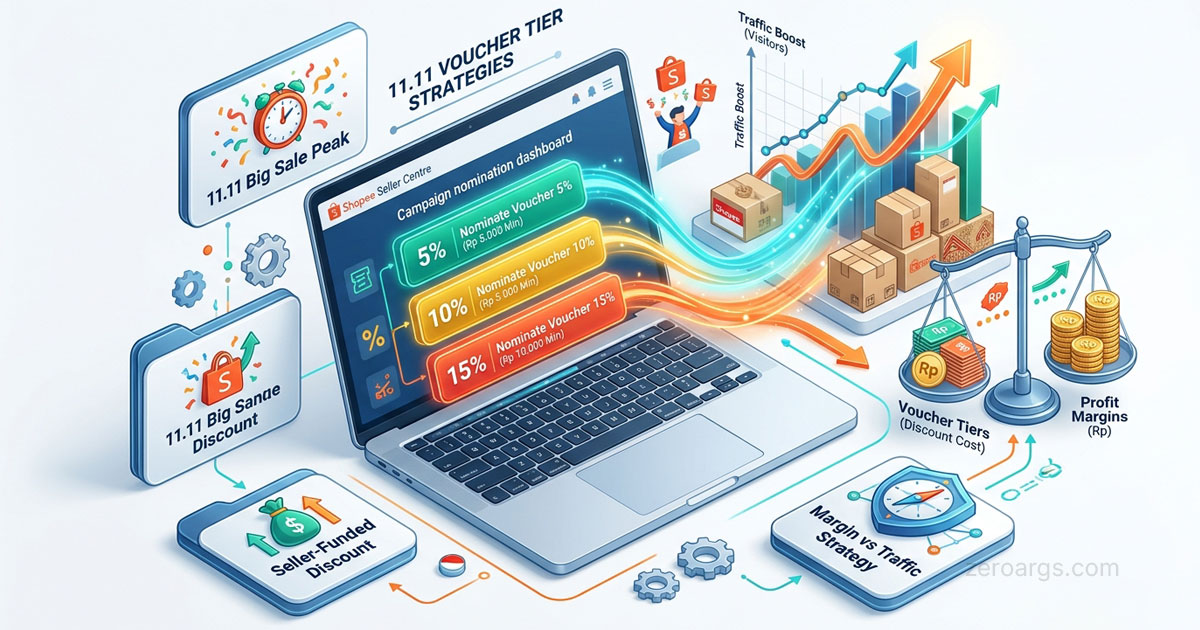
Shopee 11.11 voucher tiers jump to 5%, 10%, and 15% the moment the mega-sale window opens — and the party paying for them is not the platform, it is the seller. The 11.11 Big Sale campaign has been running since October 25 and peaks on November 11, 2026, with product nomination in Seller Centre open through November 12. The decision you make this week is not just "join or sit out"; it is how much margin you are willing to bid for traffic weight.
1. What Changes When the Mega-Sale Window Opens: Platform Vouchers Rise to 5%, 10%, 15%
On ordinary days, Shopee's platform vouchers run at a few fixed, relatively low tiers. Once a mega-sale window opens — 9.9, 11.11, 12.12, and Pay Day events — the tiers jump straight to 5%, 10%, and 15%, with one rule the platform states explicitly: the seller-funded portion is deducted from your sales as a marketing cost. Higher tiers trade for more ranking weight in the recommendation model; in practice, not joining means voluntarily surrendering traffic.
That makes the 11.11 platform voucher behave like paid acquisition. You are spending a percentage of the selling price to buy position in search results — exactly like advertising, except it is deducted from settlement instead of an ads balance. This framing drives the rest of the article: treat every tier as a traffic-price offer, and only take offers your margin can carry.
The schedule that matters this week: campaign period October 25 through November 11, 2026, promo peak on November 11, and product nomination October 25 through November 12 via Promotion Center → 11.11 Big Sale Nomination. Each nomination has a limited window — once one program's window closes, you can only register for programs that are still open.
2. Five Layers of Cost Behind One 11.11 Order
The most common mega-sale mistake is counting only the voucher money. The real deductions stack five layers deep: voucher tier + category commission + transaction fee + shipping subsidy + ads. Before assembling any numbers, check your own rates in Seller Centre — Shopee's regular commission generally falls in the 2.5–10% range by category (Mall up to about 11.7%) according to October 2026 tracking data, and rates differ per shop.
The free-shipping program adds its own load. Participation is called voluntary, but listings that opt out rank lower in the recommendation model — during mega-sale season, that is effectively not a choice. Then add one mandatory deduction sellers keep forgetting: PPh Article 22 at 0.5% of gross turnover, withheld by the marketplaces appointed by Indonesia's Directorate General of Taxes since October 1, 2026 (Shopee among them) when each transaction settles.
Build a small spreadsheet with one row per deduction. Without that table, 11.11 ends and you discover you worked the peak for nothing when settlement reconciles a month later.
3. Compute Gross Margin per SKU First, Then Pick a Tier
A worked example. A fashion product priced at Rp150,000, with a cost of goods of Rp90,000, carries a gross margin of Rp60,000 (40%). Illustrative rates: 8% commission, 2% transaction fee, Rp5,000 shipping subsidy per order, 0.5% PPh 22 (you have not submitted the exemption statement). Run all three tiers under the worst case — every order redeems a voucher:
| Deduction component | Tier 5% | Tier 10% | Tier 15% |
|---|---|---|---|
| Platform voucher | Rp7,500 | Rp15,000 | Rp22,500 |
| Commission 8% | Rp12,000 | Rp12,000 | Rp12,000 |
| Transaction fee 2% | Rp3,000 | Rp3,000 | Rp3,000 |
| Shipping subsidy | Rp5,000 | Rp5,000 | Rp5,000 |
| PPh 22 (0.5%) | Rp750 | Rp750 | Rp750 |
| Total deductions | Rp28,250 | Rp35,750 | Rp43,250 |
| Net contribution per order | Rp31,750 | Rp24,250 | Rp16,750 |
At tier 15%, contribution nearly halves versus tier 5% — and that is before ads. Now stress-test: if a second product's cost of goods is Rp112,500 (25% gross margin), tier 15% produces a net contribution of minus Rp5,750 per order. You are paying customers to shop, for the sake of ranking.
Do not stop at the worst case. Open your 9.9 settlement and compute the actual redeem rate of platform vouchers last month. If only 60 of 100 orders used a voucher, the effective voucher cost of tier 10% is 6% of price, not 10%. Make the final call with that number — worst case to cap risk, historical redeem rate to forecast reality.
4. Set Tiers per Product, Not per Shop
A voucher tier is not one decision per shop. Treat every SKU as its own bidder:
- Traffic magnets with gross margin above 35% — candidates for tier 10% or 15%, buying rank and absorbing new buyers.
- Margin keepers in the 25–35% band — tier 10% maximum, or stay at 5% if your redeem rate runs high.
- Thin-margin products below 25% — do not join a high tier. Pull them from the voucher program, or route buyers to a channel you control.
Two operational notes. First, set your price position two weeks before the peak, not at the last minute — sudden price changes right before a campaign tend to trigger the platform's price-comparison mechanisms. Second, make sure nominated stock is safe: the platform may adjust stock allocations without notice, and selling out at peak hour wastes the ranking weight you already paid for.
If you run livestreams or short video, stack them on top of the voucher tier — those channels have shown daily sales multiplying several times over in Shopee's 9.9 data in other markets, which lowers your effective traffic cost per transaction.
5. Deductions Beyond the Voucher: PPh 22, Shopee Fee Invoices, and the Sapa UMKM Discount
Three items outside the voucher decide your final numbers:
- PPh Article 22 at 0.5% is withheld from gross turnover at settlement, separate from all platform fees. If you are an individual seller with cumulative annual turnover below Rp500 million, submit a stamped statement letter (meterai Rp10,000) to be exempted — turnover counts combined across all appointed marketplaces, not per platform. The details are in the marketplace PPh 22 guide.
- Shopee fee tax invoices from November — service fees, affiliate commission, and ad-balance top-ups start carrying 11% VAT invoices. If you are a VAT-registered business (PKP), that invoice becomes creditable input VAT; if not, just book the cost. This is one more reason your sales ledger must separate fees by type, as covered in the Shopee tax invoice guide for November 2026.
- The Sapa UMKM 50% service-fee discount trims commission, admin fees, and base shop-app fees for verified micro and small businesses selling local products — fashion and craft are explicitly prioritized. The discount does not touch voucher costs, but it lifts your gross margin so a higher tier becomes more affordable. Check whether your product category qualifies in the marketplace fee discount guide.
6. Reconcile After the Peak: Verify Real Deductions Before 12.12
The 11.11 decision repeats at 12.12 with the same tiers, so the November 11 peak doubles as your evaluation run. Within three days after the peak, match settlement against your order lines, one deduction type at a time:
| Line to check | The question it answers |
|---|---|
| Platform vouchers | What was the actual redeem rate, and the effective cost as % of price? |
| Commission + transaction fee | Did rates match your category, or did something change without notice? |
| Shipping subsidy | What was the per-order load during the free-shipping window? |
| Ads | What did customer acquisition cost per 11.11 campaign order? |
| PPh 22 | Do the withholding slips reconcile against that month's gross turnover? |
Compare actual net contribution per tier against the table you built before the campaign. If tier 10% turned out to produce negative contribution, you have exact numbers for 12.12 and for Harbolnas on December 10–16. Save the redeem rate — it is your bargaining data for next year's tiers. The per-channel per-SKU bookkeeping method is laid out in the net margin guide: marketplace vs website.
7. Decision Table: Join at 5%, 10%, 15%, or Route to Your Own Channel
Compress the math into one decision table per SKU:
| Gross margin per SKU | Recommended 11.11 tier | Notes |
|---|---|---|
| Above 35% | 10–15% | Buy rank during the window; stack livestreams and measurable ads |
| 25–35% | 10% maximum | Check your 9.9 redeem rate first; keep the shipping subsidy affordable |
| 15–25% | 5% only | Enough not to be left behind; do not chase rank |
| Below 15% | Do not join | Route buyers to your own channel or postpone the promo |
Products in the bottom two rows are not failed products — they are natural candidates for an owned channel. On your own website, micro-business transactions can run through QRIS with 0% MDR up to Rp500,000 per transaction for micro merchants (in effect since October 1, 2026), with no category commission and no voucher stack. The mechanics are covered in the QRIS zero-MDR guide for SME websites. When 11.11 traffic arrives, a product page on your own channel is the net that catches customers you no longer pay for per order — and if December's Harbolnas is on your roadmap, your own channel's technical readiness should start now; see the Harbolnas 2026 website readiness guide.
Conclusion
Shopee 11.11 voucher tiers are a traffic auction funded by your margin: 5% to show up, 10% to compete, 15% for the front row. Compute the full stack per SKU — voucher, commission, transaction fee, shipping subsidy, ads, and PPh 22 — pick the highest tier your gross margin can carry, and verify the result through settlement reconciliation before the 12.12 window opens. This per-SKU per-channel framework comes from the net margin guide: marketplace vs website. If your owned channel is not yet ready to catch the customers you cannot profitably serve at high tiers, website development services from Zero Args Technology can build an online store with QRIS integration, per-SKU bookkeeping, and campaign-ready promo pages. Start a conversation and bring your margin table — we start from your numbers, not from a feature list.
Frequently asked questions
When does Shopee 11.11 Big Sale product nomination close?
Nomination runs from October 25 to November 12, 2026 through the Promotion Center in Seller Centre, with the campaign peaking on November 11. Each nomination program has a limited window, so register before the program you are targeting ends.
Who funds the 11.11 platform vouchers?
The seller-funded portion of each platform voucher is deducted from your sales as a marketing cost. Higher tiers trade for more ranking weight in search and recommendations during the mega-sale window.
What are the platform voucher tier rates during 11.11?
During mega-sale windows such as 9.9, 11.11, and 12.12, Shopee's platform voucher tiers rise to 5%, 10%, and 15%. On normal days the tiers are lower, and the exact value of each tier follows the program terms in Seller Centre.
Is the 0.5% PPh 22 withholding applied during 11.11?
Yes. Since October 1, 2026, the marketplaces appointed by Indonesia's tax office withhold PPh Article 22 at 0.5% of gross turnover when a transaction settles. Individual sellers with annual turnover up to Rp500 million can be exempted with a stamped statement letter.
How do I pick a voucher tier for low-margin products?
Compute the full deduction stack per SKU: voucher, commission, transaction fee, shipping subsidy, and ads. If the net contribution is negative or too thin, do not climb tiers — stay at 5%, pull the product from the program, or route buyers to your own channel.