- engineering
- ai
- mvp
- startup
Model Context Protocol (MCP) for Indonesian Business AI
Model Context Protocol (MCP) connects AI to your business data and APIs. A practical architecture, UU PDP security, and MVP roadmap for companies in Indonesia.
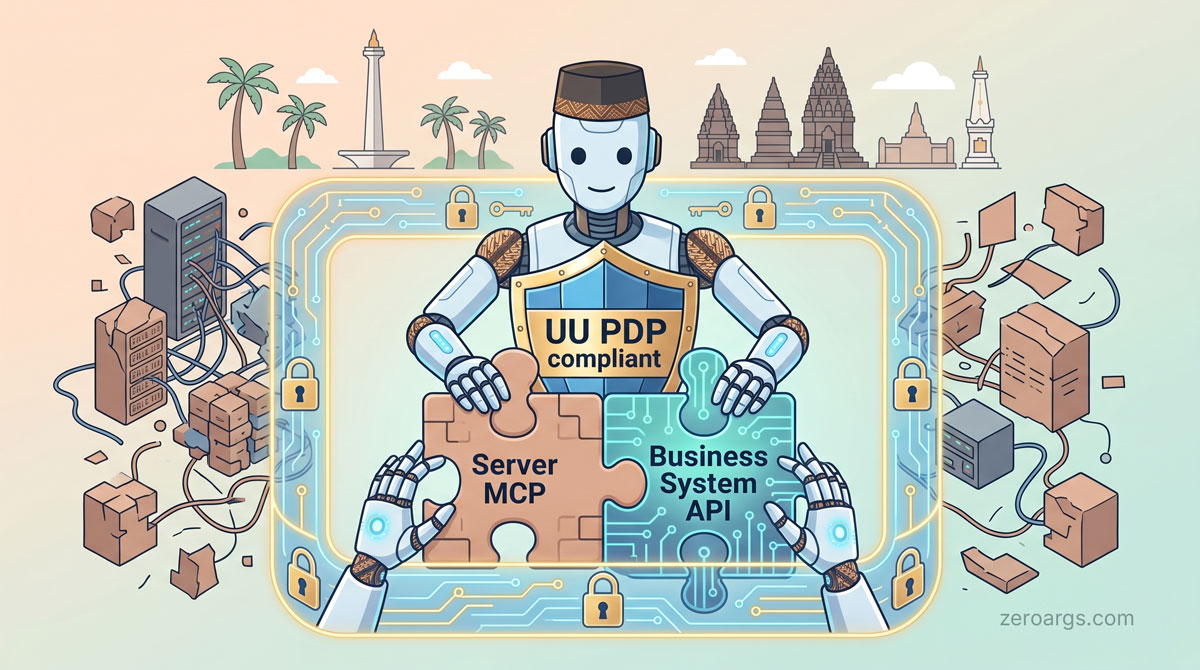
Model Context Protocol (MCP) is quickly becoming the default way to connect AI assistants to real business systems — not generic chat that guesses at your policies, but a standardized integration layer that lets models read transaction data, call payment APIs, or check order status under explicit permissions. In Indonesia, local MCP servers from providers such as Mayar and DOKU, plus the push toward agentic AI on major platforms, signal that the topic has moved well beyond lab experiments.
This article explains what MCP means in product terms, when it beats one-off API glue, and how to design a first implementation that stays aligned with Indonesia's Personal Data Protection Law (UU PDP).
1. What MCP Is and How It Differs from Custom API Glue
Model Context Protocol is an open standard that defines how AI applications (hosts) talk to external data sources (servers) through a consistent interface. Instead of writing bespoke connectors for every model-and-service pairing, MCP uses the same pattern everywhere: servers expose tools (callable functions), resources (readable data), and prompts (standardized templates).
The practical difference shows up once you already integrate with Midtrans, an order database, and Google Sheets — then want to swap model providers or add an assistant on another channel. Without MCP, each change often means copying authentication, validation, and response-shaping logic into multiple codebases. With MCP, the same server can be reused by Claude Desktop, an AI-powered IDE, or an internal agent runtime you build yourself.
MCP does not replace the REST APIs and webhooks you already have. It is a layer above them that makes your business capabilities discoverable and invokable by AI systems with uniform semantics.
2. Real Operational Problems MCP Solves for Indonesian Businesses
Many teams in Indonesia hit the same pattern when adding AI to a website, internal app, or WhatsApp Business channel:
- Customer data lives in a CRM, stock in spreadsheets, payments in a separate gateway — the assistant has no canonical starting point.
- Every integration proof-of-concept ships as a quick script that becomes hard to audit when regulators or enterprise clients ask who accessed what.
- The AI vendor changes, and the team rewrites connectors even though business logic stayed the same.
MCP reduces that friction by separating data ownership (a server you or a partner control) from the conversation surface (the host users see). A concrete example: an MCP server wrapping JNE or SiCepat shipment-status APIs can power a support agent without embedding credentials in every prompt.
If you are already evaluating AI agents for business automation, MCP is often the foundation that connects those agents to systems already in production — it does not replace workflow design, but it standardizes how steps execute.
3. Architecture Components: Host, Server, and Tools
MCP architecture boils down to three roles:
- Host — the application running the model and managing user sessions (a desktop client, internal web app, or agent runtime).
- MCP server — a process exposing capabilities to the outside world: read balances, draft invoices, or fetch FAQs from a knowledge base.
- Transport — typically JSON-RPC over stdio, HTTP, or SSE depending on deployment.
In a healthy design, the MCP server does not store AI model credentials. It stores or forwards credentials for business systems (payment gateway API keys, WhatsApp tokens) with tight scope limits. The host owns inference policy; the server owns authorization for actions against your data.
For small teams, one MCP server with three to five well-defined tools usually beats dozens of generic functions. Start with the workflow you repeat most — for example, "look up order status by phone number" — then expand once audit logs and quality metrics stabilize.
4. When to Build Custom MCP Servers vs Use Off-the-Shelf Ones
This mirrors build-vs-buy on any integration, with higher security stakes because AI can trigger many calls in a loop.
Use off-the-shelf servers when:
- A provider you already trust ships an official MCP server (for example, payment servers in the local ecosystem).
- Your needs align with exposed tools — check transactions, create payment links, pull sales summaries.
- You want faster validation without a full backend team.
Build custom servers when:
- Data sits in internal systems without modern APIs — legacy ERP, on-prem databases, or industry-specific workflows.
- You need extra policy layers: sensitive-field masking, business-hours restrictions, human approval before refunds.
- Multiple AI hosts will run in parallel and you want one source of truth for access control.
As a rule of thumb, if an existing community or vendor server covers 70% of your needs, use it first. Custom investment pays off once you know which tools are actually invoked in production, not in demos.
5. Integrating with Indonesia's Stack: Payments, WhatsApp, and Internal Data
MCP shines in the Indonesian market because it unifies tools you already use daily:
- Payments: gateways such as Midtrans, Xendit, or Doku can be wrapped as MCP tools to create virtual accounts, check QRIS status, or list today's transactions — without copying API snippets into every prompt experiment. Our payment gateway integration guide still applies to REST foundations; MCP adds an agent-friendly interface on top.
- WhatsApp Business: an MCP server can read approved templates, prepare draft replies, or fetch conversation metadata — with human-in-the-loop before anything actually sends. See our WhatsApp Business API guide for official channel requirements.
- Marketplaces and omnichannel: instead of letting the model guess stock from chat snippets, the MCP server pulls numbers from the source you designate — aligned with omnichannel inventory sync if you sell on Tokopedia, Shopee, or TikTok Shop.
Hosting close to users — for example GCP asia-southeast2 (Jakarta) or AWS ap-southeast-3 — remains advisable so latency does not become the bottleneck when an agent chains multiple tool calls in one session.
6. Security, UU PDP, and Access Control for MCP
Every MCP tool expands your attack surface and personal-data processing chain. In Indonesia, UU PDP requires clear processing purposes, restricted access, and auditable trails.
Minimum practices we apply on client projects:
- Least privilege: each MCP server exposes only the functions a specific workflow needs; separate read-only servers from write/transaction servers.
- Centralized authentication: API keys live in a secret manager, not in config files committed to a repo.
- Strict input validation: treat model output as untrusted input; servers must validate parameters before calling downstream APIs.
- Rate limiting and token budgets: prevent agent loops that invoke tools hundreds of times because of a planning mistake.
- Auditable logging: who triggered a tool, which parameters (after redaction), and whether the call succeeded or failed.
For broader compliance foundations, review our practical UU PDP guide for web and mobile apps. MCP does not exempt you from those obligations — it makes integration points more visible and therefore easier to govern.
7. MVP Implementation Roadmap: One Server, One Workflow
Here is the sequence we usually recommend for an MCP MVP in eight to twelve weeks with a small team:
- Pick one measurable workflow — example: "support staff summarizes order status plus tracking for WhatsApp customers."
- Inventory source systems — which APIs are stable, which data may enter model context.
- Build a minimal MCP server — three tools:
get_order_by_phone,get_shipment_status,draft_reply(no auto-send in phase one). - Connect a host — internal client or agent runtime with a daily inference budget cap.
- Test on real cases — at least 50 historical conversations (anonymized) to measure accuracy and manual escalation rate.
- Harden — add human approval, tighten logging, document retention policy.
Do not start with "connect the entire company to AI." One reliable server beats a platform vision that never reaches production. This aligns with practical AI integration: start narrow, measure, then expand.
A conceptual local server config (not a full production recipe):
{
  "mcpServers": {
    "orders": {
      "command": "node",
      "args": ["./mcp-servers/orders/dist/index.js"],
      "env": {
        "ORDER_API_URL": "https://api.internal.example.id",
        "MCP_READ_ONLY": "true"
      }
    }
  }
}
Environment variables keep configuration out of code; a read-only flag helps pilot phases before you allow write actions.
8. Comparison: Custom Integrations, MCP, and AI SaaS Platforms
| Approach | Best when | Main strength | Main weakness |
|---|---|---|---|
| Custom glue per model | One-off experiments, single AI vendor | Fast demos | Hard to maintain, hard to audit, vendor lock-in |
| MCP (standardized servers) | Multiple AI hosts, data in your systems | Reusable tools, clear access boundaries, path to agents | Requires upfront security and engineering discipline |
| AI SaaS platforms (plug-and-play chatbots) | Simple FAQ, no technical team | Fast time to market | Less flexible for cross-system workflows |
SaaS platforms remain valid for businesses that only need answers from a website FAQ. Model Context Protocol becomes compelling once you have custom applications, data spread across APIs, and want an agent or internal assistant that actually executes steps — not just paraphrases marketing copy.
Conclusion
Model Context Protocol (MCP) offers a standardized way to connect AI to your business data and operations in Indonesia — from QRIS payments to marketplace order status — without rewriting connectors every time the model or channel changes. Success depends less on buzzwords than on disciplined scope, security aligned with UU PDP, and one measurable MVP workflow before expansion.
If you are planning a custom MCP server, agent integration on an existing app, or an architecture review of AI already in production, we help design implementations that fit your team size and compliance needs. Start a conversation by describing the systems you want to connect and the first workflow you aim to automate.