- engineering
- umkm
- mvp
- startup
Vibe Coding for Indonesian Businesses: When AI Is Enough
Vibe coding for Indonesian businesses: realistic SMB use cases, security and UU PDP limits, comparison with low-code and custom dev, plus a checklist before you commit.

Vibe coding — building software by describing what you want to AI instead of writing every line yourself — became one of the most talked-about technology trends in Indonesia during 2026. Global downloads of generative AI apps doubled to 3.8 billion throughout 2025, and AI app revenue nearly tripled to USD 5 billion according to Sensor Tower's State of Mobile 2026 report. In Indonesia, an APJII survey shows 26.9% of people already use AI for work productivity — yet the national AI literacy index sits at 49.96, meaning many people can use AI but not necessarily build with it safely.
For SMB owners and early-stage founders, the practical question is not whether vibe coding works in a demo. It is when AI-assisted building is enough and when you need professional developers so your digital investment does not turn into expensive technical debt.
1. What Vibe Coding Is and Why It Took Off in 2026
Vibe coding means describing features, flows, or UI in natural language — often Bahasa Indonesia — and letting AI produce code, components, or automation scripts. Popular tools among business builders include Cursor, Bolt, Lovable, v0, and ChatGPT in coding mode.
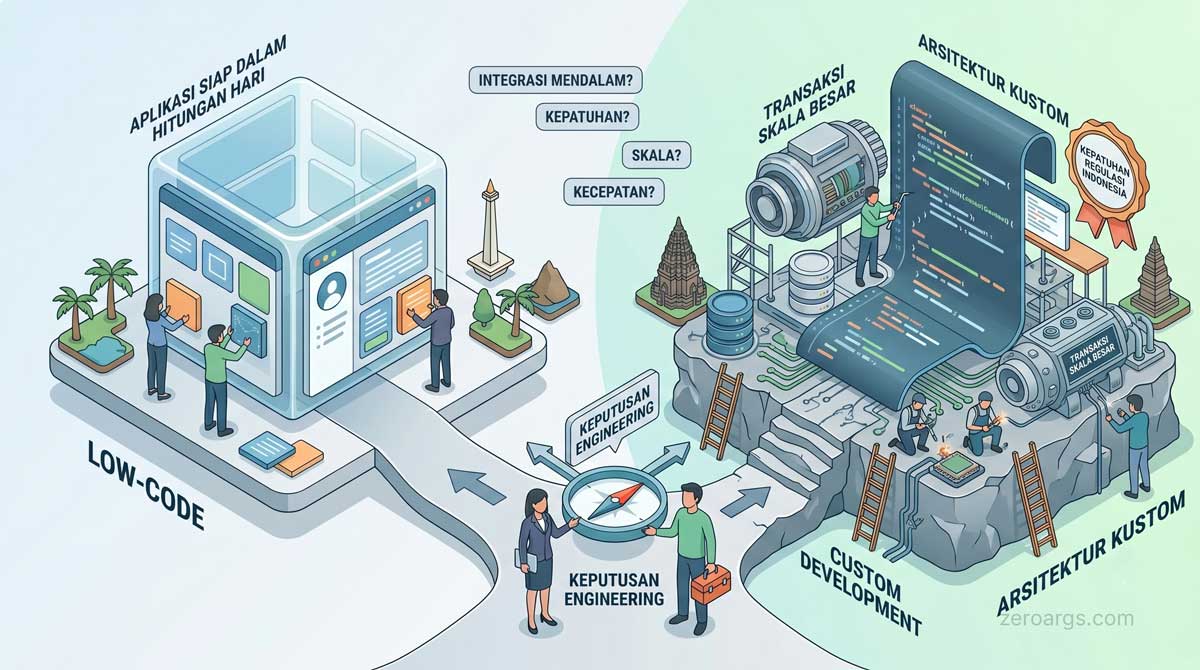
The difference from low-code: platforms like Bubble or Retool offer visual builders inside platform constraints. Vibe coding produces real code (React, Python, SQL) that can theoretically be moved and modified — if the output quality is acceptable and someone on your team can read it.
Drivers of adoption in Indonesia in 2026:
- Rising developer costs while AI coding assistants get cheaper.
- Efficiency pressure on MSMEs without IT teams — Indonesia's Ministry of MSMEs notes that more than 90% of MSME operators still do not use AI optimally in daily operations.
- Speed expectations: a landing page overnight, a stock dashboard over a weekend.
The narrative that "anyone can be a developer" is attractive — but in practice, the gap between a demo that works on a laptop and a system that is safe in production is often wider than marketing suggests.
2. Realistic Use Cases for SMBs and Early Startups
Vibe coding makes the most sense for needs with clear flows, small scale, and limited error tolerance. Examples that often succeed:
- Promotional landing pages — campaign pages, event registration forms, or mini catalogs for a seasonal promotion.
- Simple internal tools — stock trackers beyond spreadsheets, invoice generators, or daily sales summaries that replace manual copy-paste.
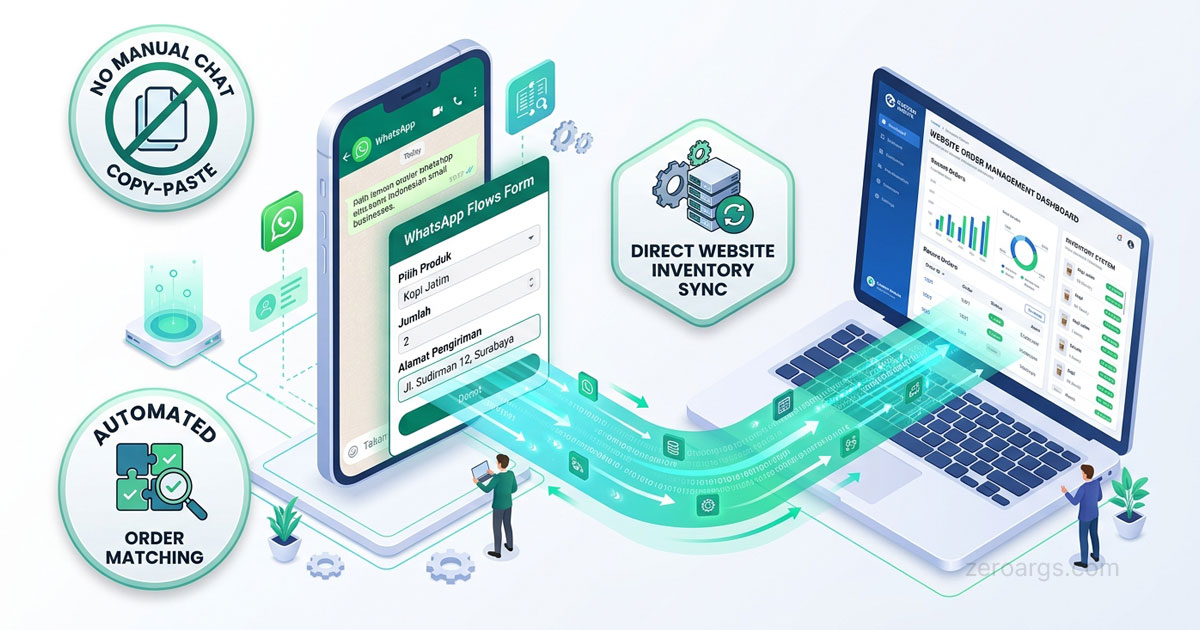
- Repetitive automation — scripts that pull WhatsApp or email data into Google Sheets, send payment reminders, or compile weekly reports.
- Basic FAQ chatbots — answers to common questions (hours, package prices, address) before you invest in full WhatsApp Business API integration.
Criteria that make these use cases suitable:
| Criterion | Why it matters |
|---|---|
| Limited users | Internal team of 5–15 people, not thousands of external customers |
| No direct financial transactions | Does not process card payments or e-wallet balances |
| Non-sensitive data | Does not store medical records, ID numbers, or customer bank accounts |
| Replaceable within a week | If it breaks, operational impact stays contained |
For more advanced chatbots — including human escalation and WhatsApp catalog integration — our guide on AI WhatsApp customer service for Indonesian SMBs explains when basic automation is enough and when architecture needs to level up.
3. Limits People Discover After the First Demo
AI-generated prototypes often look finished on a founder's laptop. Problems usually appear after go-live:
- Unmaintainable code — messy file structure, no tests, duplicated logic. Developers assigned to fix it later often spend more time than rebuilding from scratch.
- Weak default security — unauthenticated endpoints, API keys embedded in source, or database queries vulnerable to injection. AI does not automatically apply OWASP practices.
- Complex Indonesia integrations — QRIS, BCA/BRI virtual accounts, Tokopedia or Shopee webhooks, and omnichannel SKU mapping need retry logic, idempotency, and error handling that AI often oversimplifies.
- Performance on slow connections — many mobile users in East Java and outside major cities access sites on unstable 3G/4G. Code generated without image optimization, caching, or lazy loading can fail in the field despite feeling fast on office WiFi.
- Hallucinated dependencies — AI recommends libraries that do not exist, deprecated versions, or fictional API endpoints. Without verification, build pipelines fail or runtime errors appear in production.
If your website or app already faces customers, our website security checklist for Indonesian businesses is a minimum baseline before publish — regardless of who wrote the code.
4. Vibe Coding vs Low-Code vs Custom Development
These three approaches are often mixed in one conversation. Operational differences:
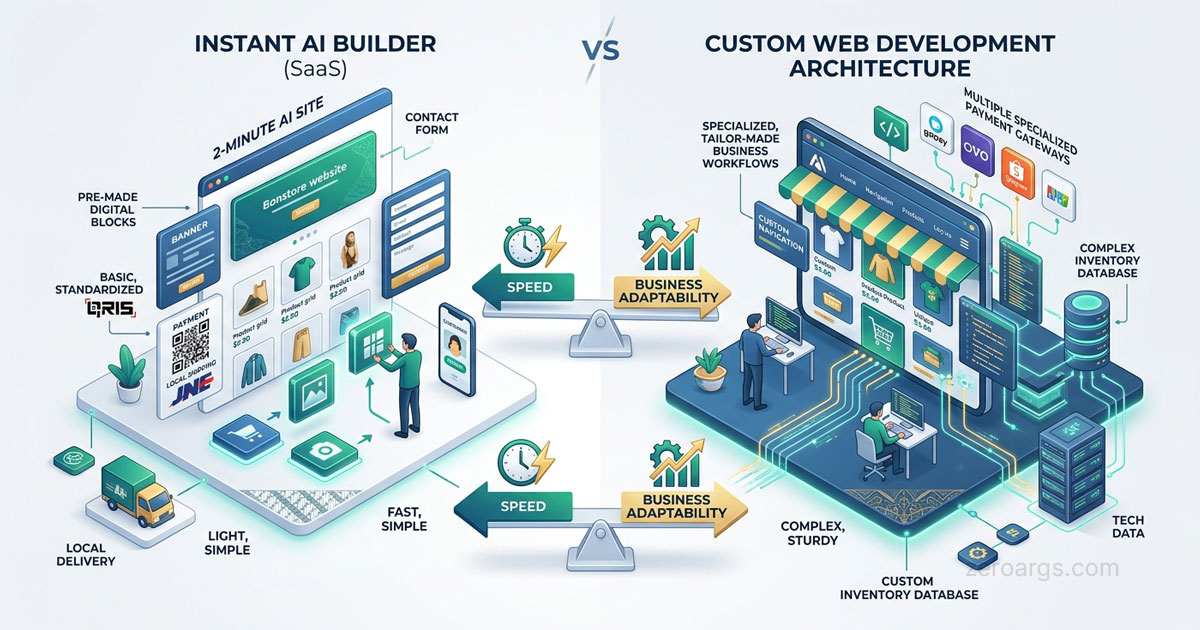
| Aspect | Vibe coding (AI) | Low-code / no-code | Custom development |
|---|---|---|---|
| Who builds | Founder, ops, marketing | Non-technical teams + vendors | Developers / agencies |
| Output | Code (variable quality) | Apps on vendor platform | Code with team standards |
| Initial speed | Very fast (hours–days) | Fast (days–weeks) | Moderate (weeks–months) |
| Architecture control | Theoretically high, practically low without engineers | Low — locked to platform | Full |
| Hidden costs | Refactor, security, production bugs | Subscriptions, lock-in, integration limits | Higher upfront cost |
| Best for | Prototypes, small internal tools | Visual operational workflows | Core product, scale, compliance |
Vibe coding is not a replacement for low-code — and not a replacement for custom development. It is a new way to accelerate the earliest layer of the build curve. Our article on when to choose low-code vs custom development covers when visual platforms are enough; vibe coding is often a step before that or an alternative for founders comfortable experimenting with prompts.
5. Indonesia Regulation: UU PDP, PSE, and NIB
Building with AI does not exempt you from the same rules as building with human developers:
- UU PDP (Indonesia's Personal Data Protection Law) — if your app stores names, phone numbers, addresses, or payment data, you need lawful basis, privacy policy, and deletion mechanisms. AI-generated code rarely includes these by default. Our practical UU PDP guide for business web apps covers minimum technical steps.
- Komdigi PSE registration — electronic systems offering public services (including web apps with user accounts) may need registration as a Private Electronic System Provider. Vibe coding does not change that obligation.
- NIB and OSS — if your online store or app sells goods or services commercially, formalization through OSS and NIB remains relevant — especially after Permendag 19/2026, which strengthens compliance for digital merchants.
"Where is data stored?" matters: many AI coding tools run on servers outside Indonesia. For Indonesian customer data, hosting in Jakarta region — GCP asia-southeast2 or AWS ap-southeast-3 — is often a compliance requirement, not just a performance preference.
6. Checklist: Seven Questions Before You Commit
Before turning an AI prototype into a permanent operational system, answer honestly:
- Does this generate revenue directly? If yes, errors mean lost sales or reputation.
- How many external users in 6 months? Above roughly 500 active users, architecture needs review.
- Is there financial or identity data? If yes, security audit is mandatory — not optional.
- Who fixes bugs on Sunday night? If the answer is "nobody," you are not ready for production.
- Do you need QRIS, marketplace, or WhatsApp API integration? If yes, plan proper engineering.
- Can this system stay down 24 hours without major loss? If not, you need monitoring and backups.
- Is there a migration plan if AI-generated code does not scale? Document business flows and export structured data from day one.
If you answered "yes" to questions 1, 3, 5, or 6, vibe coding may still help for exploration — but production should involve developers who can review, harden, and maintain the code.
7. Roadmap from AI Prototype to Production
Patterns we see work across Indonesian businesses — from food MSMEs in Nganjuk to B2B startups in Jakarta:
Phase 0 — Exploration (1–3 days)
Use vibe coding to visualize flows and gather internal feedback. Goal: learn, not go-live.
Phase 1 — Validation (1–2 weeks)
AI-built landing page or internal tool to test whether the problem is real. Dummy data, limited users, no live payments.
Phase 2 — MVP Engineering (4–8 weeks)
Developers rebuild the product core with a maintainable stack — often Next.js, PostgreSQL, and a payment gateway like Midtrans or Xendit. AI code can inform UX, not foundation.
Phase 3 — Hardening
Security testing, monitoring, backups, documentation, and UU PDP compliance before scaling marketing.
Phase 4 — Ongoing operations
Ops teams can keep using vibe coding for internal scripts and ad-hoc reports; core product stays with engineers.
The transition from Phase 1 to Phase 2 is where many businesses save money if planned early — not when a prototype has run for six months and refactor becomes a three-month project.
8. Decision Framework: DIY AI, Low-Code, or Developers
| Your situation | Recommendation |
|---|---|
| Two-week marketing campaign, no user login | Vibe coding or Webflow — go |
| Internal dashboard for 8-person team | Vibe coding or low-code — go |
| Online store with QRIS and 500+ SKUs | Custom development — start engineering |
| App with user accounts and personal data | Custom + compliance review |
| Tokopedia + Shopee + unified stock sync | Custom — vibe coding for mockups only |
| Startup with investors and 18-month roadmap | Custom from MVP — avoid technical debt |
Google and Public First estimate AI adoption in Indonesian SMEs could add up to IDR 910 trillion in economic value — but the same research notes only about 14.5% of SMEs currently use AI. That gap is often not because tools are missing; it is because there is no clear path from experiment to production.
Conclusion
Vibe coding for Indonesian businesses is a powerful validation tool — not a substitute for an engineering team when the product is your revenue backbone. Use AI to move fast on prototypes, landing pages, and internal automation. Move to professional developers when customer data, payments, marketplace integrations, or user scale make system failure too expensive.
We help businesses in Nganjuk, Kediri, Madiun, and across Indonesia assess whether an AI prototype is production-ready — or needs rebuilding on a proper foundation. From website development cost estimates to custom app MVPs, our approach always starts from operational needs, not tool hype.